REPOST: Talking to Your Child About What’s in The News
I originally blogged this post on August 5th last year. With the recent natural disasters in places like Haiti and Chile, and also the very raw and terrible tragedies involving young children and youth closer to my home in southeast Queensland, Australia, I have decided to repost it. I have done so in case it is helpful for other parents who, like myself are dealing with kids who are concerned about what they see and hear and read about troubling local and world events…
My experience is that many children, particularly those who have generalised anxiety can become quite distressed by exposure to seemingly innocuous exposure to events that are a part of everyday life.
 Although news gleaned from television, radio, or the Internet often is a positive educational experience for kids, problems can arise when the images presented are violent or the stories touch on disturbing topics. While we worry about our childrens’ exposure to violence and sexual content in movies, on the internet, and on tv, we need to remember that news programs shpw often live and real images and media from real events which are often distressing and increasingly graphic.
News about a natural disaster, such as the devastating earthquake in China or cyclone in Myanmar, could make kids worry that something similar is going to hit home, or fear a part of daily life — such as rain and thunderstorms — that they’d never worried about before.
Reports on natural disasters, child abductions, homicides, terrorist attacks, and school violence can teach kids to view the world as a confusing, threatening, or unfriendly place.
How can you deal with these disturbing stories and images? Talking to your kids about what they watch or hear will help them put frightening information into a reasonable context.
How Kids Perceive the News
Unlike movies or entertainment programs, news is real. But depending on a child’s age or maturity level, he or she may not yet understand the distinctions between fact and fantasy. By the time kids reach 7 or 8, however, what they see on TV can seem all too real. For some youngsters, the vividness of a sensational news story can be internalized and transformed into something that might happen to them. A child watching a news story about a bombing on a bus or a subway might worry, “Could I be next? Could that happen to me?”Natural disasters or
stories of other types of devastation can be personalized in the same manner. A child in Massachusetts who sees a house being swallowed by floods from a hurricane in Louisiana may spend a sleepless night worrying about whether his home will be OK in a rainstorm. A child in Chicago, seeing news about an attack on subways in London, might get scared about using public transportation around town. TV has the effect of shrinking the world and bringing it into our own living rooms.
By concentrating on violent stories, TV news also can promote a “mean-world” syndrome and give kids an inaccurate view of what the world and society are actually like.
Talking About the News
To calm children’s fears about the news, parents should be prepared to deliver what psychologists call “calm, unequivocal, but limited information.” This means delivering the truth, but only as much truth as a child needs to know. The key is to be as truthful yet as inexplicit as you can be. There’s no need to go into more details than your child is interested in. Although it’s true that some things — like a natural disaster — can’t be controlled, parents should still give kids space to share their fears. Encourage them to talk openly about what scares them.
Older kids are less likely to accept an explanation at face value. Their budding skepticism about the news and how it’s produced and sold might mask anxieties they have about the stories it covers. If older kids are bothered about a story, help them cope with these fears. An adult’s willingness to listen sends a powerful message.
Teens also can be encouraged to consider why a frightening or disturbing story was on the air: Was it to increase the program’s ratings because of its sensational value or because it was truly newsworthy? In this way, a scary story can be turned into a worthwhile discussion about the role and mission of the news.
Tips for Parents
Keeping an eye on kids’ TV news habits can go a long way toward monitoring the content of what they hear and see. Other tips:
- Recognize that news doesn’t have to be driven by disturbing pictures. Public TV programs, newspapers, or newsmagazines specifically designed for kids can be less sensational — and less upsetting — ways of getting information to children.
- Discuss current events with your child regularly. It’s important to help kids think through stories they hear about. Ask questions: What do you think about these events? How do you think these things happen? These questions can encourage conversation about non-news topics too.
- Put news stories in proper context. Showing that certain events are isolated or explaining how one event relates to another helps kids make better sense of what they hear. Broaden the discussion from a disturbing news item to a larger conversation: Use the story of a natural disaster as an opportunity to talk about philanthropy, cooperation, and the ability of people to cope with overwhelming hardship.
- Watch the news with your kids to filter inappropriate or frightening stories.
- Anticipate when guidance will be necessary and avoid shows that aren’t appropriate for your child’s age or level of development.
- If you’re uncomfortable with the content of the news or if it’s inappropriate for your child’s age, turn it off.
- Talk about what you can do to help. In the case of a news event like a natural disaster, kids may gain a sense of control and feel more secure if you find ways to help those who have been affected.

sourced from http://www.kidshealth.org
reviewed by: Mary L. Gavin, MD
Viva La Siesta!: A Nap Significantly Boosts the Brain’s Learning Capacity
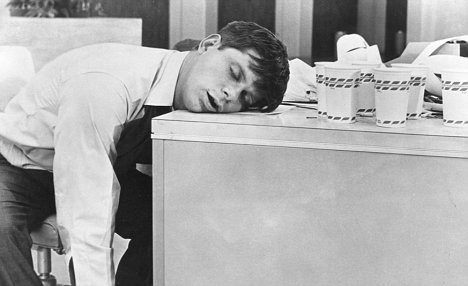 BERKELEY — If you see a student dozing in the library or a co-worker catching 40 winks in her cubicle, don’t roll your eyes. New research from the University of California, Berkeley, shows that an hour’s nap can dramatically boost and restore your brain power. Indeed, the findings suggest that a biphasic sleep schedule not only refreshes the mind, but can make you smarter.
Conversely, the more hours we spend awake, the more sluggish our minds become, according to the findings. The results support previous data from the same research team that pulling an all-nighter — a common practice at college during midterms and finals — decreases the ability to cram in new facts by nearly 40 percent, due to a shutdown of brain regions during sleep deprivation.
“Sleep not only rights the wrong of prolonged wakefulness but, at a neurocognitive level, it moves you beyond where you were before you took a nap,” said Matthew Walker, an assistant professor of psychology at UC Berkeley and the lead investigator of these studies.
In the recent UC Berkeley sleep study, 39 healthy young adults were divided into two groups — nap and no-nap. At noon, all the participants were subjected to a rigorous learning task intended to tax the hippocampus, a region of the brain that helps store fact-based memories. Both groups performed at comparable levels.
At 2 p.m., the nap group took a 90-minute siesta while the no-nap group stayed awake. Later that day, at 6 p.m., participants performed a new round of learning exercises. Those who remained awake throughout the day became worse at learning. In contrast, those who napped did markedly better and actually improved in their capacity to learn.
Matthew Walker, assistant psychology professor, has found that a nap clears the brain to absorb new information.
These findings reinforce the researchers’ hypothesis that sleep is needed to clear the brain’s shor
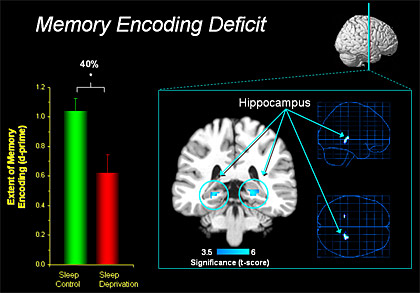
- Students who napped (green column) did markedly better in memorizing tests than their no-nap counterparts. (Courtesy of Matthew Walker)

t-term memory storage and make room for new information, said Walker, who presented his preliminary findings on Sunday, Feb. 21, at the annual meeting of the American Association of the Advancement of Science (AAAS) in San Diego, Calif.
Since 2007, Walker and other sleep researchers have established that fact-based memories are temporarily stored in the hippocampus before being sent to the brain’s prefrontal cortex, which may have more storage space.
“It’s as though the e-mail inbox in your hippocampus is full and, until you sleep and clear out those fact e-mails, you’re not going to receive any more mail. It’s just going to bounce until you sleep and move it into another folder,” Walker said.
In the late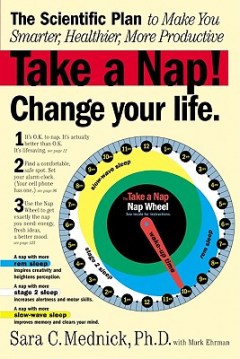 st study, Walker and his team have broken new ground in discovering that this memory-refreshing process occurs when nappers are engaged in a specific stage of sleep. Electroencephalogram tests, which measure electrical activity in the brain, indicated that this refreshing of memory capacity is related to Stage 2 non-REM sleep, which takes place between deep sleep (non-REM) and the dream state known as Rapid Eye Movement (REM). Previously, the purpose of this stage was unclear, but the new results offer evidence as to why humans spend at least half their sleeping hours in Stage 2, non-REM, Walker said.
“I can’t imagine Mother Nature would have us spend 50 percent of the night going from one sleep stage to another for no reason,” Walker said. “Sleep is sophisticated. It acts locally to give us what we need.”
Walker and his team will go on to investigate whether the reduction of sleep experienced by people as they get older is related to the documented decrease in our ability to learn as we age. Finding that link may be helpful in understanding such neurodegenerative conditions as Alzheimer’s disease, Walker said.
In addition to Walker, co-investigators of these new findings are Bryce A. Mander and psychology undergraduate Sangeetha Santhanam.
Related articles
- Be Active, Sleep Better! Aerobic Exercise Helps Beat Insomnia (peterhbrown.wordpress.com)
- Do Big People Need “Blankies” Too ? (peterhbrown.wordpress.com)

School Related Issues: Guest apearance on 96.5 FM’s “Talking Life”
On Sunday 14th February I took part in a discussion on School related issues from preschool to Secondary school as a guest on Peter Jan etzki’s terrific “Talking Life” radio program on which I have been a regular guest over its nine year history. It was a great discussion with some interesting content and phone calls.

Peter Janetzki
A podcast of the entire show and recent shows can be found here or by clicking on the 96.5 logo.You can listen to the podcast from your browser or with iTunes, The show streams live every Sunday night from from 8-10pm Australian Eastern Standard Time (GMT+10) and you can listen by going to the 96.5 website @ 96five.com and clicking on the home page media player.
Asperger’s, PDD-NOS may no longer receive separate diagnoses in DSM-V
Recently, the American Psychiatric Association released some preliminary draft changes to the Diagnostic and  Statistical Manual of Mental Disorders (DSM-V) that may affect those diagnosed on the autism spectrum. There are several significant changes proposed that are now posted for public view, including: Asperger’s Syndrome and Pervasive Developmental Disorder-Not Otherwise Specified (PDD-NOS) would both be subsumed into the Autistic Disorder category, meaning that they would no longer be considered a separate diagnosis from autism, and the inclusion of potential co-morbidities with ADHD and other medical conditions.
The Autism Society is currently investigating the implications this change could have for the service and support systems currently in place for those with autism spectrum disorders. We will also be holding a town hall meeting at the Autism Society’s National Conference on Autism Spectrum Disorders in Dallas July 7–10, 2010 (learn more about the conference or register at www.autism-society.org/conference). You can also give your feedback on the changes at the Web site www.DSM5.org – look for the diagnoses on the autism spectrum under “Disorders Usually First Diagnosed in Infancy, Childhood, or Adolescence.”
These changes are not yet official – they are proposed for the update to the manual, which is expected to be published in May 2013. Whatever changes do go into effect surrounding autism spectrum disorders, the Autism Society will continue to work as we have always done to improve the lives of people across the entire spectrum of autism.
Watch What They’re Watching:Children Viewing Adult-targeted TV May Become Sexually Active Earlier In Life
Early onset of sexual activity among teens may relate to the amount of adult content children were exposed to during their childhood, according to a new study released by Children’s Hospital Boston. Based on a longitudinal study tracking children from age six to eighteen, researchers found that the younger children are exposed to content intended for adults in television and movies, the earlier they become sexually active during adolescence. The findings are being presented at the Pediatric Academic Societies meetings on Monday, May 4 in Baltimore.
“Television and movies are among the leading sources of information about sex and relationships for adolescents,” says Hernan Delgado, MD, fellow in the Division of Adolescent/Young Adult Medicine at Children’s Hospital Boston and lead author of the study. “Our research shows that their sexual attitudes and expectations are influenced much earlier in life.”
The study consisted of 754 participants, 365 males and 389 females, who were tracked during two stages in life: first during childhood, and again five years later when their ages ranged from 12 to 18-years-old. At each stage, the television programs and movies viewed, and the amount of time spent watching them over a sample weekday and weekend day were logged. The program titles were used to determine what content was intended for adults. The participants’ onset of sexual activity was then tracked during the second stage.
According to the findings, when the youngest children in the sample–ages 6 to 8-years-old–were exposed to adult-targeted television and movies, they were more likely to have sex earlier when compared those who watched less adult-targeted content. The study found that for every hour the youngest group of children watched adult-targeted content over the two sample days, their chances of having sex during early adolescence increased by 33 percent. Meanwhile, the reverse was not found to be true that is, becoming sexually active in adolescence did not subsequently increase youth’s viewing of adult-targeted television and movies.
“Adult entertainment often deals with issues and challenges that adults face, including the complexities of sexual relationships. Children have neither the life experience nor the brain development to fully differentiate between a reality they are moving toward and a fiction meant solely to entertain,” adds David Bickham, PhD, staff scientist in the Center on Media and Child Health and co-author of the study. “Children learn from media, and when they watch media with sexual references and innuendos, our research suggests they are more likely to engage in sexual activity earlier in life.”
The researchers encourage parents to follow current American Academy of Pediatrics viewing guidelines such as no television in the bedroom, no more than 1 to 2 hours of screen time a day, and to co-view television programs and have an open dialogue about its content with your children. They also suggest that–while the results demonstrate a longitudinal relationship–more research needs be done to understand how media influences children’s growing awareness of human relationships and sexual behavior.
“Adolescent sexual behaviors may be influenced at a younger age, but this is just one area we studied,” adds Dr. Delgado. “We showed how adult media impacts children into adolescence, yet there are a number of other themes in adult television shows and movies, like violence and language, whose influence also needs to be tracked from childhood to adolescence.”
The study was funded by support by grants from the Maternal and Child Health Bureau and the Center on Media and Child Health.
Children’s Hospital Boston is home to the world’s largest research enterprise based at a pediatric medical center, where its discoveries have benefited both children and adults since 1869. More than 500 scientists, including eight members of the National Academy of Sciences, 11 members of the Institute of Medicine and 13 members of the Howard Hughes Medical Institute comprise Children’s research community. Founded as a 20-bed hospital for children, Children’s Hospital Boston today is a 397-bed comprehensive center for pediatric and adolescent health care grounded in the values of excellence in patient care and sensitivity to the complex needs and diversity of children and families. Children’s also is the primary pediatric teaching affiliate of Harvard Medical School.
Source: MedicalNewsToday.com, Children’s Hospital Boston//
![Reblog this post [with Zemanta]](https://i0.wp.com/img.zemanta.com/reblog_e.png)
About Peter
Peter Brown BHMS (Hons) MPsychClin MAPS
I’m a Clinical Psychologist and have a private practice and consultancy in Brisbane Australia. I have 24 years experience in child, adult and family clinical psychology. I have a wonderful wife and three kids.
I am co-founder of Christian Wholeness Counselling Services.
I like researching issues of the brain & mind, reading and seeking out new books and resources for myself and my clients. I thought that others might be interested in some of what I have found also, hence this blog…

Subscribe to My Blog Posts & Updates
-

Blog Surfer
Alphainventions


Recent Comments


 Peter H Brown Clinical Psychologist