Violence and Young People: An Enlightening & Alarming Discussion
On Sunday 27th Feb. I took part in a rich and informed discussion on Violence and Young People on Peter Jan etzki’s “Talking Life” radio program on which I am a regular guest. I was very much a “third wheel” in this discussion, with the key guests being Dr Steven Stathis, Psychiatrist and Paediatrician, who is a consultant at Royal Children’s Hospital in Brisbane. Steven is also Director of the Child and Family Therapy Unit (CAFTU), and consults at the Youth Detention Centre, Wacol. The other key guest was Dr Mubarak Ali, a researcher in Social Work at Flinders University in Adelaide. Mubarak has done extensive and ground-breaking international research examining child and youth use of the internet and digital technology, and how this usage correlates with violent behaviour. It was a rich discussion with some interesting content and phone calls. If this is a topic which in any way interests you, I would encourage you to take the time to have a listen.
UPDATE: You can now listen to the entire podcast by selecting the links below. These files are now stored in my library internally for easy access: (Free – mp3-internal links) click to play or right click and “save link /target as” to download.
OR

Peter Janetzki
A podcast of the entire show in easy to listen parts, and podcasts of recent shows can be found here or by clicking on the 96.5 logo.You can listen to the podcast from your browser or with iTunes, Talking Life streams live every Sunday night from from 8-10pm Australian Eastern Standard Time (GMT+10) and you can listen by going to the 96.5 website @ 96five.com and clicking on the home page media player.

Related articles by Zemanta
- ‘8% rise’ in violence against children (news.bbc.co.uk)
![Reblog this post [with Zemanta]](https://i0.wp.com/img.zemanta.com/reblog_e.png)
REPOST: Talking to Your Child About What’s in The News
I originally blogged this post on August 5th last year. With the recent natural disasters in places like Haiti and Chile, and also the very raw and terrible tragedies involving young children and youth closer to my home in southeast Queensland, Australia, I have decided to repost it. I have done so in case it is helpful for other parents who, like myself are dealing with kids who are concerned about what they see and hear and read about troubling local and world events…
My experience is that many children, particularly those who have generalised anxiety can become quite distressed by exposure to seemingly innocuous exposure to events that are a part of everyday life.
 Although news gleaned from television, radio, or the Internet often is a positive educational experience for kids, problems can arise when the images presented are violent or the stories touch on disturbing topics. While we worry about our childrens’ exposure to violence and sexual content in movies, on the internet, and on tv, we need to remember that news programs shpw often live and real images and media from real events which are often distressing and increasingly graphic.
News about a natural disaster, such as the devastating earthquake in China or cyclone in Myanmar, could make kids worry that something similar is going to hit home, or fear a part of daily life — such as rain and thunderstorms — that they’d never worried about before.
Reports on natural disasters, child abductions, homicides, terrorist attacks, and school violence can teach kids to view the world as a confusing, threatening, or unfriendly place.
How can you deal with these disturbing stories and images? Talking to your kids about what they watch or hear will help them put frightening information into a reasonable context.
How Kids Perceive the News
Unlike movies or entertainment programs, news is real. But depending on a child’s age or maturity level, he or she may not yet understand the distinctions between fact and fantasy. By the time kids reach 7 or 8, however, what they see on TV can seem all too real. For some youngsters, the vividness of a sensational news story can be internalized and transformed into something that might happen to them. A child watching a news story about a bombing on a bus or a subway might worry, “Could I be next? Could that happen to me?”Natural disasters or
stories of other types of devastation can be personalized in the same manner. A child in Massachusetts who sees a house being swallowed by floods from a hurricane in Louisiana may spend a sleepless night worrying about whether his home will be OK in a rainstorm. A child in Chicago, seeing news about an attack on subways in London, might get scared about using public transportation around town. TV has the effect of shrinking the world and bringing it into our own living rooms.
By concentrating on violent stories, TV news also can promote a “mean-world” syndrome and give kids an inaccurate view of what the world and society are actually like.
Talking About the News
To calm children’s fears about the news, parents should be prepared to deliver what psychologists call “calm, unequivocal, but limited information.” This means delivering the truth, but only as much truth as a child needs to know. The key is to be as truthful yet as inexplicit as you can be. There’s no need to go into more details than your child is interested in. Although it’s true that some things — like a natural disaster — can’t be controlled, parents should still give kids space to share their fears. Encourage them to talk openly about what scares them.
Older kids are less likely to accept an explanation at face value. Their budding skepticism about the news and how it’s produced and sold might mask anxieties they have about the stories it covers. If older kids are bothered about a story, help them cope with these fears. An adult’s willingness to listen sends a powerful message.
Teens also can be encouraged to consider why a frightening or disturbing story was on the air: Was it to increase the program’s ratings because of its sensational value or because it was truly newsworthy? In this way, a scary story can be turned into a worthwhile discussion about the role and mission of the news.
Tips for Parents
Keeping an eye on kids’ TV news habits can go a long way toward monitoring the content of what they hear and see. Other tips:
- Recognize that news doesn’t have to be driven by disturbing pictures. Public TV programs, newspapers, or newsmagazines specifically designed for kids can be less sensational — and less upsetting — ways of getting information to children.
- Discuss current events with your child regularly. It’s important to help kids think through stories they hear about. Ask questions: What do you think about these events? How do you think these things happen? These questions can encourage conversation about non-news topics too.
- Put news stories in proper context. Showing that certain events are isolated or explaining how one event relates to another helps kids make better sense of what they hear. Broaden the discussion from a disturbing news item to a larger conversation: Use the story of a natural disaster as an opportunity to talk about philanthropy, cooperation, and the ability of people to cope with overwhelming hardship.
- Watch the news with your kids to filter inappropriate or frightening stories.
- Anticipate when guidance will be necessary and avoid shows that aren’t appropriate for your child’s age or level of development.
- If you’re uncomfortable with the content of the news or if it’s inappropriate for your child’s age, turn it off.
- Talk about what you can do to help. In the case of a news event like a natural disaster, kids may gain a sense of control and feel more secure if you find ways to help those who have been affected.
sourced from http://www.kidshealth.org
reviewed by: Mary L. Gavin, MD
Facebook: Is it Really your Face or Someone Else’s?
Do people display their actual or idealised personalities on social networking sites? This interesting article from PsyBlog reports that recent research addressed this issue with surprising results. I wonder if similar research on role playing and avatar based environments like World of Warcraft and Second Life would yield different findings…
There are now over 700 million people around the world with profiles on social networking sites like Facebook and MySpace. In the US 75% of those between 18 and 24 who have access to the internet use social networking sites. And over the past four years, across all adult age-groups, their use has quadrupled.
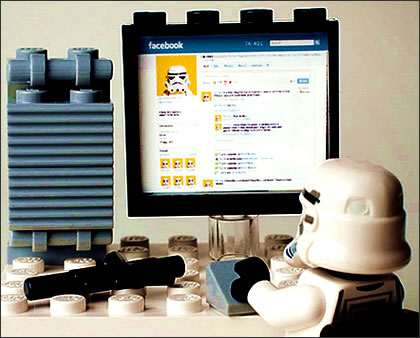 But do these profiles tell us anything about people’s real-life personalities? Online it is very easy to display an idealised version of the self to others so surely the temptation to exaggerate or even give a completely misleading impression is just too great?
Actual versus idealised personality
To find out psychologists recruited 236 US and German students who use social networking sites and had them complete personality measures (Back et al., 2010).
These measured first their actual personalities on what psychologists call the ‘Big 5‘ personality traits (extraversion, agreeableness, conscientiousness, neuroticism and openness to experience).
Secondly it measured their idealised personalities: who they would like to be. Then independent observers were shown their real social networking profiles and asked to rate participants’ personalities.
The surprising truth
After comparing the actual personalities with the idealised and observed, the researchers found that, on average, people were much more likely to display their real personality on the social networking sites rather than their idealised selves.
Overall people were remarkably honest in representing themselves. People were honest—we don’t read those words often enough.
In line with other findings, this study found that, when looking at a stranger’s profile for the first time, some aspects of personality are more difficult to discern. Neuroticism in others is particularly difficult to gauge, whereas people find extraversion and openness to experience relatively easily to assess, even in strangers.

Todd Kashdan's Book "Curious?: Discover the Missing Ingredient to a Fulfilling Life"
Lying online?
This study is another blow for that old stereotype that the web is some kind of scary hinterland, an untrustworthy place where anything goes and nothing is what it appears, peopled by adolescent boys pretending to be anything but adolescent boys.
Contrary to the received wisdom, as well as academic theorising that the internet encourages people to project an idealised self, this research suggests that people are remarkably honest in displaying their true personalities online.
Whatever the cause, this fact may help to explain the phenomenal popularity of social networking sites: the truth draws people in.
Source: http://www.PsyBlog.com
Related articles by Zemanta
- The Psychology of Facebook Profiles (wellness.blogs.time.com)
- Self-Reporting (ezrasf.com)
Aspergers and Ipods: Reaching into the Hearts & Minds of ASD Youth
I love using technology to engage and reach people in therapy. For me, it started with the relaxation cassette tape! I frequently use the internet,email, PowerPoint narratives and mp3’s and even Twitter and this Blog with clients. A Minneapolis center is experimenting with Ipods as an intervention tool with ASD youth. The wonderful book “Getting IT” is a must for anyone interested in using technology with children and youth in the areas of mental heath and disability. I thoroughly recommend it.
This story from Reuters

Sue Pederson knows that the teenage boys in her treatment program have trouble making conversation. They may not know what to talk about; or once they get started, when to shut up.
That’s one of the striking features of people with Asperger’s syndrome: they struggle with the social skills that come so naturally to others.
But about a year ago, Pederson, a psychologist, and her colleagues at the Fraser Child & Family Center in Minneapolis found a new way to reach these students — right through their headphones.
They’re using iPods, which play music and videos, to teach them how to fit in.
It may have started out as a form of entertainment, but Pederson says this kind of technology is turning into an unexpected boon for children and teenagers with special needs. The devices, it turns out, can be crammed with the kind of information they need to get through the day. While it’s still experimental, she said, “I think it’s going to spread like wildfire.”
With Asperger’s, a form of autism, people lack the inner voice that tells them what is, or is not, appropriate behavior. At Fraser, Pederson’s staff came up with the idea of programming iPods to act as an electronic substitute for that missing voice.
In this case, the staff helped students create a series of short videos and slide shows on how to behave in different social settings. Some are barely 30 seconds long: How to carry on a conversation (“Let the other person talk AND change the topic…”); how to respect other people’s boundaries, and think before they speak (“Use your filter!”)
In the world of special education, these scripts are known as “social stories,” used to teach basic social skills. “It’s a mental checklist for things to think about when you’re interacting with other people,” explained Mandy Henderson, who works with Fraser’s Asperger’s program.
As part of the Fraser project, the students can transfer the videos onto their iPods, and replay them over and over, to drive the lessons home.
Jack O’Riley, of Eagan, said it’s just what his 15-year-old son P.J. needed. “This really hit the mark,” he said. Like many kids with Asperger’s, P.J. is baffled by the normal rhythms of social interaction: in conversation, he may blurt out too much information, or say nothing at all, his father says.
At the same time, P.J. is easily distracted and has a hard time staying on task, another common trait of Asperger’s. For years, O’Riley posted laminated signs around the house to remind his son how to get through the day — take a shower, brush his teeth, get ready for school.
Now, with the videos developed at Fraser, “we can plug this stuff into his little ‘extended memory,'” O’Riley said. P.J. is building a library of videos on his iPhone, so they’ll be at his fingertips. “He can pull up a topic on his ‘to do list’ and find everything he needs to know,” his father said.
Sixteen-year-old Myles Lund of Lakeville, another student in the Fraser program, said he’s learned to use the iPod to help control his emotions by playing his favorite music. “It helps take my mind off of it,” he said. At the same time, Myles, who says he rarely initiates a conversation, agrees the videos can help in social situations. “I just pull out my iPod and go through a list of things to talk about.”
The staffers at Fraser came up with the idea after they noticed how students with Asperger’s would use iPods as a calming device, to block out noise or other distractions. “We just started thinking how else can we use this technology,” said Pederson. They got a $7,500 private grant to buy the iPods and other equipment, and started experimenting.
Jim Ball, an adviser to the Autism Society of America, said similar projects are popping up around the country. Some people are designing adaptations for smart phones, Palm Pilots and other devices to fill the same need, he said.
“This is just another way of prompting kids when they’re in situations when they don’t know what to do,” said Ball, who works with autistic children in New Jersey. “The technology gives them the ability to be independent.”
Ball noted the devices could work especially well with Asperger’s kids, because they’re often far more comfortable with electronic gadgets than they are with people. “It’s a machine; they don’t have to react to it, they don’t have to understand it,” Ball said. “They just need to know how to work it. And they do.”
Another advantage, especially for teenagers, is that they won’t stand out using this kind of device, noted Pederson. “If you walk into a family reunion and you’ve got a teenager with an iPod, nobody bats an eye,” she said.
Barbara Luskin, a psychologist with the Autism Society of Minnesota, agrees. “Adolescents with Asperger’s, like all adolescents, don’t want to look different,” she said. If the device just blends in with everyone else’s, she said, “you’re much more likely to use it.”
So far, there appear to be few commercial products aimed at this market, but that may be changing. The Conover Co., a special-education software company in Appleton, Wis., recently adapted its “Functional Skills System” for the iPod Touch. But the package, which sells for $3,500, is mainly marketed to schools and other organizations.
Fraser, meanwhile, is hoping to get another grant to expand its iPod program.
Ball, of the Autism Society, predicts this is just the beginning. “I think that technology is limitless in its potential for working with kids,” he said.

About Peter
Peter Brown BHMS (Hons) MPsychClin MAPS
I’m a Clinical Psychologist and have a private practice and consultancy in Brisbane Australia. I have 24 years experience in child, adult and family clinical psychology. I have a wonderful wife and three kids.
I am co-founder of Christian Wholeness Counselling Services.
I like researching issues of the brain & mind, reading and seeking out new books and resources for myself and my clients. I thought that others might be interested in some of what I have found also, hence this blog…

Subscribe to My Blog Posts & Updates
-

Blog Surfer
Alphainventions


Recent Comments


 Peter H Brown Clinical Psychologist