Mid Life – What’s The Crisis?: Why Self Esteem Peaks In The Middle-Aged
Credit: LiveScience
Read the original research article HERE (PDF)
Bad vision and other physical ailmen ts aren’t the only things that seem to get worse as people grow old. Self-esteem also declines around the age of retirement, a new study finds.
The study involved 3,617 American men and women ranging in age from 25 to 104. Self-esteem was lowest among young adults, but increased throughout adulthood, peaking at age 60, before it started to decline.
Several factors might explain this trend, the researchers say.
“Midlife is a time of highly stable work, family and romantic relationships. People increasingly occupy positions of power and status, which might promote feelings of self-esteem,” said study author Richard Robins of the University of California, Davis. “In contrast, older adults may be experiencing a change in roles such as an empty nest, retirement and obsolete work skills in addition to declining health.”
Measuring self-esteem
The participants were surveyed four times between 1986 and 2002. They were asked to rate their level of agreement with statements such as: “I take a positive attitude toward myself,” which suggests high self-esteem; “At times I think I am no good at all,” and “All in all, I am inclined to feel that I am a failure,” which both suggest low self-esteem.
Subjects also indicated their demographics, relationship satisfaction, and whether they had experienced stressful life events, including suddenly losing a job, being the victim of a violent crime, or experiencing the death of a parent or child.
On average, women had lower self-esteem than men throughout most of adulthood, but self-esteem levels converged as men and women reached their 80s and 90s. Blacks and whites had similar self-esteem levels throughout young adulthood and middle age. In old age, average self-esteem among blacks dropped much more sharply than self-esteem among whites. This result held even after accounting for differences in income and health.
Future research should further explore these ethnic differences, which might lead to better interventions aimed at improving self-esteem, the study authors say.
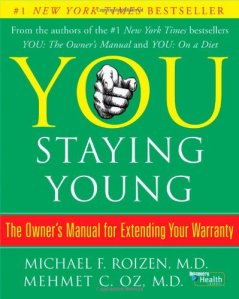
Click on image to read reviews
More self-esteem factors
Education, income, health and employment status all had some effect on the self-esteem trajectories, especially as people aged.
“People who have higher incomes and better health in later life tend to maintain their self-esteem as they age,” Orth said.
“We cannot know for certain that more wealth and better health directly lead to higher self-esteem, but it does appear to be linked in some way. For example, it is possible that wealth and health are related to feeling more independent and better able to contribute to one’s family and society, which in turn bolsters self-esteem.”
People of all ages in satisfying and supportive relationships tend to have higher self-esteem, according to the findings.
However, despite maintaining higher self-esteem throughout their lives, people in happy relationships experienced the same drop in self-esteem during old age as people in unhappy relationships.
“Thus, being in a happy relationship does not protect a person against the decline in self-esteem that typically occurs in old age,” said study author Kali H. Trzesniewski of the University of Western Ontario.
With medical advances, the drop in self-esteem might occur later for baby boomers, Orth said. Boomers might be healthier for longer and, therefore, able to work and earn money longer.
Read the original research article HERE (PDF)

Related articles by Zemanta
- Self-Esteem And Self-Respect (andrewsullivan.theatlantic.com)
- Aging Health Strongly Affected by How You Feel About Aging (seniormemorysource.com)
- Parenting: Signs of Low Self-Esteem in Children (abcnews.go.com)
![Reblog this post [with Zemanta]](https://i0.wp.com/img.zemanta.com/reblog_e.png)
Exercise DOES Help Improve Mood! And Just 25 Minutes Worth Will Decrease Stress & Increase Energy
Having an Honors degree in Human Movement Studies and working in gyms in a former life while studying for my Clinical Masters degree, I have seen this to be true. Of course it seems self evident, but these researchers have used great science with an excellent and now research-proven written program and workbook. These, along with their recent meta-analytic research review, show just how effective exercise can be in improving mood.
 Credit: PhysOrg.com) — Exercise is a magic drug for many people with depression and anxiety disorders, according to researchers who analyzed numerous studies, and it should be more widely prescribed by mental health care providers.
“Exercise has been shown to have tremendous benefits for mental health,” says Jasper Smits, director of the Anxiety Research and Treatment Program at Southern Methodist University in Dallas. “The more therapists who are trained in exercise therapy, the better off patients will be.”
The traditional treatments of cognitive behavioral therapy and pharmacotherapy don’t reach everyone who needs them, says Smits, an associate professor of psychology.
“Exercise can fill the gap for people who can’t receive traditional therapies because of cost or lack of access, or who don’t want to because of the perceived social stigma associated with these treatments,” he says. “Exercise also can supplement traditional treatments, helping patients become more focused and engaged.”
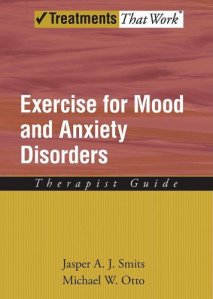
The Program used in the study is available from bookstores-Click Image to view description
Smits and Michael Otto, psychology professor at Boston University, presented their findings to researchers and mental health care providers March 6 at the Anxiety Disorder Association of America’s annual conference in Baltimore.
Their workshop was based on their therapist guide “Exercise for Mood and Anxiety Disorders,” with accompanying patient workbook (Oxford University Press, September 2009).
The guide draws on dozens of population-based studies, clinical studies and meta-analytic reviews that demonstrate the efficacy of exercise programs, including the authors’ meta-analysis of exercise interventions for mental health and study on reducing anxiety sensitivity with exercise.
“Individuals who exercise report fewer symptoms of anxiety and depression, and lower levels of stress and anger,” Smits says. “Exercise appears to affect, like an antidepressant, particular neurotransmitter systems in the brain, and it helps patients with depression re-establish positive behaviors. For patients with anxiety disorders, exercise reduces their fears of fear and related bodily sensations such as a racing heart and rapid breathing.”
After patients have passed a health assessment, Smits says, they should work up to the public health dose, which is 150 minutes a week of moderate-intensity activity or 75 minutes a week of vigorous-intensity activity.
At a time when 40 percent of Americans are sedentary, he says, mental health care providers can serve as their patients’ exercise guides and motivators.
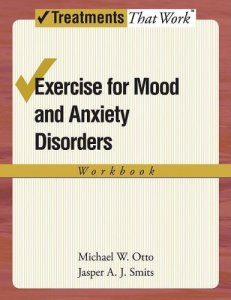
The patient workbook which accompanies the program - Click image to view description
“Rather than emphasize the long-term health benefits of an exercise program — which can be difficult to sustain — we urge providers to focus with their patients on the immediate benefits,” he says. “After just 25 minutes, your mood improves, you are less stressed, you have more energy — and you’ll be motivated to exercise again tomorrow. A bad mood is no longer a barrier to exercise; it is the very reason to exercise.”
Smits says health care providers who prescribe exercise also must give their patients the tools they need to succeed, such as the daily schedules, problem-solving strategies and goal-setting featured in his guide for therapists.
“Therapists can help their patients take specific, achievable steps,” he says. “This isn’t about working out five times a week for the next year. It’s about exercising for 20 or 30 minutes and feeling better today.”
Related articles by Zemanta
- Personal Health: Research Is Starting to Shed Light on Body Dysmorphic Disorder (nytimes.com)
- Music Soothes Anxiety as Well as Massage Does (nlm.nih.gov)
The Real “Rain Man”: A Fascinating Look At Kim Peek

Kim Peek 1951-2009 Image via Wikipedia
Kim Peek was the inspiration for the movie Rain Man starring Dustin Hoffman and Tom Cruise. Peek, who passed away last year at the age of 58, lived with his father Fran. Peek suffered from a brain development disorder known as agenesis of the corpus collosum. Malformation and absence of the corpus callosum are rare developmental disorders that result in a wide spectrum of symptoms, ranging from severe cerebral palsy, epilepsy and autism to relatively mild learning problems.
While Kim was able to perform extraordinary mental feats, particularly related to memory of historical facts, he struggled with many of the day to day tasks of life. This is a fascinating short video of Kim’s visit to London and his explanation of his condition. Enjoy!Vodpod videos no longer available.

click image to read reviews
click image to read reviews
Related articles by Zemanta
- Man Who Inspired ‘Rain Man’ Dies At 58 (npr.org)
- “I have so many things in me that you can’t even guess them all.” – Kim Peek. (althouse.blogspot.com)
Binge Eating: A 12 Week Self-Guided Program Gets Great Results
Kaiser Permanente Center for Health Research, Press Release
Short-Term Program  for Binge Eaters Using “Overcoming Binge Eating” by Dr. Christopher Fairburn Has Long-Term Benefits
PORTLAND, Ore. — A new study finds that a self-guided, 12-week program helps binge eaters stop binging for up to a year and the program can also save money for those who participate. Recurrent binge eating is the most common eating disorder in the country, affecting more than three percent of the population, or nine million people, yet few treatment options are available.
But a first-of-a-kind study conducted by researchers at the Kaiser Permanente Center for Health Research, Wesleyan University and Rutgers University found that more than 63 percent of participants had stopped binging at the end of the program — compared to just over 28 percent of those who did not participate. The program lasted only 12 weeks, but most of the participants were still binge free a year later. A second study, also published in the April issue of the Journal of Consulting and Clinical Psychology, found that program participants saved money because they spent less on things like dietary supplements and weight loss programs.
“It is unusual to find a program like this that works well, and also saves the patient money. It’s a win-win for everyone,” said study author Frances Lynch, PhD, MSPH, a health economist at the Kaiser Permanente Center for Health Research. “This type of program is something that all health care systems should consider implementing.”
“People who binge eat more than other people do during a short period of time and they lose control of their eating during these episodes. Binge eating is often accompanied by depression, shame, weight gain, loss of self-esteem and it costs the health care system millions of extra dollars,” said the study’s principal investigator Ruth H. Striegel-Moore, PhD, a professor of psychology at Wesleyan University. “Our studies show that recurrent binge eating can be successfully treated with a brief, easily administered program, and that’s great news for patients and their providers.”
Binge eating has received a lot of media attention recently because the American Psychiatric Association is recommending that it be considered a separate, distinct eating disorder like bulimia and anorexia. This new diagnosis can be expected to focus more attention on binge eating and how best to treat it, according to the researchers. It also could influence the number of people diagnosed and how insurers will cover treatment.
This randomized controlled trial, conducted in 2004–2005, involved 123 members of the Kaiser Permanente health plan in Oregon and southwest Washington. More than 90 percent of them were women, and the average age was 37. To be included in the study, participants had to have at least one binge eating episode a week during the previous three months with no gaps of two or more weeks between episodes.
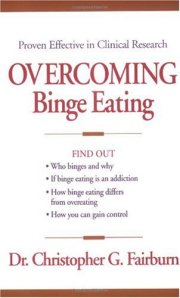
Click image to read reviews: Book helps achieve results in this research study
Half of the participants were enrolled in the intervention and asked to read the book “Overcoming Binge Eating” by Dr. Christopher Fairburn, a professor of psychiatry and expert on eating disorders. The book details scientific information about binge eating and then outlines a six-step self-help program using self-monitoring, self-control and problem-solving strategies. Participants in the study attended eight therapy sessions over the course of 12 weeks in which counselors explained the rationale for cognitive behavioral therapy and helped participants apply the strategies in the book. The first session lasted one hour, and subsequent sessions were 20–25 minutes. The average cost of the intervention was $167 per patient.
All participants were mailed fliers detailing the health plan’s offerings for healthy living and eating and encouraged to contact their primary care physician to learn about more services.
By the end of the 12-week program 63.5 percent of participants had stopped binging, compared to 28.3 percent of those who did not participate. Six months later, 74.5 percent of program participants abstained from binging, compared to 44.1 percent in usual care. At one year, 64.2 percent of participants were binge free, compared to 44.6 percent of those in usual care.
Everyone in the trial was asked to provide extensive information about their binge eating episodes, how often they missed work or were less productive at work, and the amount they spent on health care, weight-loss programs and weight loss supplements. Researchers also examined expenditures on medications, doctor visits, and other health-related services.
The researchers then compared these costs between the two groups and found that average total costs were $447 less in the intervention group. This included an average savings of $149 for the participants, who spent less on weight loss programs, over-the-counter medications and supplements. Total costs for the intervention group were $3,670 per person per year, and costs for the control group were $4,098.
“While program results are promising, we highly encourage anyone who has problems with binge eating to consult with their doctors to make sure this program is right for them,” said study co-author Lynn DeBar, PhD, clinical psychologist at the Kaiser Permanente Center for Health Research.
Study authors include: Lynn DeBar, John F. Dickerson, Frances Lynch and Nancy Perrin from the Kaiser Permanente Center for Health Research in Portland, Oregon; Ruth H. Striegel-Moore and Francine Rosselli from Wesleyan University; G. Terence Wilson from Rutgers, The State University of New Jersey; and Helena C. Kraemer from the Stanford University School of Medicine.
Intimacy & Desire: David Schnarch On Sex After Marriage

Dr David Schnarch
I have just found this video which includes a rare interview with Dr David Schnarch, author of “Passionate Marriage”, “Resurrecting Sex” & his latest book released in October 2009 “Intimacy & Desire”. Anyone who knows me well knows I am an advocate of Schnarch’s personal development approach to improving intimate relationships. For more information on my personal experiences with Schnarch and his unique contributions to this field read THIS POST.
Here are Schnarch’s online self evaluation surveys and statistics for the health of your sexual relationship and personal intimacy style. If you’re having issues (like 70% of couples in committed relationships) and have tried and failed to spark things up again, please watch this interview, read one of Schnarch’s books and check out his website for online resources. It will be worth your time and money.
Related articles by Zemanta
- Jim Selman: 7 Reasons Why Sex Is Better After 60 (huffingtonpost.com)
- Would You Ever Fight Your Romantic Battles on Facebook? (marieclaire.com)
World Autism Awareness Day: “David’s Gift” A Mother’s Journey
 As today is World Autism Awareness Day, I thought I’d highlight A new book by Australian author and mum Sally Thibault, whose son David, now 24 and studying at University, has Asperger’s Syndrome. Below is an interview with Sally and the story of “David’s Gift”
Credit : davidsgift.com.au: A new book called David’s Gift by Australian author Sally Thibault is a real-life story about her long struggle to cope with son David’s Asperger’s Syndrome – an autistic spectrum disorder. The book was released in mid March 2010 to help other parents facing challenging behaviours with children.
The message of the book is for everyone – that it’s not what happens to you in life that’s important, but how you handle it that matters.
Sally was a pioneering parent dealing with autistic spectrum disorder when it was unknown and first being diagnosed in Australia about 12 years ago. Now this complex neurological disorder is the most common developmental disorder in Australia. One in every 166 children in Australia has autism and that number has increased to one in every 91 children in the USA. Three out of every four are boys.
Interview with Sally Thibault ABC Queensland 1st April 2010 DownloadAlready being touted as a must read for all parents, teachers and health care professionals, David’s Gift helps others understand the pain and emotions parents deal with as they navigate the challenges of having a child with ASD.
Thibault’s story is inspirational and offers hope to people from all walks of life, especially those with disabilities. The book reveals useful information about Asperger’s Syndrome and autistic spectrum disorder (ASD), and gives parents real, tangible tools to assist them to come to terms with the diagnosis and create strategies to ensure their child grows to be a strong, self-actualised and confident young adult.
“When Asperger’s Syndrome first came into our lives it presented us with a challenge that, at the time, seemed sad, unfair and overwhelming. It is only now I can see that it was in fact an incredible gift,” said Mrs Thibault.
“As parents, we had to become the people we wanted David to be. What we learned about ourselves and who we became as people was David’s gift to us.”

Find Out More & Order The Book or eBook at davidsgift.com.au
“The book transcends the issue of autism and can be transferred to anyone’s life situation. The story has the potential to transform how people view the challenges they face, by helping readers see how those challenges are a gift offering them opportunity to grow and have a better life.”
Sally Thibault is a ‘wise mother’ of three children aged 24, 22 and 16, who has lived with autistic spectrum disorder for 24 years. She hopes her honest account of parenting a child with Asperger’s Syndrome will help other parents learn through her experiences.
When her eldest son David was a toddler, Sally knew he was different from other children. After searching for answers for many years, it wasn’t until David was 12 years old that he was finally diagnosed with Asperger’s Syndrome, an autistic spectrum disorder, in 1997.
“Back then, there wasn’t nearly as much information about Asperger’s as there is today, but judgements still haven’t changed in 12 years,” said Mrs Thibault. “One of the greatest challenges for children with ASD and their families is coping with a world that doesn’t accept difference very well.
As Barack Obama said: “My advice is to cultivate a sense of empathy – to put yourself in other people’s shoes – to see the world from their eyes. Empathy is a quality of character that can change the world.”
Asperger’s Syndrome is the mildest and highest function end of the autistic spectrum. People with Asperger’s find it difficult to understand social skills, often misunderstand the use of language and can be considered ‘obsessive’, focussing on one particular area of interest. People diagnosed with Asperger’s are generally intelligent, intense and self-focussed individuals who usually find success in a career that requires enormous amounts of attention to detail.
Steven Spielberg was diagnosed with Asperger’s as an adult. Today, David is following a similar career path and studying to be a digital video editor, which is perfect for his personality type.
Bill Gates is suspected to have Asperger’s Syndrome, along with Albert Einstein, Isaac Newton, Benjamin Franklin and Ludwig van Beethoven. David’s Gift has parallel themes to the award-winning book and film, The Horse Boy – a true story about a father’s quest to heal his autistic son by traveling with horses through Mongolia.
Related articles by Zemanta
- Today is World Autism Awareness Day (attachmentparenting.org)
- Company Only Hires People Who Have Autism (abcnews.go.com)
- Extraordinary Perception (scientificamerican.com)
You Can Trust Me More Than You Can Trust Them: Cynicism & The Trust Gap
Read the original research paper HERE (PDF)
Credit: Jeremy Dean from Psyblog
How do people come to believe that others are so much less trustworthy than themselves?
Much as we might prefer otherwise, there’s solid evidence that, on average, people are quite cynical. When thinking about strangers, studies have shown that people think others are more selfishly motivated than they really are and that others are less helpful than they really are.
 Similarly in financial games psychologists have run in the lab, people are remarkably cynical about the trustworthiness of others. In one experiment people honored the trust placed in them between 80 and 90 percent of the time, but only estimated that others would honor their trust about 50 percent of the time.
Our cynicism towards strangers may develop as early as 7 years old (Mills & Keil, 2005). Surprisingly people are even overly cynical about their loved ones, assuming they will behave more selfishly than they really do (Kruger & Gilovich, 1999).
What could create such a huge gap between how people behave themselves and how they think others behave?
Trust me
People often say that it’s experience that breeds this cynicism rather than a failing in human nature. This is true, but only in a special way.
Think about it like this: the first time you trust a stranger and are betrayed, it makes sense to avoid trusting other strangers in the future. The problem is that when we don’t ever trust strangers, we never find out how trustworthy people in general really are. As a result our estimation of them is governed by fear.
If this argument is correct, it is lack of experience that leads to people’s cynicism, specifically not enough positive experiences of trusting strangers. This idea is tested in a new study published in Psychological Science. Fetchenhauer and Dunning (2010) set up a kind of ideal world in the lab where people were given accurate information about the trustworthiness of strangers to see if that would reduce their cynicism.
They recruited 120 participants to take part in a game of economic trust. Each person was given €7.50 and asked if they’d like to hand it to another person. If the other person made the same decision the pot would increase to €30. They were then asked to estimate whether the other person would opt to give them their half of the total winnings.

Click image to read reviews
The participants watched 56 short videos of the people they were playing against. The researchers set up two experimental conditions, one to mimic what happens in the real world and one to test an ideal world scenario:
1. Real life condition: in this group participants were only told about the other person’s decision when they decided to trust them. The idea is that this condition simulates real life. You only find out if others are trustworthy when you decide to trust them. If you don’t trust someone you never find out whether or not they are trustworthy.
2. Ideal world condition: here participants were given feedback about the trustworthiness of other people whether or not they decided to trust them. This simulates an ideal-world condition where we all know from experience just how trustworthy people are (i.e. much more trustworthy than we think!)
Breaking down cynicism
Once again this study showed that people are remarkably cynical about strangers. Participants in this study thought that only 52 percent of the people they saw in the videos could be trusted to share their winnings. But the actual level of trustworthiness was a solid 80 percent. There’s the cynicism.
That cynicism was quickly broken down, though, by giving participants accurate feedback about others’ trustworthiness. People in the ideal world condition noticed that others could be trusted (they upped their estimate to 71 percent) and were also more trusting themselves, handing over the money 70.1 percent of the time.
People in the ideal world condition could even be seen shedding their cynicism as the study went on, becoming more trusting as they noticed that others were trustworthy. This suggests people aren’t inherently cynical, it’s just that we don’t get enough practice at trusting.
Self-fulfilling prophecy
Unfortunately we don’t live in the ideal world condition and have to put up with only receiving feedback when we decide to trust others. This leaves us in the position of trusting to psychology studies like this one to tell us that other people are more trustworthy than we imagine (or at least people who take part in psychology studies are!).
Trusting others is also a kind of self-fulfilling prophecy, just as we find in interpersonal attraction. If you try trusting others you’ll find they frequently repay that trust, leading you to be more trusting. On the other hand if you never trust anyone, except those nearest and dearest, then you’ll end up more cynical about strangers.
Visit Psyblog
Read the original research paper HERE (PDF)
Multitasking: New Study Challenges Previous Cognitive Theory But Shows That Only A Few “Supertaskers” Can Drive And Phone
Read The Original Research Paper HERE (PDF – internal link)
A new study from University of Utah psychologists found a small group of people with an extraordinary ability to multitask: Unlike 97.5 percent of those studied, they can safely drive while chatting on a cell phone.
These individuals – described by the researchers as “supertaskers” – constitute only 2.5 percent of the population. They are so named for their ability to successfully do two things at once: in this case, talk on a cell phone while operating a driving simulator without noticeable impairment.

Jason Watson, a University of Utah psychologist, negotiates cybertraffic in a driving simulator used to study driver distractions such as cell phones and testing. While many people think they can safely drive and talk on a cell phone at the same time, Watson's new study shows only one in 40 is a "supertasker" who can perform both tasks at once without impairment of abilities measured in the study. Credit: Valoree Dowell, University of Utah
The study, conducted by psychologists Jason Watson and David Strayer, is now in press for publication later this year in the journal Psychonomic Bulletin and Review.
This finding is important not because it shows people can drive well while on the phone – the study confirms that the vast majority cannot – but because it challenges current theories of multitasking. Further research may lead eventually to new understanding of regions of the brain that are responsible for supertaskers’ extraordinary performance.
“According to cognitive theory, these individuals ought not to exist,” says Watson. “Yet, clearly they do, so we use the supertasker term as a convenient way to describe their exceptional multitasking ability. Given the number of individuals who routinely talk on the phone while driving, one would have hoped that there would be a greater percentage of supertaskers. And while we’d probably all like to think we are the exception to the rule, the odds are overwhelmingly against it. In fact, the odds of being a supertasker are about as good as your chances of flipping a coin and getting five heads in a row.”
The researchers assessed the performance of 200 participants over a single task (simulated freeway driving), and again with a second demanding activity added (a cell phone conversation that involved memorizing words and solving math problems). Performance was then measured in four areas—braking reaction time, following distance, memory, and math execution.
As expected, results showed that for the group, performance suffered across the board while driving and talking on a hands-free cell phone.
For those who were not supertaskers and who talked on a cell phone while driving the simulators, it took 20 percent longer to hit the brakes when needed and following distances increased 30 percent as the drivers failed to keep pace with simulated traffic while driving. Memory performance declined 11 percent, and the ability to do math problems fell 3 percent.

Click image to read reviews
However, when supertaskers talked while driving, they displayed no change in their normal braking times, following distances or math ability, and their memory abilities actually improved 3 percent.
The results are in line with Strayer’s prior studies showing that driving performance routinely declines under “dual-task conditions” – namely talking on a cell phone while driving – and is comparable to the impairment seen in drunken drivers.
Yet contrary to current understanding in this area, the small number of supertaskers showed no impairment on the measurements of either driving or cell conversation when in combination. Further, researchers found that these individuals’ performance even on the single tasks was markedly better than the control group.
“There is clearly something special about the supertaskers,” says Strayer. “Why can they do something that most of us cannot? Psychologists may need to rethink what they know about multitasking in light of this new evidence. We may learn from these very rare individuals that the multitasking regions of the brain are different and that there may be a genetic basis for this difference. That is very exciting. Stay tuned.”
Watson and Strayer are now studying expert fighter pilots under the assumption that those who can pilot a jet aircraft are also likely to have extraordinary multitasking ability.
The current value society puts on multitasking is relatively new, note the authors. As technology expands throughout our environment and daily lives, it may be that everyone – perhaps even supertaskers – eventually will reach the limits of their ability to divide attention across several tasks.
“As technology spreads, it will be very useful to better understand the brain’s processing capabilities, and perhaps to isolate potential markers that predict extraordinary ability, especially for high-performance professions,” Watson concludes.
Information from University of Utah
Read The Original Research Paper HERE (PDF – internal link)
//
Sticking To The Status Quo: Why Habits Are So Tough To Break
Read the original Research Paper HERE (PDF internal link)
Kelly McGonigal, Ph.D. @ Psychology Today (excerpted)
A new study from the Proceedings of the National Academy of Sciences confirms what many confused shoppers, dieters, and investors know first-hand: when a decision is difficult, we go with the status quo or choose to do nothing. [..
..] Researchers from the Wellcome Trust Centre for Neuroimaging at University College London created a computerized decision-making task. Participants viewed a series of visual tests that asked them to play a referee making a sports call (e.g., whether a tennis ball bounced in our out of bounds).
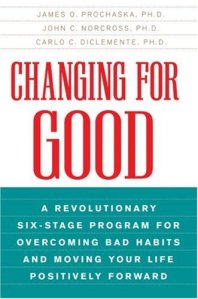
Click image to read reviews
Before each test, participants were told that one of the responses (in or out) was the “default” for this round. They were asked to hold down a key while they watched. If they continued to hold down the key, they were choosing the default. If they lifted their finger, they were choosing the non-default. Importantly, the default response (in or out) switched randomly between rounds, so that a participant’s response bias (to make a call in or out) would not be confused with their tendency to stick with the status quo.
The researchers were interested in two questions:
1) Does the difficulty of the decision influence the participants’ likelihood of choosing the default?
2) Is there a neural signature for choosing the default vs. overriding the status quo? [..
As the researchers].. predicted, participants were more likely to stick with the default when the decision was difficult. It didn’t matter whether the default was in or out. If they couldn’t make a confident choice, they essentially chose to do nothing. And as the researchers point out, this tendency led to more errors.
What was happening in the participants’ brains as they chose? The researchers observed an interesting pattern when participants went against the default in a difficult decision. There was increased activity in, and increased connectivity between, two regions: the prefrontal cortex (PFC) and an area of the midbrain called the subthalamic nucleus (STN). The PFC is well-known to be involved in decision-making and self-control. The STN is thought to be important for motivating action.
The researcher’s analyses couldn’t determine for sure what the relationship between the PFC and STN was, but the observations were consistent with the idea that the PFC was driving, or boosting, activity in the STN.
These brain analyses suggest that going against the default in difficult decisions requires some kind of extra motivation or confidence. Otherwise, the decider in our mind is puzzled, and the doer in our mind is paralyzed
Knowing this can help explain why changing habits can be so difficult. If you aren’t sure why you’re changing, don’t fully believe you’re making the right choice, or question whether what you’re doing will work, you’re likely to settle back on your automatic behaviors. That’s why self-efficacy-the belief that you can make a change and overcome obstacles-is one of the best predictors of successful change. The decider and the doer need a boost of confidence.
It also helps explain why we love formulaic diets, investment strategies, and other decision aids. Formulas feel scientific, tested, and promising. They also give us a new default. We can rely on the rules (no eating after 7 PM, automatically invest X% of your income in mutual funds twice a month) when we’re feeling overwhelmed. A new automatic makes change much easier.
So next time you’re trying to make a change, figure out what your current default is, and remind yourself exactly why it isn’t working. Then look for ways to change your default (clean out your fridge, set up direct deposit) so you don’t have to fight the old default as often. And feel free to be your own cheerleader when the going gets rough. Look for the first evidence (a pound lost here, a dwindling credit card statement there) that what you’re doing is paying off. The status quo is seductive, and we all need a little encouragement to lift our fingers off the keyboard..
Study cited:
Fleming, S.M., Thomas, C.L., & Dolan, R.J. Overcoming status quo bias in the human brain. PNAS. Published online before print March 15, 2010. doi:10.1073/pnas.0910380107
Read the original Research Paper HERE (PDF internal link)
Pack Up Your Troubles And (Apparently) Smile: Physical Enclosure Helps Psychological Closure
Read the original research paper HERE (Free PDF-internal link)
ScienceDaily (Mar. 25, 2010) — Finding it hard to get over a failed love interest? Just can’t get details of a bad financial move out of your head.
A new study from the Rotman School of Management suggests you might want to stick something related to your disappointment in a box or envelope if you want to feel better. In four separate experiments researchers found that the physical act of enclosing materials related to an unpleasant experience, such as a written recollection about it, improved people’s negative feelings towards the event and created psychological closure. Enclosing materials unrelated to the experience did not work as well.

Click image to read reviews
“If you tell people, ‘You’ve got to move on,’ that doesn’t work,” said Dilip Soman, who holds the Corus Chair in Communication Strategy at the Rotman School and is also a professor of marketing, who co-wrote the paper with colleagues Xiuping Li from the National University of Singapore and Liyuan Wei from City University of Hong Kong. “What works is when people enclose materials that are relevant to the negative memories they have. It works because people aren’t trying to explicitly control their emotions.”
While the market implications might not be immediately obvious, Prof. Soman believes the findings point to new angles on such things as fast pick-up courier services and pre-paid mortgage deals that relieve people’s sense of debt burden. If people realize that the memory of past events or tasks can be distracting, perhaps there is a market for products and services that can enclose or take away memories of that task.
The paper is to be published in Psychological Science.
Read the original research paper HERE (Free PDF-internal link)
About Peter
Peter Brown BHMS (Hons) MPsychClin MAPS
I’m a Clinical Psychologist and have a private practice and consultancy in Brisbane Australia. I have 24 years experience in child, adult and family clinical psychology. I have a wonderful wife and three kids.
I am co-founder of Christian Wholeness Counselling Services.
I like researching issues of the brain & mind, reading and seeking out new books and resources for myself and my clients. I thought that others might be interested in some of what I have found also, hence this blog…

Subscribe to My Blog Posts & Updates
-

Blog Surfer
Alphainventions


Recent Comments


 Peter H Brown Clinical Psychologist