The Smile: A Super-Powered Facial Expression
John M Grohol PsyD http://www.psychcentral.com
 What’s In a Smile? For decades, psychology and its researchers have focused on the negative side of humanity — the things that bring dysfunction into our lives. Depression, sadness, anxiety, you name it. More recently, psychologists have also begun to better understand the value of positive emotions too. This understanding has resulted in a new field of research called “positive psychology” or “happiness research.”
So how do we recognize a positive emotion? Or put more simply, “What’s in a smile?”
A new paper just published by Disa Sauter (2010) helps us answer this question.
Happiness is In Your Smile
Psychological research into happiness has, for the most part, focused on facial expressions. It’s no wonder: most of our communication — both verbal and nonverbal — comes from our face. People across cultures understand the value of a smile and other facial expressions that point toward the emotion we call “being happy” or happiness. And we know that smiling itself can help increase positive, pro-social behaviors.
But how much research has examined more specific positive emotions in facial expressions? Surprisingly, only one study has been conducted that examined how the face displays specific positive emotions. The researchers in that study found:
[…] that displays of amusement and pride were signaled by smiles, but that amused smiles tended to be open-mouthed, whereas smiles of pride had compressed lips. In contrast, awe was typically expressed with raised eyebrows and a slightly open mouth, but not with smiles.
This study highlights that there is likely more than one kind of smile and that different smile configurations may communicate different affective states.
Smiles are more complicated that the simple communication of happiness. They can communicate a wide range of positive emotions, depending upon their specific makeup.
Pride
What about expressions of pride? Pride is considered a “secondary emotion” behind more basic emotions such as happiness and fear. Surprisingly, expressions of pride across cultures shares some specific characteristics:
Using photographs of participants from over 30 nations, Tracy and Matsumoto showed that individuals who won a fight produced a number of behaviors typically associated with pride expressions, including raising their arms, tilting their head back, smiling, and expanding their chest. This configuration of cues is recognized by observers as communicating pride.
Happy Noises & Touching
Just as with pride, there are apparently a number of universally recognized human sounds that express positive emotion. Research has shown that specific emotions recognized from sounds alone include amusement, triumph, sensual pleasure (the one we’re all most familiar with!) and relief.
You’d think that touch would be a sense that has been well-studied, given how important touch is to our emotional needs. But there has been very little research conducted examining the effects of human touch. What little research that has been done has found that certain positive emotions can sometimes be detected through touch:
They found that participants from two cultures (USA and Spain) could decode affective states from tactile stimulation on the arm. Emotions that were well recognized included several positive states, such as love, gratitude, and sympathy. Hertenstein et al. also showed that love was typically signaled with stroking, gratitude was communicated with a handshake, and sympathy was expressed with a patting movement.
Of course, some positive emotions are not well communicated through touch, including the general sense of “happiness.” Notice that only specific positive emotions — and only certain ones — are well-communicated through touch. Pride is an example of a positive emotion that has no equivalent touch sense.
Conclusions
What’s in a smile? A lot of information, telling the receiver of the smile whether you meant you were happy, amused, or proud. Research into human expression of positive emotions is ongoing and will explore more of these areas in years to come.
What we have found so far is that not every specific positive emotion — for instance, pride — is expressed through every type of sense.
As the researcher notes, “It will be interesting to consider whether ease of communication via different types of signals may relate to different “families” of emotions, such as self-conscious emotions including pride, and prosocial emotions like love.” If happiness can only be communicated through facial expressions, and not through touch, that’s good information to know when we think we’re communicating our happiness to a loved one through a specific gesture.
Happiness is a core component of life and living, and is associated with helping protect us against heart disease and enhancing our overall health. We also know that gratitude tends to lead to more happiness. The better we understand how happiness is expressed to others, perhaps the more clearly we’ll be able to communicate such emotions in the future.
Reference:
Sauter, D. (2010). More Than Happy: The Need for Disentangling Positive Emotions. Current Directions in Psychological Science, 19.Original paper can be found HERE
Dr. John Grohol is the CEO and founder of Psych Central. He has been writing about online behavior, mental health and psychology issues, and the intersection of technology and psychology since 1992. //
//
Facebook: Is it Really your Face or Someone Else’s?
Do people display their actual or idealised personalities on social networking sites? This interesting article from PsyBlog reports that recent research addressed this issue with surprising results. I wonder if similar research on role playing and avatar based environments like World of Warcraft and Second Life would yield different findings…
There are now over 700 million people around the world with profiles on social networking sites like Facebook and MySpace. In the US 75% of those between 18 and 24 who have access to the internet use social networking sites. And over the past four years, across all adult age-groups, their use has quadrupled.
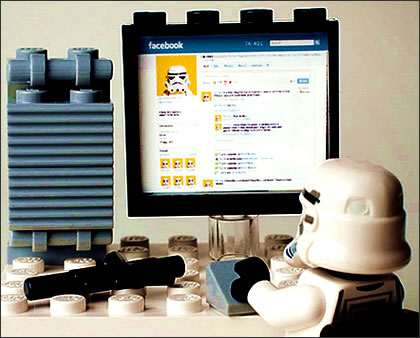 But do these profiles tell us anything about people’s real-life personalities? Online it is very easy to display an idealised version of the self to others so surely the temptation to exaggerate or even give a completely misleading impression is just too great?
Actual versus idealised personality
To find out psychologists recruited 236 US and German students who use social networking sites and had them complete personality measures (Back et al., 2010).
These measured first their actual personalities on what psychologists call the ‘Big 5‘ personality traits (extraversion, agreeableness, conscientiousness, neuroticism and openness to experience).
Secondly it measured their idealised personalities: who they would like to be. Then independent observers were shown their real social networking profiles and asked to rate participants’ personalities.
The surprising truth
After comparing the actual personalities with the idealised and observed, the researchers found that, on average, people were much more likely to display their real personality on the social networking sites rather than their idealised selves.
Overall people were remarkably honest in representing themselves. People were honest—we don’t read those words often enough.
In line with other findings, this study found that, when looking at a stranger’s profile for the first time, some aspects of personality are more difficult to discern. Neuroticism in others is particularly difficult to gauge, whereas people find extraversion and openness to experience relatively easily to assess, even in strangers.

Todd Kashdan's Book "Curious?: Discover the Missing Ingredient to a Fulfilling Life"
Lying online?
This study is another blow for that old stereotype that the web is some kind of scary hinterland, an untrustworthy place where anything goes and nothing is what it appears, peopled by adolescent boys pretending to be anything but adolescent boys.
Contrary to the received wisdom, as well as academic theorising that the internet encourages people to project an idealised self, this research suggests that people are remarkably honest in displaying their true personalities online.
Whatever the cause, this fact may help to explain the phenomenal popularity of social networking sites: the truth draws people in.
Source: http://www.PsyBlog.com
Related articles by Zemanta
- The Psychology of Facebook Profiles (wellness.blogs.time.com)
- Self-Reporting (ezrasf.com)
![Reblog this post [with Zemanta]](https://i0.wp.com/img.zemanta.com/reblog_e.png)
Viva La Siesta!: A Nap Significantly Boosts the Brain’s Learning Capacity
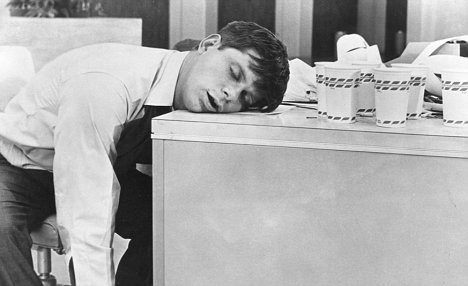 BERKELEY — If you see a student dozing in the library or a co-worker catching 40 winks in her cubicle, don’t roll your eyes. New research from the University of California, Berkeley, shows that an hour’s nap can dramatically boost and restore your brain power. Indeed, the findings suggest that a biphasic sleep schedule not only refreshes the mind, but can make you smarter.
Conversely, the more hours we spend awake, the more sluggish our minds become, according to the findings. The results support previous data from the same research team that pulling an all-nighter — a common practice at college during midterms and finals — decreases the ability to cram in new facts by nearly 40 percent, due to a shutdown of brain regions during sleep deprivation.
“Sleep not only rights the wrong of prolonged wakefulness but, at a neurocognitive level, it moves you beyond where you were before you took a nap,” said Matthew Walker, an assistant professor of psychology at UC Berkeley and the lead investigator of these studies.
In the recent UC Berkeley sleep study, 39 healthy young adults were divided into two groups — nap and no-nap. At noon, all the participants were subjected to a rigorous learning task intended to tax the hippocampus, a region of the brain that helps store fact-based memories. Both groups performed at comparable levels.
At 2 p.m., the nap group took a 90-minute siesta while the no-nap group stayed awake. Later that day, at 6 p.m., participants performed a new round of learning exercises. Those who remained awake throughout the day became worse at learning. In contrast, those who napped did markedly better and actually improved in their capacity to learn.
Matthew Walker, assistant psychology professor, has found that a nap clears the brain to absorb new information.
These findings reinforce the researchers’ hypothesis that sleep is needed to clear the brain’s shor
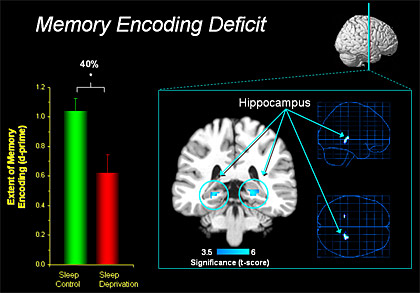
- Students who napped (green column) did markedly better in memorizing tests than their no-nap counterparts. (Courtesy of Matthew Walker)

t-term memory storage and make room for new information, said Walker, who presented his preliminary findings on Sunday, Feb. 21, at the annual meeting of the American Association of the Advancement of Science (AAAS) in San Diego, Calif.
Since 2007, Walker and other sleep researchers have established that fact-based memories are temporarily stored in the hippocampus before being sent to the brain’s prefrontal cortex, which may have more storage space.
“It’s as though the e-mail inbox in your hippocampus is full and, until you sleep and clear out those fact e-mails, you’re not going to receive any more mail. It’s just going to bounce until you sleep and move it into another folder,” Walker said.
In the late st study, Walker and his team have broken new ground in discovering that this memory-refreshing process occurs when nappers are engaged in a specific stage of sleep. Electroencephalogram tests, which measure electrical activity in the brain, indicated that this refreshing of memory capacity is related to Stage 2 non-REM sleep, which takes place between deep sleep (non-REM) and the dream state known as Rapid Eye Movement (REM). Previously, the purpose of this stage was unclear, but the new results offer evidence as to why humans spend at least half their sleeping hours in Stage 2, non-REM, Walker said.
“I can’t imagine Mother Nature would have us spend 50 percent of the night going from one sleep stage to another for no reason,” Walker said. “Sleep is sophisticated. It acts locally to give us what we need.”
Walker and his team will go on to investigate whether the reduction of sleep experienced by people as they get older is related to the documented decrease in our ability to learn as we age. Finding that link may be helpful in understanding such neurodegenerative conditions as Alzheimer’s disease, Walker said.
In addition to Walker, co-investigators of these new findings are Bryce A. Mander and psychology undergraduate Sangeetha Santhanam.
Related articles
- Be Active, Sleep Better! Aerobic Exercise Helps Beat Insomnia (peterhbrown.wordpress.com)
- Do Big People Need “Blankies” Too ? (peterhbrown.wordpress.com)

More than Words: The Importance of Physical Touch
 Psychologists have long studied the grunts and winks of nonverbal communication, the vocal tones and facial expressions that carry emotion. A warm tone of voice, a hostile stare — both have the same meaning in Terre Haute or Timbuktu, and are among dozens of signals that form a universal human vocabulary.
But in recent years some researchers have begun to focus on a different, often more subtle kind of wordless communication: physical contact. Momentary touches, they say — whether an exuberant high five, a warm hand on the shoulder, or a creepy touch to the arm — can communicate an even wider range of emotion than gestures or expressions, and sometimes do so more quickly and accurately than words.
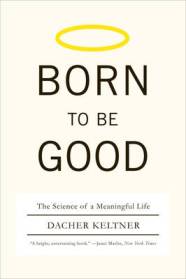 “It is the first language we learn,” said Dacher Keltner, a professor of psychology at the University of California, Berkeley, and the author of “Born to Be Good: The Science of a Meaningful Life” (Norton, 2009), and remains, he said, “our richest means of emotional expression” throughout life.
The evidence that such messages can lead to clear, almost immediate changes in how people think and behave is accumulating fast. Students who received a supportive touch on the back or arm from a teacher were nearly twice as likely to volunteer in class as those who did not, studies have found. A sympathetic touch from a doctor leaves people with the impression that the visit lasted twice as long, compared with estimates from people who were untouched. Research by Tiffany Field of the Touch Research Institute in Miami has found that a massage from a loved one can not only ease pain but also soothe depression and strengthen a relationship.
In a series of experiments led by Matthew Hertenstein, a psychologist at DePauw University in Indiana, volunteers tried to communicate a list of emotions by touching a blindfolded stranger. The participants were able to communicate eight distinct emotions, from gratitude to disgust to love, some with about 70 percent accuracy.
“We used to think that touch only served to intensify communicated emotions,” Dr. Hertenstein said. Now it turns out to be “a much more differentiated signaling system than we had imagined.”
To see whether a rich vocabulary of supportive touch is in fact related to performance, scientists at Berkeley recently analyzed interactions in one of the most physically expressive arenas on earth: professional basketball. Michael W. Kraus led a research team that coded every bump, hug and high five in a single game played by each team in the National Basketball Association early last season.
In a paper due out this year in the journal Emotion, Mr. Kraus and his co-authors, Cassy Huang and Dr. Keltner, report that with a few exceptions, good teams tended to be touchier than bad ones. The most touch-bonded teams were the Boston Celtics and the Los Angeles Lakers, currently two of the league’s top teams; at the bottom were the mediocre Sacramento Kings and Charlotte Bobcats.
The same was true, more or less, for players. The touchiest player was Kevin Garnett, the Celtics’ star big man, followed by star forwards Chris Bosh of the Toronto Raptors and Carlos Boozer of the Utah Jazz. “Within 600 milliseconds of shooting a free throw, Garnett has reached out and touched four guys,” Dr. Keltner said.
To correct for the possibility that the better teams touch more often simply because they are winning, the researchers rated performance based not on points or victories but on a sophisticated measure of how efficiently players and teams managed the ball — their ratio of assists to giveaways, for example. And even after the high expectations surrounding the more talented teams were taken into account, the correlation persisted. Players who made contact with teammates most consistently and longest tended to rate highest on measures of performance, and the teams with those players seemed to get the most out of their talent.
The study fell short of showing that touch caused the better performance, Dr. Kraus acknowledged. “We still have to test this in a controlled lab environment,” he said.
If a high five or an equivalent can in fact enhance performance, on the field or in the office, that may be because it reduces stress. A warm touch seems to set off the release of oxytocin, a hormone that helps create a sensation of trust, and to reduce levels of the stress hormone cortisol.
In the brain, prefrontal areas, which help regulate emotion, can relax, freeing them for another of their primary purposes: problem solving. In effect, the body interprets a supportive touch as “I’ll share the load.”
“We think that humans build relationships precisely for this reason, to distribute problem solving across brains,” said James A. Coan, a a psychologist at the University of Virginia. “We are wired to literally share the processing load, and this is the signal we’re getting when we receive support through touch.”
The same is certainly true of partnerships, and especially the romantic kind, psychologists say. In a recent experiment, researchers led by Christopher Oveis of Harvard conducted five-minute interviews with 69 couples, prompting each pair to discuss difficult periods in their relationship.
The investigators scored the frequency and length of touching that each couple, seated side by side, engaged in. In an interview, Dr. Oveis said that the results were preliminary.
“But it looks so far like the couples who touch more are reporting more satisfaction in the relationship,” he said. Again, it’s not clear which came first, the touching or the satisfaction. But in romantic relationships, one has been known to lead to the other. Or at least, so the anecdotal evidence suggests.
It Takes HOW Long to Form a Habit?: Research Shows a Curved Relationship Between Practice and Automaticity.
Say you want to create a new habit, whether it’s taking more exercise, eating more healthily or writing a blog post every day, how often does it need to be performed before it no longer requires Herculean self control?
Clearly it’s going to depend on the type of habit you’re trying to form and how single-minded you are in pursuing your goal. But are there any general guidelines for how long it takes before behaviours become automatic?
Ask Google and you’ll get a figure of somewhere between 21 and 28 days. In fact there’s no solid evidence for this number at all. The 21 day myth may well come from a book published in 1960 by a plastic surgeon. Dr Maxwell Maltz noticed that amputees took, on average, 21 days to adjust to the loss of a limb and he argued that people take 21 days to adjust to any major life changes.
Unless you’re in the habit of sawing off your own arm, this is not particularly relevant.
Doing without thinking
Now, however, there is some psychological research on this question in a paper recently published in the European Journal of Social Psychology. Phillippa Lally and colleagues from University College London recruited 96 people who were interested in forming a new habit such as eating a piece of fruit with lunch or doing a 15 minute run each day Lally et al. (2009). Participants were then asked daily how automatic their chosen behaviours felt. These questions included things like whether the behaviour was ‘hard not to do’ and could be done ‘without thinking’.
When the researchers examined the different habits, many of the participants showed a curved relationship between practice and automaticity of the form depicted below (solid line). On average a plateau in automaticity was reached after 66 days. In other words it had become as much of a habit as it was ever going to become.

This graph shows that early practice was rewarded with greater increases in automaticity and gains tailed off as participants reached their maximum automaticity for that behaviour.
Although the average was 66 days, there was marked variation in how long habits took to form, anywhere from 18 days up to 254 days in the habits examined in this study. As you’d imagine, drinking a daily glass of water became automatic very quickly but doing 50 sit-ups before breakfast required more dedication (above, dotted lines). The researchers also noted that:
- Missing a single day did not reduce the chance of forming a habit.
- A sub-group took much longer than the others to form their habits, perhaps suggesting some people are ‘habit-resistant’.
- Other types of habits may well take much longer.
No small change
What this study reveals is that when we want to develop a relatively simple habit like eating a piece of fruit each day or taking a 10 minute walk, it could take us over two months of daily repetitions before the behaviour becomes a habit. And, while this research suggests that skipping single days isn’t detrimental in the long-term, it’s those early repetitions that give us the greatest boost in automaticity.
Unfortunately it seems there’s no such thing as small change: the much-repeated 21 days to form a habit is a considerable underestimation unless your only goal in life is drinking glasses of water.
Multi-Taskers may Muddle More!
The people who multitask the most are the ones who are worst at it. That’s the surprising conclusion of researchers at Stanford University, who found multitaskers are more easily distracted and less able to ignore irrelevant information than people who do less multitasking.
“The huge finding is, the more media people use the worse they are at using any media. We were totally shocked,” Clifford Nass, a professor at Stanford’s communications department, said in a telephone interview.
 The researchers studied 262 college undergraduates, dividing them into high and low multitasking groups and comparing such things as memory, ability to switch from one task to another and being able to focus on a task. Their findings are reported in Tuesday’s edition of Proceedings of the National Academy of Sciences.
When it came to such essential abilities, people who did a lot of multitasking didn’t score as well as others, Nass said.
Still to be answered is why the folks who are worst at multitasking are the ones doing it the most.
It’s sort of a chicken-or-egg question.
“Is multitasking causing them to be lousy at multitasking, or is their lousiness at multitasking causing them to be multitaskers?” Nass wondered. “Is it born or learned?”
In a society that seems to encourage more and more multitasking, the findings have social implications, Nass observed. Multitasking is already blamed for car crashes as several states restrict the use of cell phones while driving. Lawyers or advertisers can try to use irrelevant information to distract and refocus people to influence their decisions.
In the study, the researchers first had to figure out who are the heavy and light multitaskers. They gave the students a form listing a variety of media such as print, television, computer-based video, music, computer games, telephone voice or text, and so forth.
The students were asked, for each form of media, which other forms they used at the same time always, often, sometimes or never.
The result ranged from an average of about 1.5 media items at the low end to more than four among heavy multitaskers.
Then they tested the abilities of students in the various groups.
For example, ability to ignore irrelevant information was tested by showing them a group of red and blue rectangles, blanking them out, and then showing them again and asking if any of the red ones had moved.
The test required ignoring the blue rectangles. The researchers thought people who do a lot of multitasking would be better at it.
“But they’re not. They’re worse. They’re much worse,” said Nass. The high media multitaskers couldn’t ignore the blue rectangles. “They couldn’t ignore stuff that doesn’t matter. They love stuff that doesn’t matter,” he said.
Perhaps the multitaskers can take in the information and organize it better? Nope.
“They are worse at that, too,” Nass said.
“So then we thought, OK, maybe they have bigger memories. They don’t. They were equal” with the low multitaskers, he added.
Finally, they tested ability to switch from one task to another by classifying a letter as a vowel or consonant, or a number as even or odd. The high multitaskers took longer to make the switch from one task to the other.
This particularly surprised the researchers, considering the need to switch from one thing to another in multitasking.
“They couldn’t help thinking about the task they weren’t doing,” lead author Eyal Ophir said. “The high multitaskers are always drawing from all the information in front of them. They can’t keep things separate in their minds.”
The next step is to look into what multitaskers are good at and see if the difference between high and low multitaskers is one of “exploring” versus “exploiting” information.
“High multitaskers just love more and more information. Their greatest thrill is to get more,” he said. On the other hand, “exploiters like to think about the information they already have.”
The research was funded by Stanford Major Grant, Volkswagen Grant, Nissan Grant and an Alfred P. Sloan Foundation Grant.
//
Proceedings of the National Academy of Sciences: http://www.pnas.org
Just Do It: Asking For Help & Why People Are Twice as Likely to Assist as You Think!
In everyday life asking others for help can be embarrassing, perhaps even a painful experience. Requesting help potentially show s our own weakness and also opens us up to rejection. It’s a relief when people say yes.
Perhaps this explains the conclusion of new research published in the Journal of Personality and Social Psychology that finds we grossly underestimate just how willing others are to help us out.
In a series of studies Francis Flynn and Vanessa Lake of Columbia University tested people’s estimation of how likely others were to help them out. They got people to ask others to fill in questionnaires, to borrow cell phones and to escort them to the gym.
Across these studies they found that people underestimated how likely others were to help them by as much as 100%.
This is such a high figure that it demands an explanation – what’s going on here?
Part of the answer is our egocentric bias – we find it difficult to understand what others are thinking and feeling because we are stuck inside our own heads.
But it’s more than just that, argue Flynn and Lake, it’s also the fact that we underestimate just how much social pressure there is on other people to say yes. In effect, when you ask someone to help you, it’s much more awkward and embarrassing for them to say ‘no’ than you might think.
In two further studies Flynn and Lake supported this intuition by asking participants to put themselves in either the role of someone asking for help, or someone being asked for help.
They found that when people were help-seekers they reliably played down the social costs of saying no. But when they were the potential helper they realised how difficult it was to say no.
There’s two very practical messages coming out of this research:
- If you want help, just ask. People are much more likely to help than you think, especially if the request is relatively small. Most people take pleasure in helping others out from time-to-time.
- Make it easy for others to say no. The other side of the coin is that most of us don’t realise just how hard it is to say no to a request for help. Other people feel much more pressure to say yes to our requests than we realise. If the help you need is likely to be burdensome then think about ways of making it easier to say no.
//
Related articles by Zemanta
- Want to buy happiness? Book a plane ticket (msnbc.msn.com)
- Brain Training Centers Bring Miracles to South Florida (eon.businesswire.com)
About Peter
Peter Brown BHMS (Hons) MPsychClin MAPS
I’m a Clinical Psychologist and have a private practice and consultancy in Brisbane Australia. I have 24 years experience in child, adult and family clinical psychology. I have a wonderful wife and three kids.
I am co-founder of Christian Wholeness Counselling Services.
I like researching issues of the brain & mind, reading and seeking out new books and resources for myself and my clients. I thought that others might be interested in some of what I have found also, hence this blog…

Subscribe to My Blog Posts & Updates
-

Blog Surfer
Alphainventions


Recent Comments


 Peter H Brown Clinical Psychologist