Narcissism, Self-Esteem & Facebook
 Following on from yesterday’s post on disinhibition and social networking, I came across this post from Dr Shock MD’s blog commenting on THIS RESEARCH PAPER (pdf) Credit to Dr Shock (excerpted). Interesting?
In normal every day life with face to face contact the physical characteristics and knowledge about social background form the identity of your contact. It’s stable and three dimensional. You know that person, it’s therefor very difficult for the other to claim another identity or create impressions inconsistent with how you know him or her. Online identity is a different topic. You can create ideal identities not necessarily overlapping your real identity. It’s a controlled setting in which you can create different identities from the person you really are. Moreover, from research it has been shown that people act differently in social networking environments when compared to those interacting in anonymous settings. Online self representation can vary according to the nature of the setting.
What is the relationship between offline personality and online self representation on facebook?
A recent study looked at the effects of narcissism and self esteem on online social activity and self promotion. The researchers included 50 male and 50 female facebook owners, they were randomly recruited at York university, their age ranged from 18 to 25 years. The facebook pages were rated and the participants took 4 questionnaires about demographic information, facebook activity, self esteem (the Rosenberg Self-Esteem Scale) and narcissism (the Narcissism Personality Inventory).
Five features of the Facebook page were coded for the extent to which they were self-promoting: (a) the About Me section, (b) the Main Photo, (c) the first 20 pictures on the View Photos of Me section, (d) the Notes section, and (e) the Status Updates section.

Click image to read reviews
Self promotion was distinguished as any descriptive or visual information that appeared to attempt to persuade others about one’s own positive qualities. For instance posting ‘‘My Celebrity Look-alikes”. Use of picture enhancement etc.
They found a strong relationship between narcissism and lower self esteem with greater facebook activity as well as more promotional self content. Gender did not influence these relationships.
This is another study implying that narcissism can be detected in facebook, the previous study is also discussed on this blog: The Dangers of Facebook. Gender differences were found in another study but on risk taking attitudes. Men with profiles on social networking sites are higher in risk taking behavior and less worried about privacy issues compared to women.
In research looking at other personality factors, the Big Five was used amongst facebook users. As discussed in a previous post on this blog: personality factors are not as influential as expected on using Facebook. The Big Five is probably not a very good instrument to investigate personality traits and facebook use.
Mehdizadeh, S. (2010). Self-Presentation 2.0: Narcissism and Self-Esteem on Facebook Cyberpsychology, Behavior, and Social Networking, 13 (4), 357–364

Related articles by Zemanta
- What Were You Thinking? The Causes Of Online Disinhibition (peterhbrown.wordpress.com)
- Twitter: 10 Psychological Insights (spring.org.uk)

What Were You Thinking? The Causes Of Online Disinhibition
 The online disinhibition effect has cost people their jobs, their income and their relationships, yet many are still oblivious to it.
Credit: Re-posted from PsyBlog
The first famous case of someone allegedly losing their job from indiscreet remarks made online was in 2002. Heather Armstrong, author of the blog ‘dooce’, claimed she was fired after her colleagues discovered she’d been lampooning them online.
In internet terms getting fired for a blog rant is ancient news; to make the headlines now your indiscretions have to be on Twitter or Facebook. One recent example was this girl who was ‘Facebook fired’ after she said exactly what she thought of her boss on Facebook after a bad day at work.
What she’d forgotten was they were Facebook friends, so the update would appear front and centre the next time he logged into Facebook. She might as well have said it straight to his face and, for good measure, kicked him in the shins.
These are two examples of what psychologists call the ‘online disinhibition effect’, the idea that when online people feel less inhibited by social conventions. Compared with face-to-face interactions, online we feel freer to do and say what we want and, as a result, often do and say things we shouldn’t.
Internet psychologist John Suler has written about six characteristics of the internet which lead to radical changes in our online behaviour (Suler, 2004):
1. Anonymity
Online people feel they can’t be identified in the same way they can when they’re in public. It’s similar to going out in a costume at night with a mask on to cover the face (see research on deindividuation). That sense of disconnection from our normal personality allows new ways of behaving. People may even consider their online behaviours to arise from an online alter ego.
Ironically, though, some people are far less anonymous online than offline. Because of the online disinhibition effect some share too much on their social networking profiles, sometimes even things they wouldn’t admit to their closest friends. It’s easy to forget that you don’t need espionage training to type someone’s name into Google.
2. Invisibility
Because others can’t see us online, we don’t have to worry about how we look to others and what emotional signals we are sending through facial expressions.
Imagine, for example, that you’re telling a friend about a distressing experience face-to-face. You may feel the urge to try and hide the depth of your emotion from them, which stops you telling the story. Online, however, you can continue to tell the story without giving away how bad it really is.
It can allow us to open up about things that we can’t discuss face-to-face. Online support groups rely on this openness to allow members to discuss their deepest hopes and fears. This is one of the potentially positive aspects of the online disinhibition effect, as long as users protect their privacy and identity.

Click image to read reviews
3. Stop/start communication
Face-to-face we see people’s reactions to what we’ve said or done immediately. That tends to put us off upsetting them or risking their judgement.
Online there are no such restrictions: because of online asynchronicity it’s possible to say something and wait 24 hours before reading the response, or never read it at all.
This cuts both ways. So-called ‘internet trolls’ are people who post to discussion forums or other online groups with the express purpose of stirring up controversy (known online as flame wars). They are experts in a kind of emotional hit-and-run. On the other hand, people who have difficulty when communicating face-to-face can become eloquent and courteous when online.
The majority of us probably fall somewhere in between these two extreme positions. Nevertheless the lack of instant feedback from other people’s body language causes all sorts of communication failures online. One of the most common causes of these failures is jokes. Without the accompanying body language, friendly jibes are easily misunderstood and interactions can quickly take a turn for the worse.
4. Voices in your head
The very act of reading online can create a surprisingly intimate connection. Because other people’s words are in our heads, we may merge them with our own internal monologues.
While humans have been reading novels and letters for centuries, these are relatively formal modes of communication, and it’s only in the last decade that online communication has brought the intimacy of a letter to informal, everyday conversation.
5. An imaginary world
The anonymity, invisibility and fantasy elements of online activities encourage us to think that the usual rules don’t apply. Like a science fiction escape fantasy, the net allows us to be who we want and do what we want, both good and bad.
The problem is that when life becomes a game that can be left behind at the flick of a switch, it’s easy to throw responsibility out of the window.
6. No police
We all fear disapproval and punishment, but this imaginary world appears to have no police and no authority figures. Although there are people with authority online, it’s difficult to tell who they are. There is no internet government, no one person in charge of it all. So people feel freer online: away from authority, social convention and conformity.
Of course the idea that authority doesn’t exist online is fantasy because the policeman exists inside all of us, to a greater or lesser extent.
Wing it
These factors work together to create a world in which we can feel freer. But this freedom is an illusion maintained by the online experience of invisibility, anonymity and lack of immediate, visceral, emotional feedback from others, or at least our ability to turn that feedback off.
Perhaps this is freedom: some people do report feeling closer to their real selves when online. But there’s a reason we developed all those social inhibitions in the old-fashioned, offline world. They stop us offending other people, which helps us keep our jobs and maintain our relationships. That’s not to say that the internet can’t help us build relationships with others or find jobs, it clearly can. It’s just that we tend to be less aware of both how much our behaviour can change online and the potential drawbacks to these changes.
Every now and then we need reminding that the internet is still a relatively fresh invention and, socially, we are still coming to terms with it. Long-established niceties of face-to-face behaviour haven’t yet taken hold online and, in the absence of precedent, we have to wing it.
Related articles by Zemanta
- Faking It: The Psychological Cost (spring.org.uk)
- Why Do Some Friends Disappear When The Going Gets Tough? (peterhbrown.wordpress.com)
- How To Effectively Manage Your Online Reputation (dumblittleman.com)
Online Shopping: Is “Drink Buying” A Problem for You?

When she hasn’t been drinking, the 26-year-old New Yorker says that she rarely does more than browse online retail sites. But give her some booze and the buying begins.
“Get some drinks in me and I’m more likely to bite the bullet and figure out where to store the crap later on,” she said.
Andrea, who asked to withhold her name to protect her privacy, said she’s shopped under the influence more than a dozen times, but the habit comes and goes.
“I’ll do it several times over a month and then forget about it for a while,” she said. “Luckily, I haven’t bought or won anything terribly extravagant. Generally, I am pleasantly surprised about my purchases.”
After her latest late-night spree, she said awoke to the whole Doc Savage comic book series, the movie “Popeye,” with Robin Williams, the children’s book “Mouse Tails,” and (her favorite) the book “Statistics for the Utterly Confused.”
Along with her list of drunken purchases, she posted on her Facebook page, “Can we PLEASE get a breathalyzer on these things?”
While inebriated Internet buying may not be be an epidemic, it’s also not that unusual. A spokesperson for an online retail site, who asked to speak on condition of anonymity, said that intoxicated-sounding shoppers regularly call the site’s customer service asking for help placing orders.
“They’re trying to get a little roadside assistance on the shopping piece,” the spokesperson said, adding that sometimes the customers need technical guidance, while other times it sounds like they just want to hear a friendly voice.
Andrea said she’s partial to things that remind her of childhood memories (her very first drunk purchases were the book “The Phantom Tollbooth” and a whittling kit), but, occasionally, she said she wakes up to the just plain bizarre. “I [bid] on a plaster casting kit, which is rather surprising as I have no idea what I was thinking of doing with it,” she said.

Click Image to read reviews
But no matter what her sober self finds in the morning, she said she never thinks of returning anything. Why? “[I’m] way too embarrassed,” she said. Psychologists say the habit is fairly harmless as long as people don’t take it to extremes or spend extravagantly. “Normally, when we haven’t had a drink or two, our rational selves intercede between the emotion and the action and we say, ‘Oh, I don’t really need that’ or ‘Oh, I don’t have the money right now,'” said John Grohol, a clinical psychologist and founder of the online mental health resource PsychCentral.com. “But alcohol takes that one step away, that rational voice away, and we go directly to the emotion and the behavior.” Source: ABC news
Related articles by Zemanta
- Compulsive Collecting: Finding Hope In The Misunderstood Mess of Hoarding (peterhbrown.wordpress.com)
- “Willy Wonky & The Chocolate Fetish”: Why Do Depressed People Eat More Chocolate? (peterhbrown.wordpress.com)
- If You Need a Breathalyzer on Your Keyring, It Probably Means You Shouldn’t Be Driving (DUH!) (geardiary.com)
![Reblog this post [with Zemanta]](https://i0.wp.com/img.zemanta.com/reblog_e.png)
Cool School Where Peace Rules: FREE Downloadable PC Video Game Teaches Kids Conflict Resolution Skills
Human development scientists and computer game developers designed a video game that teaches kids how to resolve conflicts peacefully amongst themselves. Inanimate objects, such as pencils and erasers, come to life to lead players through a series of common scenarios in which arguments are about to occur. The player is prompted for the non-violent solution and is rewarded for choosing correctly
Amid growing concern surrounding the effects violent video games have on children, a new computer game could be the alternative parents have been waiting for.
You can download it HERE for free
Kids who play together also argue together. Fights over games, toys and friendships are common, but when arguments heat up, it’s time to solve them before things get out of hand. A new computer game teaches kids how to solve playground and classroom quarrels that kids face every day in a positive way — without fists and fights.
“It helps them resolve conflicts by giving them a chance to think about what happens in the course of an actual conflict episode,” said Melanie Killen, Ph.D., a human development expert at the University of Maryland in College Park, Md.
The game, called “Cool School: Where Peace Rules” — designed by a team of human development scientists, teachers, government mediators, computer game developers and animators — helps kids solve school violence and bullying while still having fun.
“You’re learning things, but at the same time it’s having fun with it,” said student Ellen Yaffe.
Animated objects come to life and depict common conflicts. Kids experiment on how to settle each argument. Players have the option of threatening the peer, telling the teacher, forgetting about it or talking things through.
Players are rewarded for choosing positive solutions to resolve conflicts with letters they collect to win.
“What this game is doing is it’s empowering children to make choices and decisions and to see what unfolds based on their own decisions,” Dr. Killen said.
Parents and teachers praise the new game, and kids love it for their own reasons.
“I think they make it very realistic with like the names and how the school looks,” student Jacob Tycko told Ivanhoe.
The best part is the game is totally free. You can download it HERE for free
Source: Sciencedaily
Related articles by Zemanta
- Violent Video Games & Kids: Definitive Study Shows Both Short & Long Term Harmful Effects (peterhbrown.wordpress.com)
- Brain Training Or Just Brain Straining?: The Benefits Of Brain Exercise Software Are Unclear (peterhbrown.wordpress.com)
- And They All Lived Together In a Little Row Boat…Clap! Clap!: How Clapping Games Improve Cognition And Motor Skills In Children (peterhbrown.wordpress.com)
TV For Toddlers: “The Wiggles” Or The Wobbles?
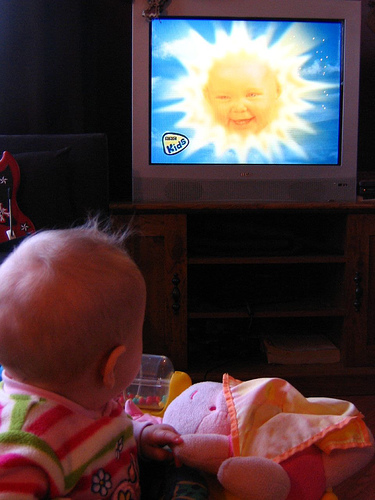 Want kids who are smarter and thinner? Keep them away from the television set as toddlers. A shocking study from child experts at the Université de Montréal, the Sainte-Justine University Hospital Research Center and the University of Michigan, published in the Archives of Pediatrics & Adolescent Medicine, has found that television exposure at age two forecasts negative consequences for kids, ranging from poor school adjustment to unhealthy habits.
“We found every additional hour of TV exposure among toddlers corresponded to a future decrease in classroom engagement and success at math, increased victimization by classmates, have a more sedentary lifestyle, higher consumption of junk food and, ultimately, higher body mass index,” says lead author Dr. Linda S. Pagani, a psychosocial professor at the Université de Montréal and researcher at the Sainte-Justine University Hospital Research Center.
The goal of the study was to determine the impact of TV exposure at age 2 on future academic success, lifestyle choices and general well being among children. “Between the ages of two and four, even incremental exposure to television delayed development,” says Dr. Pagani.
A total of 1,314 kids took part in the investigation, which was part of the Quebec Longitudinal Study of Child Development Main Exposure. Parents were asked to report how much TV their kids watched at 29 months and at 53 months in age. Teachers were asked to evaluate academic, psychosocial and health habits, while body mass index (BMI) was measured at 10 years old.
“Early childhood is a critical period for brain development and formation of behaviour,” warns Dr. Pagani. “High levels of TV consumption during this period can lead to future unhealthy habits. Despite clear recommendations from the American Academy of Pediatrics suggesting less than two hours of TV per day — beyond the age of two — parents show poor factual knowledge and awareness of such existing guidelines.”
According to the investigation, watching too much TV as toddlers later forecasted:
- a seven percent decrease in classroom engagement;
- a six percent decrease in math achievement (with no harmful effects on later reading);
- a 10 percent increase in victimization by classmates (peer rejection, being teased, assaulted or insulted by other students);
- a 13 percent decrease in weekend physical activity;
- a nine percent decrease in general physical activity;
- a none percent higher consumption of soft drinks;
- a 10 percent peak in snacks intake;
- a five percent increase in BMI.
“Although we expected the impact of early TV viewing to disappear after seven and a half years of childhood, the fact that negative outcomes remained is quite daunting,” says Dr. Pagani. “Our findings make a compelling public health argument against excessive TV viewing in early childhood and for parents to heed guidelines on TV exposure from the American Academy of Pediatrics.”

Click Image to read reviews
Since TV exposure encourages a sedentary lifestyle, Dr. Pagani says, television viewing must be curbed for toddlers to avoid the maintenance of passive mental and physical habits in later childhood: “Common sense would have it that TV exposure replaces time that could be spent engaging in other developmentally enriching activities and tasks which foster cognitive, behavioral, and motor development.”
“What’s special about this study is how it confirms suspicions that have been out there and shown by smaller projects on one outcome or another. This study takes a comprehensive approach and considers many parental, pediatric and societal factors simultaneously,” she adds.
This research was funded by the Social Science and Humanities Research Council of Canada.
The article, published in the Archives of Pediatrics & Adolescent Medicine, was authored by Linda S. Pagani, Caroline Fitzpatrick and Tracie A. Barnett of the Université de Montréal and its affiliated Sainte-Justine University Hospital Research Center in Canada in collaboration with Eric Dubow of the University of Michigan in the United States.
Source: Sciencedaily
Related articles by Zemanta
- Violent Video Games & Kids: Definitive Study Shows Both Short & Long Term Harmful Effects (peterhbrown.wordpress.com)
- And They All Lived Together In a Little Row Boat…Clap! Clap!: How Clapping Games Improve Cognition And Motor Skills In Children (peterhbrown.wordpress.com)
- Too Sexy Too Soon! PART I – Should Girls As Young As 9 Be Taken To Get Their Legs Waxed? (peterhbrown.wordpress.com)
Violent Video Games & Kids: Definitive Study Shows Both Short & Long Term Harmful Effects
 Iowa State University Distinguished Professor of Psychology Craig Anderson has made much of his life’s work studying how violent video game play affects youth behavior. And he says a new study he led, analyzing 130 research reports on more than 130,000 subjects worldwide, proves conclusively that exposure to violent video games makes more aggressive, less caring kids — regardless of their age, sex or culture.
Read the original research paper (PDF)
“We can now say with utmost confidence that regardless of research method — that is experimental, correlational, or longitudinal — and regardless of the cultures tested in this study [East and West], you get the same effects,” said Anderson, who is also director of Iowa State’s Center for the Study of Violence. “And the effects are that exposure to violent video games increases the likelihood of aggressive behavior in both short-term and long-term contexts. Such exposure also increases aggressive thinking and aggressive affect, and decreases prosocial behavior.”
The study was conducted by a team of eight researchers, including ISU psychology graduate students Edward Swing and Muniba Saleem; and Brad Bushman, a former Iowa State psychology professor who now is on the faculty at the University of Michigan. Also on the team were the top video game researchers from Japan — Akiko Shibuya from Keio University and Nobuko Ihori from Ochanomizu University — and Hannah Rothstein, a noted scholar on meta-analytic review from the City University of New York.
Meta-analytic procedure used in research
The team used meta-analytic procedures — the statistical methods used to analyze and combine results from previous, related literature — to test the effects of violent video game play on the behaviors, thoughts and feelings of the individuals, ranging from elementary school-aged children to college undergraduates.
The research also included new longitudinal data which provided further confirmation that playing violent video games is a causal risk factor for long-term harmful outcomes.
“These are not huge effects — not on the order of joining a gang vs. not joining a gang,” said Anderson. “But these effects are also not trivial in size. It is one risk factor for future aggression and other sort of negative outcomes. And it’s a risk factor that’s easy for an individual parent to deal with — at least, easier than changing most other known risk factors for aggression and violence, such as poverty or one’s genetic structure.”
The analysis found that violent video game effects are significant in both Eastern and Western cultures, in males and females, and in all age groups. Although there are good theoretical reasons to expect the long-term harmful effects to be higher in younger, pre-teen youths, there was only weak evidence of such age effects.
Time to refocus the public policy debate
The researchers conclude that the study has important implications for public policy debates, including development and testing of potential intervention strategies designed to reduce the harmful effects of playing violent video games.
“From a public policy standpoint, it’s time to get off the question of, ‘Are there real and serious effects?’ That’s been answered and answered repeatedly,” Anderson said. “It’s now time to move on to a more constructive question like, ‘How do we make it easier for parents — within the limits of culture, society and law — to provide a healthier childhood for their kids?'”

Click Image To Read Reviews
But Anderson knows it will take time for the creation and implementation of effective new policies. And until then, there is plenty parents can do to protect their kids at home.
“Just like your child’s diet and the foods you have available for them to eat in the house, you should be able to control the content of the video games they have available to play in your home,” he said. “And you should be able to explain to them why certain kinds of games are not allowed in the house — conveying your own values. You should convey the message that one should always be looking for more constructive solutions to disagreements and conflict.”
Anderson says the new study may be his last meta-analysis on violent video games because of its definitive findings. Largely because of his extensive work on violent video game effects, Anderson was chosen as one of the three 2010 American Psychological Association Distinguished Scientist Lecturers
Read the original research paper (PDF)
Source: Iowa State University
Related articles by Zemanta
- Study: Violent Video Game Play Makes More Aggressive Kids (usnews.com)
- Metastudy: Violent video games raise aggression (news.cnet.com)
- “I Saw It Happen”: Children Who Witness Bullying Can Be Traumatized Too (peterhbrown.wordpress.com)
The Internet, Facebook, Pornography & Affairs: A Talkback Podcast Of Real-Life Stories
On Sunday 12th March I took part in an amazing talk-back discussion on Peter Jan etzki’s “Talking Life” radio program on which I am a regular guest. The discussion, which involved a number of stories from listeners calling in, was about the darker side of the internet and social networking. A number of people spoke of the tragic circumstances of losing their relationships through affairs, in which Facebook and other social networking sites where involved. We explored with callers what their experiences had been, what they had learned and advice which they would give to others about realationships and social networking. If you use Facebook, social networking or online gaming or your partner does, this is well worth a listen.
You can now listen to the entire podcast (four parts) by selecting the links below. These files are now stored in my library internally for easy access: (Free – mp3-internal links) click to play or right click on the links and “save link /target as” to download.
Affairs on the Internet part 1
Affairs on the Internet part 2
Affairs on the Internet part 3
Affairs on the Internet part 4
OR

Peter Janetzki
A podcast of the entire show in easy to listen parts, and podcasts of recent shows can be found here or by clicking on the 96.5 logo.You can listen to the podcast from your browser or with iTunes, Talking Life streams live every Sunday night from from 8-10pm Australian Eastern Standard Time (GMT+10) and you can listen by going to the 96.5 website @ 96five.com and clicking on the home page media player.
Anxiety & Depression: Self-Help Internet Interventions Work!
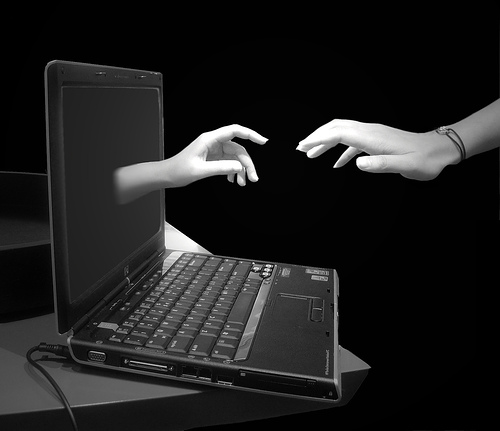 A little while ago I posted a list of free interactive self-help web sites, all research based, which have been shown to effective in the treatment of anxiety & depression. A recent study adds to the body of evidence which supports web based intervention as a viable treatment option or adjunct.
Cognitive behaviour therapy (CBT) via the internet is just as effective in treating panic disorder (recurring panic attacks) as traditional group-based CBT. It is also efficacious in the treatment of mild and moderate depression. This according to a new doctoral thesis soon to be presented at Karolinska Institutet.
Read the original research thesis here (PDF)
It is estimated that depression affects some 15 per cent and panic disorder 4 per cent of all people during their lifetime. Depression can include a number of symptoms, such as low mood, lack of joy, guilt, lethargy, concentration difficulties, insomnia and a low zest for life. Panic disorder involves debilitating panic attacks that deter a person from entering places or situations previously associated with panic. Common symptoms include palpitations, shaking, nausea and a sense that something dangerous is about to happen (e.g. a heart attack or that one is going mad ).
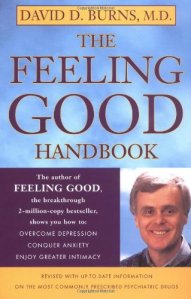
Click image to read reviews
It is known from previous studies that CBT is an effective treatment for both panic disorder and depression. However, there is a lack of psychologists and psychotherapists that use CBT methods, and access to them varies greatly in Sweden as well as in many other countries. Internet-based CBT has therefore been developed, in which the patient undergoes an Internet-based self-help programme and has contact with a therapist by email.
The present doctoral thesis includes a randomised clinical trial of 104 patients with panic disorder and compares the effectiveness of Internet-based CBT and group CBT within a regular healthcare service. The study shows that both treatments worked very well and that there was no significant difference between them, either immediately after treatment or at a six-month follow-up. Analyses of the results for the treatment of depression show that Internet-based CBT is most effective if it is administered as early as possible. Patients with a higher severity of depression and/or a history of more frequent depressive episodes benefited less well from the Internet treatment.
Jan Bergström works as a clinical psychologist at the Anxiety Disorders Unit of the Psychiatry Northwest division of the Stockholm County Council. This research was also financed by the Stockholm County Council.
“Thanks to our research, Internet treatment is now implemented within regular healthcare in Stockholm, at the unit Internetpsykiatri.se of Psychiatry Southwest, which probably makes the Stockholm County Council the first in the world to offer such treatment in its regular psychiatric services,” says Jan Bergström.
Read the original research thesis here (PDF)
Credit: Adapted from materials provided by Karolinska Institutet.
Related articles by Zemanta
- CBT Via the URLs – Treatment for Depression Online May Be as Effective as Group-Based Therapy IRL (healthmgmtrx.blogspot.com)
- Study: Treating panic disorder works as well online (news.cnet.com)
Fast Food, Fast You! How Fast Food Makes You Impatient
 Like it or not, the golden arches of McDonalds are one of the most easily recognised icons of the modern world. The culture they represent is one of instant gratification and saved time, of ready-made food that can be bought cheaply and eaten immediately. Many studies have looked at the effects of these foods on our waistlines, but their symbols and brands are such a pervasive part of our lives that you’d expect them to influence the way we think too.
Read the original research paper (PDF)
And so they do – Chen-Bo Zhong and Sanford DeVoe have found that fast food can actually induce haste and impatience, in ways that have nothing to do with eating. They showed that subliminal exposure to fast food symbols, such as McDonalds’ golden arches, can actually increase people’s reading speed. Just thinking about these foods can boost our preferences for time-saving goods and even nudge us towards financial decisions that value immediate gains over future returns. Fast food, it seems, is very appropriately named.
Zhong and DeVoe asked 57 students to stare at the centre of a computer screen while ignoring a stream of objects flashing past in the corners. For some of the students, these flashes included the logos of McDonald’s, KFC, Subway, Taco Bell, Burger King and Wendy’s, all appearing for just 12 milliseconds. We can’t consciously recognise images that appear this quickly and, indeed, none of the students said that they saw anything other than blocks of colour.
The students were then asked to read out a 320-word description of Toronto and those who had subconsciously seen the fast food logos were faster. Even though they had no time limit, they whizzed through the text in just 70 seconds. The other students, who were shown blocks of colours in place of the logos, took a more leisurely 84 seconds.
Zhong and DeVoe also found that thoughts of fast food could sway students towards more efficient, time-saving products. They asked 91 students to complete a marketing survey by saying how much they wanted each of five product pairs. One option in each pair was more time-efficient (as rated by an independent panel of 54 people), such as 2-in-1 shampoo rather than regular shampoo or a four-slice toaster versus a one-slice one.
If the students had previously thought about the last time they ate at a fast food joint, they were more likely to prefer the time-saving products that students who had thought about their last visit to the grocery store. Zhong and DeVoe say that this supports their idea that thinking about fast-food makes people impatient. [This seems to be] the weakest part of their study, for products like 2-in-1 shampoo are as much about saving money (perhaps more so) as they are about saving time. Fast food is not only served quickly but priced cheaply, and it may be this aspect that altered the students’ preference.

Click image to read reviews
However, the duo addressed this issue in their third experiment. They randomly asked 58 students to judge one of four different logos on their aesthetic qualities, including those of McDonald’s, KFC and two cheap diners. Later, they were told that they could either have $3 immediately or a larger sum in a week. They had to say how much it would take to make them delay their windfall.
As predicted, those who considered the fast food logos were more impatient, and demanded significantly more money to forego their smaller immediate payment in favour of a larger future one. It seems that they put a greater price on instant gratification over larger future returns
Of course, these results can’t tell us if fast food actually contributes to a culture of impatience and hurry, or if it’s just a symptom of it. Nor do they say anything about whether this effect is good or bad. That would all depend on context. As Zhong and DeVoe note, a brisk walking speed is a good thing if you’re trying to get to a meeting but it would be a sign of impatience if you’re aiming for a leisurely stroll in the park.
Their study does, however, suggest that fast food and the need to save time are inextricably linked in our minds so that even familiar brands can make us behave more hastily. They could even affect our economic decisions, harming our finances in the long run. As Zhong and DeVoe say, even our leisure activites are “experienced through the coloured glasses of impatience” and “it is possible that a fast food culture that extols saving time not only changes the way people eat, but also fundamentally alters the way they experience events”
Read the original research paper (PDF)
Credit: discovermagazine
Related articles by Zemanta
- How a fast-food sign changes your day (thestar.com)
- Rotman Paper Finds Exposure To Fast Food Can Make Us Impatient (lockergnome.com)
Sticks & Stones AND Words Can Hurt You: How Words Can Cause Physical Pain
 “Watch out, it’ll hurt for a second.” Not only children but also many adults get uneasy when they hear those words from their doctor. And, as soon as the needle touches their skin the piercing pain can be felt very clearly. “After such an experience it is enough to simply imagine a needle at the next vaccination appointment to activate our pain memory,” knows Prof. Dr. Thomas Weiss from the Friedrich-Schiller-University Jena.
Read the original research paper (PDF)
As the scientist and his team from the Dept. of Biological and Clinical Psychology could show in a study for the first time it is not only the painful memories and associations that set our pain memory on the alert. “Even verbal stimuli lead to reactions in certain areas of the brain,” claims Prof. Weiss. As soon as we hear words like “tormenting,” “gruelling” or “plaguing,” exactly those areas in the brain are being activated which process the corresponding pain. The psychologists from Jena University were able to examine this phenomenon using functional magnetic resonance tomography (fMRT). In their study they investigated how healthy subjects process words associated with experiencing pain. In order to prevent reactions based on a plain negative affect the subjects were also confronted with negatively connotated words like “terrifying,” “horrible” or “disgusting” besides the proper pain words.
“Subjects performed two tasks,” explains Maria Richter, doctoral candidate in Weiss’s team. “In a first task, subjects were supposed to imagine situations which correspond to the words,” the Jena psychologist says. In a second task, subjects were also reading the words but they were distracted by a brain-teaser. “In both cases we could observe a clear activation of the pain matrix in the brain by pain-associated words,” Maria Richter states. Other negatively connotated words, however, do not activate those regions. Neither for neutrally nor for positively connotated words comparable activity patterns could be examined.
Click image to read reviews
Can words intensify chronic pain?
“These findings show that words alone are capable of activating our pain matrix,” underlines Prof. Weiss. To save painful experiences is of biological advantage since it allows us to avoid painful situations in the future which might be dangerous for our lives. “However, our results suggest as well that verbal stimuli have a more important meaning than we have thought so far.” For the Jena psychologist the question remains open which role the verbal confrontation with pain plays for chronic pain patients. “They tend to speak a lot about their experiencing of pain to their physician or physiotherapist,” Maria Richter says. It is possible that those conversations intensify the activity of the pain matrix in the brain and therefore intensify the pain experience. This is what the Jena psychologists want to clarify in another study.
And so far it won’t do any harm not to talk too much about pain. Maybe then the next injection will be only half as painful.
Read the original research paper (PDF)
Adapted from ScienceDaily March 31 2010
Related articles by Zemanta
- The Hidden Causes of Back Pain (abcnews.go.com)
- Sciatica: More and More and then Some More (painblogger.com)
About Peter
Peter Brown BHMS (Hons) MPsychClin MAPS
I’m a Clinical Psychologist and have a private practice and consultancy in Brisbane Australia. I have 24 years experience in child, adult and family clinical psychology. I have a wonderful wife and three kids.
I am co-founder of Christian Wholeness Counselling Services.
I like researching issues of the brain & mind, reading and seeking out new books and resources for myself and my clients. I thought that others might be interested in some of what I have found also, hence this blog…

Subscribe to My Blog Posts & Updates
-

Blog Surfer
Alphainventions


Recent Comments


 Peter H Brown Clinical Psychologist