Cyber-Bullying & LGBT Groups: Prevalence & Psychological Impact
 From http://www.medicalnewstoday.com
Schools are typically on guard against students who bully by inflicting repeated violence on other students. But technology has given rise to a relatively new form of bullying which inflicts emotional harm in a stealth manner, working through Web sites, chat rooms, e-mail, cell phones and instant messaging.
And according to a new national study by Iowa State University researchers, one out of every two lesbian, gay, bisexual, transgender (LGBT) and allied youths are regular victims of “cyberbullying,” which causes psychological and emotional distress to victims — producing thoughts of suicide in some who are repeatedly victimized.
In the online survey of 444 junior high, high school and college students between the ages of 11 and 22 — including 350 self-identified non-heterosexual subjects — 54 percent of the LGBT and allied youth reported being victims of cyberbullying in the 30 days prior to the survey. Cyberbullying includes attacks such as electronic distribution of humiliating photos, dissemination of false or private information, or targeting victims in cruel online polls.
Among the non-heterosexual respondents, 45 percent reported feeling depressed as a result of being cyberbullied, 38 percent felt embarrassed, and 28 percent felt anxious about attending school. More than a quarter (26 percent) had suicidal thoughts.
“There’s a saying that we’ve now changed to read, ‘Sticks and stones can break my bones, but words can kill,'” said Warren Blumenfeld, an Iowa State assistant professor of curriculum and instruction and the study’s lead author. “And especially at this age — pre-adolescence through adolescence — this is a time when peer influences are paramount in a young person’s life. If one is ostracized and attacked, that can have devastating consequences — not only physically, but on their emotional health for the rest of their lives.”
Co-authored by Robyn Cooper, a research and evaluation scientist at ISU’s Research Institute for Studies in Education (RISE), the study is being published in this month’s special LGBT-themed issue of the International Journal of Critical Pedagogy.
The results underscore the helplessness felt by victims of cyberbullying. Forty percent of the non-heterosexual respondents indicated that their parents wouldn’t believe them if they were being bullied online, while 55 percent reported that their parents couldn’t do anything to stop it. Fifty seven percent also indicated that they didn’t think a school official could do anything to stop it.
“They feared that there might be more retribution by ‘tattling,'” said Blumenfeld, who was bullied as a teen for being gay.
 “One of the things we found is that the LGBT students really want to make a difference,” said Cooper, who authored her doctoral dissertation on minority stress and the well-being of sexual minority college students. “They want their stories told. They want people to know what they’re going through, but they don’t want the repercussions of being bullied. So being able to respond to this survey was very helpful.”
One in four of the LGBT and allied students responded that they needed to learn how to deal with cyberbullying by themselves. More than half also feared telling their parents about the cyberbullying because they might restrict their use of technology, which Blumenfeld says is often the “lifeline to the outside world” for many young LGBT students who have been ostracized by their peers at school.
The ISU study also proposes strategies for cyberbullying prevention. Eighty percent of the survey’s respondents indicated that their peers should do more to stop it.
“One of the strategies coming out of this study – since respondents expect and want their peers to step in more – is that we should find ways on our campuses to empower young people to speak up and act as allies,” Blumenfeld said. “In bullying circles, it’s empowering the bystander to become the upstander to help eliminate the problem.”
Blumenfeld and Cooper recommend developing social norms programming at schools that focus on peer influences that correct misperceived societal norms.
The ISU researchers plan to author additional papers on their analysis from this survey. They also have submitted a new grant proposal to extend their research to a larger national sample that would include face-to-face interviews and focus groups.
Source: Mike Ferlazzo Iowa State University
Cyber Safety and Social Networking: Don’t Let Your Kids Play Roulette Online
* Alex Dickinson From: The Courier-Mail http://couriermail.com.au* March 05, 2010 11:00AM <break>
A NEW website dubbed “a predator’s paradise” has become an internet sensation in Australia but there is almost nothing that Queensland authorities can do to track those preying on children.
 Chat Roulette, http://chatroulette.com launched online in November, instantly puts users face-to-face with a stranger anywhere in the world
In a concept Queensland Police say is one of the most dangerous on the web, the site shows webcam footage of the stranger – one of more than 20,000 on the site at one time – and has an option to “spin the wheel” to the next stranger.Users don’t have to register any identifying information and the site has already been flooded with users exposing themselves and sharing intimate details.
Some reports suggest 20 per cent of the webcams show masturbating men. The Courier-Mail logged on to the site for 15 minutes last night and was connected to 10 users from across the globe – three were shirtless men hiding their faces, another man was showing his penis while a woman with a US accent started stripping. The website mixes the most dangerous aspects of social networking, chat rooms and web cameras, according to police.
“Predators seek out and chat to children with webcams and can place enormous pressure on them to transmit indecent images of themselves,” a police spokeswoman said. Queensland Council of Parents and Citizens’ Associations president Margaret Black said the concept was extremely risky for children. We are quite horrified about where social networking sites are going,” Ms Black said.
US-based psychiatrist Dr Keith Ablow has labelled the site a “predator’s paradise”. “Parents should keep all children off (Chat Roulette) because it’s much too dangerous,” Dr Ablow said. The site, hosted in Germany, was created by 17-year-old Moscow high school student Andrey Ternovskiy.
But unlike the millions who use Facebook, offenders on http://www.chatroulette.com are a lot harder to track, according to Associate Professor of Law at the University of South Australia, Melissa deZwart. “You don’t have to be a member or register details so the service provider doesn’t have the same control over its users that Facebook does,” Ms deZwart said.
Technology website CNET suggests most parental filtering programs will be able to block the website.
So here are a couple of sites that I would deem unsafe or unhealthy for children and adolescents to access. These are specifically sites that may well slip through the net of your parental control software. I will add to them as I receive your comments and as I do more research
Chat Roulette: http://chatroulette.comSee article above.
Answerbag: http://answerbag.comThis site invites users to post questions, than engages users by starting a discussion around those questions. Seems innocuous enough on face value, but a sample of questions posted include:
Is it odd that I let Freddy Krueger perform a C-section on me?
Violence and Young People: An Enlightening & Alarming Discussion
On Sunday 27th Feb. I took part in a rich and informed discussion on Violence and Young People on Peter Jan etzki’s “Talking Life” radio program on which I am a regular guest. I was very much a “third wheel” in this discussion, with the key guests being Dr Steven Stathis, Psychiatrist and Paediatrician, who is a consultant at Royal Children’s Hospital in Brisbane. Steven is also Director of the Child and Family Therapy Unit (CAFTU), and consults at the Youth Detention Centre, Wacol. The other key guest was Dr Mubarak Ali, a researcher in Social Work at Flinders University in Adelaide. Mubarak has done extensive and ground-breaking international research examining child and youth use of the internet and digital technology, and how this usage correlates with violent behaviour. It was a rich discussion with some interesting content and phone calls. If this is a topic which in any way interests you, I would encourage you to take the time to have a listen.
UPDATE: You can now listen to the entire podcast by selecting the links below. These files are now stored in my library internally for easy access: (Free – mp3-internal links) click to play or right click and “save link /target as” to download.
OR

Peter Janetzki
A podcast of the entire show in easy to listen parts, and podcasts of recent shows can be found here or by clicking on the 96.5 logo.You can listen to the podcast from your browser or with iTunes, Talking Life streams live every Sunday night from from 8-10pm Australian Eastern Standard Time (GMT+10) and you can listen by going to the 96.5 website @ 96five.com and clicking on the home page media player.
Related articles by Zemanta
- ‘8% rise’ in violence against children (news.bbc.co.uk)
![Reblog this post [with Zemanta]](https://i0.wp.com/img.zemanta.com/reblog_e.png)
Facebook: Is it Really your Face or Someone Else’s?
Do people display their actual or idealised personalities on social networking sites? This interesting article from PsyBlog reports that recent research addressed this issue with surprising results. I wonder if similar research on role playing and avatar based environments like World of Warcraft and Second Life would yield different findings…
There are now over 700 million people around the world with profiles on social networking sites like Facebook and MySpace. In the US 75% of those between 18 and 24 who have access to the internet use social networking sites. And over the past four years, across all adult age-groups, their use has quadrupled.
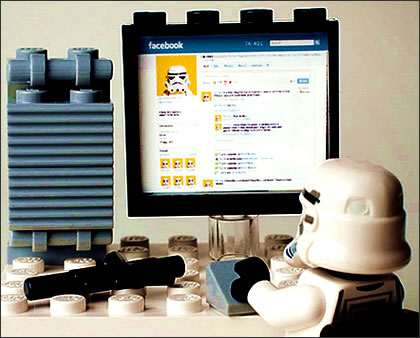 But do these profiles tell us anything about people’s real-life personalities? Online it is very easy to display an idealised version of the self to others so surely the temptation to exaggerate or even give a completely misleading impression is just too great?
Actual versus idealised personality
To find out psychologists recruited 236 US and German students who use social networking sites and had them complete personality measures (Back et al., 2010).
These measured first their actual personalities on what psychologists call the ‘Big 5‘ personality traits (extraversion, agreeableness, conscientiousness, neuroticism and openness to experience).
Secondly it measured their idealised personalities: who they would like to be. Then independent observers were shown their real social networking profiles and asked to rate participants’ personalities.
The surprising truth
After comparing the actual personalities with the idealised and observed, the researchers found that, on average, people were much more likely to display their real personality on the social networking sites rather than their idealised selves.
Overall people were remarkably honest in representing themselves. People were honest—we don’t read those words often enough.
In line with other findings, this study found that, when looking at a stranger’s profile for the first time, some aspects of personality are more difficult to discern. Neuroticism in others is particularly difficult to gauge, whereas people find extraversion and openness to experience relatively easily to assess, even in strangers.

Todd Kashdan's Book "Curious?: Discover the Missing Ingredient to a Fulfilling Life"
Lying online?
This study is another blow for that old stereotype that the web is some kind of scary hinterland, an untrustworthy place where anything goes and nothing is what it appears, peopled by adolescent boys pretending to be anything but adolescent boys.
Contrary to the received wisdom, as well as academic theorising that the internet encourages people to project an idealised self, this research suggests that people are remarkably honest in displaying their true personalities online.
Whatever the cause, this fact may help to explain the phenomenal popularity of social networking sites: the truth draws people in.
Source: http://www.PsyBlog.com
Related articles by Zemanta
- The Psychology of Facebook Profiles (wellness.blogs.time.com)
- Self-Reporting (ezrasf.com)
Internet Safety is an Issue for the Whole Family
Be aware of Internet safety.
There are six major areas parents need to be concerned about:
- Amount of overall Internet/computer use
- Inappropriate websites—violence, pornography, hate groups
- Internet predators, perhaps posing as children or teens
- Online abuse and bullying
- Divulging confidential family information or ID numbers

- Downloading/installing malicious software
Create a family policy.
Your Internet policy will depend on how old your kids are and what level of individual responsibility you’re willing to grant them. The point is to have a policy.
- Use parental controls (see below) to enforce the level of safety you’re comfortable with.
- Ask the child to suggest a reasonable amount of daily computer usage. Reach agreement on this and then hold the child accountable. Renegotiate if necessary—again, the point is to have an agreed standard, not to expect that the limit will never be exceeded.
Emphasize safety and privacy.
Be sure that children understand that talking on the Internet is the same as talking to strangers.
- Talk to children about the dangers of giving away family secrets—whether it’s bank account numbers or vacation schedules.
- Make sure children understand that anyone they “meet” on the Internet might not be who they claim to be.
- Teach children to be wary of free offers or attractive lures.
Use parental controls.
Install parental controls and kid-appropriate Web browsing and email software at an early age. Let your children decide when they want to ask for less restricted access, and talk to them about their decision. And remember, controls are not foolproof.
- Many Web portals, such as Yahoo! and America Online, offer child- and teen-appropriate portals that block inappropriate content and activities.
- Your PC or your wired or wireless router may include a program that lets you monitor all websites visited and the amount of time each family member spent on the Internet.
- Third-party solutions, such as the parental controls in the Norton Internet Security and Norton 360 free add-on packs, enable even greater control and flexibility.
Conclusion
- The Internet is no more dangerous—or safe—than the real world. You can’t protect your children from everything, but you can guide them toward sensible and responsible Internet behavior.
//
About Peter
Peter Brown BHMS (Hons) MPsychClin MAPS
I’m a Clinical Psychologist and have a private practice and consultancy in Brisbane Australia. I have 24 years experience in child, adult and family clinical psychology. I have a wonderful wife and three kids.
I am co-founder of Christian Wholeness Counselling Services.
I like researching issues of the brain & mind, reading and seeking out new books and resources for myself and my clients. I thought that others might be interested in some of what I have found also, hence this blog…

Subscribe to My Blog Posts & Updates
-

Blog Surfer
Alphainventions


Recent Comments


 Peter H Brown Clinical Psychologist