Mid Life – What’s The Crisis?: Why Self Esteem Peaks In The Middle-Aged
Credit: LiveScience
Read the original research article HERE (PDF)
Bad vision and other physical ailmen ts aren’t the only things that seem to get worse as people grow old. Self-esteem also declines around the age of retirement, a new study finds.
The study involved 3,617 American men and women ranging in age from 25 to 104. Self-esteem was lowest among young adults, but increased throughout adulthood, peaking at age 60, before it started to decline.
Several factors might explain this trend, the researchers say.
“Midlife is a time of highly stable work, family and romantic relationships. People increasingly occupy positions of power and status, which might promote feelings of self-esteem,” said study author Richard Robins of the University of California, Davis. “In contrast, older adults may be experiencing a change in roles such as an empty nest, retirement and obsolete work skills in addition to declining health.”
Measuring self-esteem
The participants were surveyed four times between 1986 and 2002. They were asked to rate their level of agreement with statements such as: “I take a positive attitude toward myself,” which suggests high self-esteem; “At times I think I am no good at all,” and “All in all, I am inclined to feel that I am a failure,” which both suggest low self-esteem.
Subjects also indicated their demographics, relationship satisfaction, and whether they had experienced stressful life events, including suddenly losing a job, being the victim of a violent crime, or experiencing the death of a parent or child.
On average, women had lower self-esteem than men throughout most of adulthood, but self-esteem levels converged as men and women reached their 80s and 90s. Blacks and whites had similar self-esteem levels throughout young adulthood and middle age. In old age, average self-esteem among blacks dropped much more sharply than self-esteem among whites. This result held even after accounting for differences in income and health.
Future research should further explore these ethnic differences, which might lead to better interventions aimed at improving self-esteem, the study authors say.
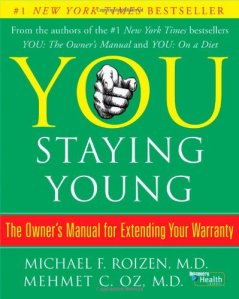
Click on image to read reviews
More self-esteem factors
Education, income, health and employment status all had some effect on the self-esteem trajectories, especially as people aged.
“People who have higher incomes and better health in later life tend to maintain their self-esteem as they age,” Orth said.
“We cannot know for certain that more wealth and better health directly lead to higher self-esteem, but it does appear to be linked in some way. For example, it is possible that wealth and health are related to feeling more independent and better able to contribute to one’s family and society, which in turn bolsters self-esteem.”
People of all ages in satisfying and supportive relationships tend to have higher self-esteem, according to the findings.
However, despite maintaining higher self-esteem throughout their lives, people in happy relationships experienced the same drop in self-esteem during old age as people in unhappy relationships.
“Thus, being in a happy relationship does not protect a person against the decline in self-esteem that typically occurs in old age,” said study author Kali H. Trzesniewski of the University of Western Ontario.
With medical advances, the drop in self-esteem might occur later for baby boomers, Orth said. Boomers might be healthier for longer and, therefore, able to work and earn money longer.
Read the original research article HERE (PDF)

Related articles by Zemanta
- Self-Esteem And Self-Respect (andrewsullivan.theatlantic.com)
- Aging Health Strongly Affected by How You Feel About Aging (seniormemorysource.com)
- Parenting: Signs of Low Self-Esteem in Children (abcnews.go.com)
![Reblog this post [with Zemanta]](https://i0.wp.com/img.zemanta.com/reblog_e.png)
Exercise DOES Help Improve Mood! And Just 25 Minutes Worth Will Decrease Stress & Increase Energy
Having an Honors degree in Human Movement Studies and working in gyms in a former life while studying for my Clinical Masters degree, I have seen this to be true. Of course it seems self evident, but these researchers have used great science with an excellent and now research-proven written program and workbook. These, along with their recent meta-analytic research review, show just how effective exercise can be in improving mood.
 Credit: PhysOrg.com) — Exercise is a magic drug for many people with depression and anxiety disorders, according to researchers who analyzed numerous studies, and it should be more widely prescribed by mental health care providers.
“Exercise has been shown to have tremendous benefits for mental health,” says Jasper Smits, director of the Anxiety Research and Treatment Program at Southern Methodist University in Dallas. “The more therapists who are trained in exercise therapy, the better off patients will be.”
The traditional treatments of cognitive behavioral therapy and pharmacotherapy don’t reach everyone who needs them, says Smits, an associate professor of psychology.
“Exercise can fill the gap for people who can’t receive traditional therapies because of cost or lack of access, or who don’t want to because of the perceived social stigma associated with these treatments,” he says. “Exercise also can supplement traditional treatments, helping patients become more focused and engaged.”
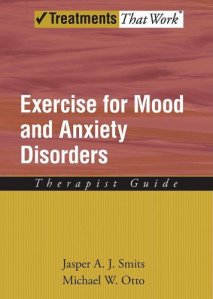
The Program used in the study is available from bookstores-Click Image to view description
Smits and Michael Otto, psychology professor at Boston University, presented their findings to researchers and mental health care providers March 6 at the Anxiety Disorder Association of America’s annual conference in Baltimore.
Their workshop was based on their therapist guide “Exercise for Mood and Anxiety Disorders,” with accompanying patient workbook (Oxford University Press, September 2009).
The guide draws on dozens of population-based studies, clinical studies and meta-analytic reviews that demonstrate the efficacy of exercise programs, including the authors’ meta-analysis of exercise interventions for mental health and study on reducing anxiety sensitivity with exercise.
“Individuals who exercise report fewer symptoms of anxiety and depression, and lower levels of stress and anger,” Smits says. “Exercise appears to affect, like an antidepressant, particular neurotransmitter systems in the brain, and it helps patients with depression re-establish positive behaviors. For patients with anxiety disorders, exercise reduces their fears of fear and related bodily sensations such as a racing heart and rapid breathing.”
After patients have passed a health assessment, Smits says, they should work up to the public health dose, which is 150 minutes a week of moderate-intensity activity or 75 minutes a week of vigorous-intensity activity.
At a time when 40 percent of Americans are sedentary, he says, mental health care providers can serve as their patients’ exercise guides and motivators.
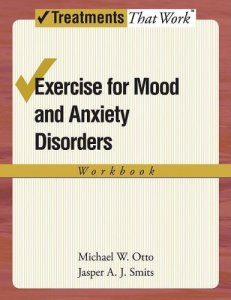
The patient workbook which accompanies the program - Click image to view description
“Rather than emphasize the long-term health benefits of an exercise program — which can be difficult to sustain — we urge providers to focus with their patients on the immediate benefits,” he says. “After just 25 minutes, your mood improves, you are less stressed, you have more energy — and you’ll be motivated to exercise again tomorrow. A bad mood is no longer a barrier to exercise; it is the very reason to exercise.”
Smits says health care providers who prescribe exercise also must give their patients the tools they need to succeed, such as the daily schedules, problem-solving strategies and goal-setting featured in his guide for therapists.
“Therapists can help their patients take specific, achievable steps,” he says. “This isn’t about working out five times a week for the next year. It’s about exercising for 20 or 30 minutes and feeling better today.”
Related articles by Zemanta
- Personal Health: Research Is Starting to Shed Light on Body Dysmorphic Disorder (nytimes.com)
- Music Soothes Anxiety as Well as Massage Does (nlm.nih.gov)
Asperger’s Syndrome on “Arthur”
Here’s a different look at Asperger’s as explained by Brain on the kids show Arthur!
Related articles by Zemanta
- ARTHUR Explores Asperger’s Syndrome in a New Episode on Monday (susanheim.blogspot.com)
- The New Autism Spectrum Disorder (NASD) in the DSM-5: Autism Minus Intellectual Disability (autisminnb.blogspot.com)
- “Parenthood”: Sex, Drugs, & Asperger’s (blisstree.com)
Intimacy & Desire: David Schnarch On Sex After Marriage

Dr David Schnarch
I have just found this video which includes a rare interview with Dr David Schnarch, author of “Passionate Marriage”, “Resurrecting Sex” & his latest book released in October 2009 “Intimacy & Desire”. Anyone who knows me well knows I am an advocate of Schnarch’s personal development approach to improving intimate relationships. For more information on my personal experiences with Schnarch and his unique contributions to this field read THIS POST.
Here are Schnarch’s online self evaluation surveys and statistics for the health of your sexual relationship and personal intimacy style. If you’re having issues (like 70% of couples in committed relationships) and have tried and failed to spark things up again, please watch this interview, read one of Schnarch’s books and check out his website for online resources. It will be worth your time and money.
Related articles by Zemanta
- Jim Selman: 7 Reasons Why Sex Is Better After 60 (huffingtonpost.com)
- Would You Ever Fight Your Romantic Battles on Facebook? (marieclaire.com)
A Change by Itself is NOT as Good as a Proper Holiday: Don’t Just Sit There…Go Somewhere!
Just having a break from work is not enough suggests new research, it is activities in the open air which have the strongest restorative effects on our mental states.
Everyone gets down sometimes – it’s only natural. It would be more unusual never to be depressed. The idea that depression is an on-off condition with a purely chemical foundation is a myth no psychologist would endorse. The causes of depression can be many and widespread. But one cause many of us have to cope with is work.
One of the main weapons against stress building up from work is going on vacation. Holidays are a firmly established way of allowing the mind and body to recuperate. In research, however, published in the Journal of Environmental Psychology, Hartig, Catalano and Ong (2007) find that all holidays are not created equal.
Getting out in the open
The lead author of this paper, Terry Hartig, lives and works in Sweden, a country well known for its long, dark winters. As such, the Swedes know the importance of getting out in the sunshine, when it finally arrives. There is even a law requiring employers to provide four consecutive weeks of holiday in the summer. And it’s actually this law that is crucial to Hartig et al’s findings.
Hartig and colleagues suggest that being stuck indoors on vacation can limit mental recuperation. On the other hand, when able to roam outdoors, we can exert ourselves at a favourite sport or simply linger in the park. Psychologically, beautiful scenery can distract us from our troubles, help us forget our normal stressful environments and reconnect us to nature.
This is a nice theory that is intuitively attractive and plausible. The problem is how to test it scientifically.
Anti-depressant prescriptions and the weather
Hartig et al. decided to use the number of SSRI anti-depressants prescribed between 1991 and 1998 as a proxy for the general level of depression in the population of Sweden. They then looked for correlations between the weather and the amount of anti-depressants prescribed, which they duly found.
Wait, though, there’s a problem with this. Perhaps people are simply happier when the weather is warmer? It would then follow there would be an association between anti-depressant prescriptions and temperature.
Hartig et al. anticipated this problem. They remove the variation in anti-depressant prescriptions associated with the general change in monthly mean temperature from the equation. Then they get a really interesting finding. Now there’s only a correlation between temperature and anti-depressant medications in one month: July. There’s no similar effect even for the adjacent months of June or August.
How can that be explained? Why would the relationship only occur in July?
Why July is unusual
Here is the authors’ reasoning. In Sweden people take most of their holiday in July at the centre of the period stipulated by law (from 1 June to 31 August). A survey found it is over 90%. This means that during July they have the highest likelihood of being free to enjoy outdoor pursuits. On average, the rest of the year they will be working, so even if the weather is unseasonably warm in May, for example, they won’t be able to take advantage of it.
The reasoning goes, then, that if the weather is bad in July people are stuck indoors. This means they are unable to fully recuperate mentally before returning to work. Alternately, if the weather is good in July people are, on average, mentally rested and have less need for medication.
Remember that this explanation relies on averaging out many people’s behaviour across nine years. Obviously not everyone requires anti-depressants to get through a spell of bad weather. Similarly some people require them whatever the weather. But think about it in terms of the people who are slipping across the boundary of requiring/asking for medication. Then the authors’ explanation makes sense.
Happiness is…
I know this study falls into the category of telling us something we already know. But it does so in rather an ingenious way that takes advantage of Swedish vacation patterns. Also, we can’t be reminded often enough that we should take every opportunity to get out in the open air.
Truly, happiness is looking out across fresh fields, gazing at a distant tree, feeling the sun on your back and the wind brushing your skin.
Sourced from Psyblog.com
Related articles
- Sleep Well: Why You Need To Fight For Good Sleep (peterhbrown.wordpress.com)
- The Type A B C’s Of How Your Personality Effects Your Health (peterhbrown.wordpress.com)

Using Music to Help Children with Autism Understand Emotions (Plus Some Favorite ASD Resources)
This post got so many Retweets on my Twitter Timeline that I decided to repost it here. The original source is examiner.com, and the author is Sharon GillsonMusic affects all of us, and we can attest to it’s appeal to our emotions. Now researchers have developed a program designed to help children with ASD better understand emotions, and learn to recognize emotions in other people.
 The children use a method of music education known as the Orff-Schulwerk (schulwerk is German for schooling) approach, which was developed by 20th-century German composer Carl Orff. This approach to music learning uses movement and is based on things that kids intuitively like to do, such as sing, chant rhymes, clap, dance and keep a beat or play a rhythm on anything near at hand.
The 12-week program uses elements from the Orff method — including games, instruments and teamwork — and combines them with musical games. The idea is to pair emotional musical excerpts with matching displays of social emotion (happy with happy, sad with sad, etc.) in a social, interactive setting.
Istvan Molnar-Szakacs, a researcher at the UCLA Tennenbaum Center for the Biology of Creativity and member of the of the Help Group–UCLA Autism Research Alliance, stated, “The purpose of this work is to provide a means for awakening the potential in every child for being ‘musical’ — that is, to be able to understand and use music and movement as forms of expression and, through that, to develop a recognition and understanding of emotions.”
Molnar-Szakacs also said that participating in musical activities has the potential to scaffold and enhance all other learning and development, from timing and language to social skills. “Beyond these more concrete intellectual benefits, the extraordinary power of music to trigger memories and emotions and join us together as an emotional, empathic and compassionate humanity are invaluable”
The goal of the research is to evaluate the effect of the music education program on outcomes in social communication and emotional functioning, as well as the children’s musical development.
————————————————————
I am constantly delighted and enthralled by the children, young people and adults with ASD with whom I have the opportunity to work. There is a frankness and depth in these conversations that blows my socks off just about every time we get together.
Here are some of the ASD resources that I use and recommend to my clients and patients as well as my colleagues.
This is not an exhaustive list by any means, but rather some of those I have found most useful or been described as most helpful. Please have a look and see if you think they may be of use to you or someone you know. There are others listed in my “Highly Recommended Books and Resources” Link to the right of this page.
Tony Atwood‘s Brilliant The Complete Guide to Asperger’s Syndrome


Freaks, Geeks & Asperger Syndrome: A User Guide to Adolescence

and there are so many others! I’m just realising that this is an entire post topic in itself. Stay tuned. Any others you like” Any questions? Leave a comment!
About Peter
Peter Brown BHMS (Hons) MPsychClin MAPS
I’m a Clinical Psychologist and have a private practice and consultancy in Brisbane Australia. I have 24 years experience in child, adult and family clinical psychology. I have a wonderful wife and three kids.
I am co-founder of Christian Wholeness Counselling Services.
I like researching issues of the brain & mind, reading and seeking out new books and resources for myself and my clients. I thought that others might be interested in some of what I have found also, hence this blog…

Subscribe to My Blog Posts & Updates
-

Blog Surfer
Alphainventions


Recent Comments


 Peter H Brown Clinical Psychologist