Intimacy & Desire: David Schnarch On Sex After Marriage

Dr David Schnarch
I have just found this video which includes a rare interview with Dr David Schnarch, author of “Passionate Marriage”, “Resurrecting Sex” & his latest book released in October 2009 “Intimacy & Desire”. Anyone who knows me well knows I am an advocate of Schnarch’s personal development approach to improving intimate relationships. For more information on my personal experiences with Schnarch and his unique contributions to this field read THIS POST.
Here are Schnarch’s online self evaluation surveys and statistics for the health of your sexual relationship and personal intimacy style. If you’re having issues (like 70% of couples in committed relationships) and have tried and failed to spark things up again, please watch this interview, read one of Schnarch’s books and check out his website for online resources. It will be worth your time and money.

Related articles by Zemanta
- Jim Selman: 7 Reasons Why Sex Is Better After 60 (huffingtonpost.com)
- Would You Ever Fight Your Romantic Battles on Facebook? (marieclaire.com)
![Reblog this post [with Zemanta]](https://i0.wp.com/img.zemanta.com/reblog_e.png)
World Autism Awareness Day: “David’s Gift” A Mother’s Journey
 As today is World Autism Awareness Day, I thought I’d highlight A new book by Australian author and mum Sally Thibault, whose son David, now 24 and studying at University, has Asperger’s Syndrome. Below is an interview with Sally and the story of “David’s Gift”
Credit : davidsgift.com.au: A new book called David’s Gift by Australian author Sally Thibault is a real-life story about her long struggle to cope with son David’s Asperger’s Syndrome – an autistic spectrum disorder. The book was released in mid March 2010 to help other parents facing challenging behaviours with children.
The message of the book is for everyone – that it’s not what happens to you in life that’s important, but how you handle it that matters.
Sally was a pioneering parent dealing with autistic spectrum disorder when it was unknown and first being diagnosed in Australia about 12 years ago. Now this complex neurological disorder is the most common developmental disorder in Australia. One in every 166 children in Australia has autism and that number has increased to one in every 91 children in the USA. Three out of every four are boys.
Interview with Sally Thibault ABC Queensland 1st April 2010 DownloadAlready being touted as a must read for all parents, teachers and health care professionals, David’s Gift helps others understand the pain and emotions parents deal with as they navigate the challenges of having a child with ASD.
Thibault’s story is inspirational and offers hope to people from all walks of life, especially those with disabilities. The book reveals useful information about Asperger’s Syndrome and autistic spectrum disorder (ASD), and gives parents real, tangible tools to assist them to come to terms with the diagnosis and create strategies to ensure their child grows to be a strong, self-actualised and confident young adult.
“When Asperger’s Syndrome first came into our lives it presented us with a challenge that, at the time, seemed sad, unfair and overwhelming. It is only now I can see that it was in fact an incredible gift,” said Mrs Thibault.
“As parents, we had to become the people we wanted David to be. What we learned about ourselves and who we became as people was David’s gift to us.”

Find Out More & Order The Book or eBook at davidsgift.com.au
“The book transcends the issue of autism and can be transferred to anyone’s life situation. The story has the potential to transform how people view the challenges they face, by helping readers see how those challenges are a gift offering them opportunity to grow and have a better life.”
Sally Thibault is a ‘wise mother’ of three children aged 24, 22 and 16, who has lived with autistic spectrum disorder for 24 years. She hopes her honest account of parenting a child with Asperger’s Syndrome will help other parents learn through her experiences.
When her eldest son David was a toddler, Sally knew he was different from other children. After searching for answers for many years, it wasn’t until David was 12 years old that he was finally diagnosed with Asperger’s Syndrome, an autistic spectrum disorder, in 1997.
“Back then, there wasn’t nearly as much information about Asperger’s as there is today, but judgements still haven’t changed in 12 years,” said Mrs Thibault. “One of the greatest challenges for children with ASD and their families is coping with a world that doesn’t accept difference very well.
As Barack Obama said: “My advice is to cultivate a sense of empathy – to put yourself in other people’s shoes – to see the world from their eyes. Empathy is a quality of character that can change the world.”
Asperger’s Syndrome is the mildest and highest function end of the autistic spectrum. People with Asperger’s find it difficult to understand social skills, often misunderstand the use of language and can be considered ‘obsessive’, focussing on one particular area of interest. People diagnosed with Asperger’s are generally intelligent, intense and self-focussed individuals who usually find success in a career that requires enormous amounts of attention to detail.
Steven Spielberg was diagnosed with Asperger’s as an adult. Today, David is following a similar career path and studying to be a digital video editor, which is perfect for his personality type.
Bill Gates is suspected to have Asperger’s Syndrome, along with Albert Einstein, Isaac Newton, Benjamin Franklin and Ludwig van Beethoven. David’s Gift has parallel themes to the award-winning book and film, The Horse Boy – a true story about a father’s quest to heal his autistic son by traveling with horses through Mongolia.
Related articles by Zemanta
- Today is World Autism Awareness Day (attachmentparenting.org)
- Company Only Hires People Who Have Autism (abcnews.go.com)
- Extraordinary Perception (scientificamerican.com)
Martin Seligman: Author Of “Learned Optimism” Speaks About Positive Psychology And Authentic Happiness
Martin Seligman was originally best known for his classic psychology studies and theory of “Learned Helplessness” (1967) and it’s relationship to depression.
These days he is considered to be a founder of positive psychology, a field of study that examines healthy states, such as authentic happiness, strength of character and optimism, and is the author of “Learned Optimism”.
This is a terrific talk on Positive Psychology and what it means to be happy. It’s about 20 mins. long but definitely worth a watch!
You Can Trust Me More Than You Can Trust Them: Cynicism & The Trust Gap
Read the original research paper HERE (PDF)
Credit: Jeremy Dean from Psyblog
How do people come to believe that others are so much less trustworthy than themselves?
Much as we might prefer otherwise, there’s solid evidence that, on average, people are quite cynical. When thinking about strangers, studies have shown that people think others are more selfishly motivated than they really are and that others are less helpful than they really are.
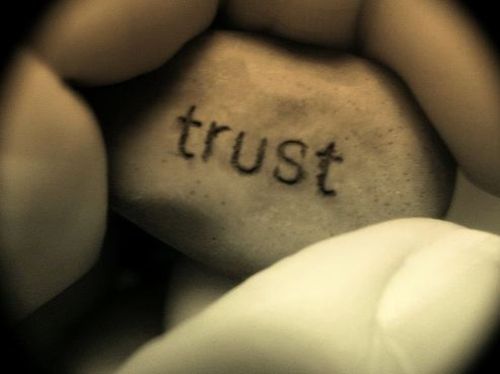 Similarly in financial games psychologists have run in the lab, people are remarkably cynical about the trustworthiness of others. In one experiment people honored the trust placed in them between 80 and 90 percent of the time, but only estimated that others would honor their trust about 50 percent of the time.
Our cynicism towards strangers may develop as early as 7 years old (Mills & Keil, 2005). Surprisingly people are even overly cynical about their loved ones, assuming they will behave more selfishly than they really do (Kruger & Gilovich, 1999).
What could create such a huge gap between how people behave themselves and how they think others behave?
Trust me
People often say that it’s experience that breeds this cynicism rather than a failing in human nature. This is true, but only in a special way.
Think about it like this: the first time you trust a stranger and are betrayed, it makes sense to avoid trusting other strangers in the future. The problem is that when we don’t ever trust strangers, we never find out how trustworthy people in general really are. As a result our estimation of them is governed by fear.
If this argument is correct, it is lack of experience that leads to people’s cynicism, specifically not enough positive experiences of trusting strangers. This idea is tested in a new study published in Psychological Science. Fetchenhauer and Dunning (2010) set up a kind of ideal world in the lab where people were given accurate information about the trustworthiness of strangers to see if that would reduce their cynicism.
They recruited 120 participants to take part in a game of economic trust. Each person was given €7.50 and asked if they’d like to hand it to another person. If the other person made the same decision the pot would increase to €30. They were then asked to estimate whether the other person would opt to give them their half of the total winnings.

Click image to read reviews
The participants watched 56 short videos of the people they were playing against. The researchers set up two experimental conditions, one to mimic what happens in the real world and one to test an ideal world scenario:
1. Real life condition: in this group participants were only told about the other person’s decision when they decided to trust them. The idea is that this condition simulates real life. You only find out if others are trustworthy when you decide to trust them. If you don’t trust someone you never find out whether or not they are trustworthy.
2. Ideal world condition: here participants were given feedback about the trustworthiness of other people whether or not they decided to trust them. This simulates an ideal-world condition where we all know from experience just how trustworthy people are (i.e. much more trustworthy than we think!)
Breaking down cynicism
Once again this study showed that people are remarkably cynical about strangers. Participants in this study thought that only 52 percent of the people they saw in the videos could be trusted to share their winnings. But the actual level of trustworthiness was a solid 80 percent. There’s the cynicism.
That cynicism was quickly broken down, though, by giving participants accurate feedback about others’ trustworthiness. People in the ideal world condition noticed that others could be trusted (they upped their estimate to 71 percent) and were also more trusting themselves, handing over the money 70.1 percent of the time.
People in the ideal world condition could even be seen shedding their cynicism as the study went on, becoming more trusting as they noticed that others were trustworthy. This suggests people aren’t inherently cynical, it’s just that we don’t get enough practice at trusting.
Self-fulfilling prophecy
Unfortunately we don’t live in the ideal world condition and have to put up with only receiving feedback when we decide to trust others. This leaves us in the position of trusting to psychology studies like this one to tell us that other people are more trustworthy than we imagine (or at least people who take part in psychology studies are!).
Trusting others is also a kind of self-fulfilling prophecy, just as we find in interpersonal attraction. If you try trusting others you’ll find they frequently repay that trust, leading you to be more trusting. On the other hand if you never trust anyone, except those nearest and dearest, then you’ll end up more cynical about strangers.
Visit Psyblog
Read the original research paper HERE (PDF)
About Peter
Peter Brown BHMS (Hons) MPsychClin MAPS
I’m a Clinical Psychologist and have a private practice and consultancy in Brisbane Australia. I have 24 years experience in child, adult and family clinical psychology. I have a wonderful wife and three kids.
I am co-founder of Christian Wholeness Counselling Services.
I like researching issues of the brain & mind, reading and seeking out new books and resources for myself and my clients. I thought that others might be interested in some of what I have found also, hence this blog…

Subscribe to My Blog Posts & Updates
-

Blog Surfer
Alphainventions


Recent Comments


 Peter H Brown Clinical Psychologist