The Internet, Facebook, Pornography & Affairs: A Talkback Podcast Of Real-Life Stories
On Sunday 12th March I took part in an amazing talk-back discussion on Peter Jan etzki’s “Talking Life” radio program on which I am a regular guest. The discussion, which involved a number of stories from listeners calling in, was about the darker side of the internet and social networking. A number of people spoke of the tragic circumstances of losing their relationships through affairs, in which Facebook and other social networking sites where involved. We explored with callers what their experiences had been, what they had learned and advice which they would give to others about realationships and social networking. If you use Facebook, social networking or online gaming or your partner does, this is well worth a listen.
You can now listen to the entire podcast (four parts) by selecting the links below. These files are now stored in my library internally for easy access: (Free – mp3-internal links) click to play or right click on the links and “save link /target as” to download.
Affairs on the Internet part 1
Affairs on the Internet part 2
Affairs on the Internet part 3
Affairs on the Internet part 4
OR

Peter Janetzki
A podcast of the entire show in easy to listen parts, and podcasts of recent shows can be found here or by clicking on the 96.5 logo.You can listen to the podcast from your browser or with iTunes, Talking Life streams live every Sunday night from from 8-10pm Australian Eastern Standard Time (GMT+10) and you can listen by going to the 96.5 website @ 96five.com and clicking on the home page media player.

![Reblog this post [with Zemanta]](https://i0.wp.com/img.zemanta.com/reblog_e.png)
“I Saw It Happen”: Children Who Witness Bullying Can Be Traumatized Too
 Students who witness bullying of their peers may suffer more psychologically than the victim or the bullies.
Read The Original Research Paper (PDF)
2002 students ages 12 to 16 were surveyed at public schools in England. The survey asked them whether they’d committed, witnessed, or been the victim of several types of bullying behavior (e.g., kicking, name-calling, threatening, etc.) and whether they had experienced psychological stress symptoms such as anxiety, depression, or hostility.
Why bystanders suffer more than victims of bullying
As reported in the article, previous research shows that children who witness bullying feel guilty, presumably for not doing anything to help the victim.
In addition, they may have felt more stressed by vacillating between doing what they thought they should do (i.e., help the victim) on the one hand, and being afraid of being victimized themselves, on the other. Being in this type of “approach/avoidance” conflict has been shown in numerous studies to create high levels of stress.
The combination of guilt and fear among witnesses that they will experience the same thing may be another reason why they are more affected by bullying than the actual victims.

Click image to read reviews
Uncertainty, especially combined with feelings of fear or guilt, contributes to stress. Stress leads to depression, anxiety, and other mental disorders.
Sitting down and discussing feelings of fear and guilt with your child may help to minimize the destructive force and ultimate impact of those emotions on mental health. Practical “survival” tips about how to avoid, distract, or other means of handling bullies would help, too, giving kids options if they are cornered by or are a witness to bullies in action.
Read The Original Research Paper (PDF)
Source: Psychological Association (2009, December 15). Witnesses to bullying may face more mental health risks than bullies and victims. ScienceDaily.
Related articles by Zemanta
- Online help for victims of bullying (guardian.co.uk)
- Witnesses to Bullying May Suffer Most of All (nlm.nih.gov)
Too Sexy Too Soon! PART ll – Are Sexual Images Now An Inescapable Part Of Children’s Lives?

A billboard for a brothel on a school route
Source: AAP
THE professional body for Australia’s psychiatrists says the self-regulation of advertising and other media industries has failed to protect children from an onslaught of sexualised content.
Today’s generation of kids faced the “widespread use of sexual images to sell anything from margarine to fashion”, Professor Newman, the president of The Royal Australian and New Zealand College of Psychiatrists, said.
She said risque images were now an “inescapable” part of a child’s environment and pointed to billboard and TV advertising, magazines and music videos and even the posters in department stores.
Prof Newman is calling for a new regime of restrictions to protect children from both targeted and inadvertent exposure to sexualised media content.
She said more Australian research was needed to gauge its effect, though the anecdotal evidence was troubling.
The exposure appeared to push typically teenage and adult concerns about body image, “sexiness” and of being a “worthwhile individual” well into a child’s first years of life.

Click image to read reviews
“I’ve seen four-year-olds and pre-schoolers who want to diet … going on intermittent food refusal,” she said.
Introducing sexualised themes to children could be overt, Prof Newman said, such as the move by a British retailer to sell a child’s pole dancing kit or “tween” magazines that offer advice to girls on how to be more attractive to the opposite sex.
But in many cases it was inadvertent.
“If you go into a 7-Eleven, at child’s eye-view will be Ralph magazine next to cartoons,” she said.
“The child might be attracted to the cartoons but what they are bombarded with are all these really quite unusual women with breast implants.
“It is sending a message that this is sexual attraction, this is what gets you on the front of a magazine.”
Prof Newman said it was natural for children to be inquisitive about bodies, and eventually about sex, though these matters should be discussed within a family at a developmentally appropriate time.
“They don’t need to know about adult sexual themes, and that’s the concern,” she said.
Prof Newman will speak on the issue at the Australian Conference on Children and the Media, in Sydney on Friday.
Related articles by Zemanta
- Too Sexy Too Soon! PART I – Should Girls As Young As 9 Be Taken To Get Their Legs Waxed? (peterhbrown.wordpress.com)
- Primark to stop selling children’s padded bikini tops (guardian.co.uk)
Too Sexy Too Soon! PART I – Should Girls As Young As 9 Be Taken To Get Their Legs Waxed?

Video still of an children's fashion shoot image which was released as part of a report into the sexualisation of children.
There has been an increasing amount of concern amongst health professionals regarding the rise of “tweenage” culture, the target marketing of pre-adolescent children, particularly girls, with clothing and cultural images that seem to be pushing them towards adulthood way too early. The following newspaper articles from this weekend’s newspapers highlight this disturbing trend, and offer up some food for thought for parents.
Source for both articles: news.com.au
PARENTS are sending girls as young as nine to have painful beauty treatments.
Beauticians say that young children are being brought into salons by parents to undergo painful hair removal treatments.
NSW Community Services Minister Linda Burney criticised the paractice, and although she stopped short of calling it abuse, she said that mothers should not force their daughters to mature too quickly.
“Most people would be pretty aghast that girls as young as nine would feel that they need to have their legs waxed,” Ms Burney said.
“It raises the broader issue of children growing up too quickly and brings up the issue of sexualisation of children. Children should be allowed to be children and not feel they need to emulate what they see in gossip magazines and the advertising industry.”
Too young, too painful
She warned that the sexualisation of young girls through such beauty treatments could lead to depression, anxiety and eating disorders.
Parents needed to use common sense in deciding when the right time was to allow their child to wax, but there was also an onus on the beauty industry, although regulation was not the answer, she said.
“At the end of the day, it is really on the proprietor to make a particular decision about whether they will allow that client in the salon,” Ms Burney said.
Bullied
Ms Burney said that there may be exceptional circumstances, for example, if a child was being teased or bullied because they were particularly hairy.
Child sexualisation expert and humanities and social science lecturer at Charles Sturt University, Emma Rush, said she was “disturbed” parents were taking young children to have the procedure.
“It might seem like a nice thing to do for a little girl, but not at that age. Mid-teens, sure. Children aged nine or younger have not got the cognitive (capacity). They don’t have the need for it. There is the question of whether they are ready to cope with the attention that can attract,” Dr Rush said.
She said girls in primary schools were now exhibiting depression, anxiety and eating disorders, which had all been strongly linked to sexualisation.
“Parents also need to think about the message that this is sending to their children,” she said.
“It is very limiting for a child how much focus there is on looks.”
She said children should never be pressured to undergo such beauty treatments and discouraged from starting them until at least 14.
Click image to read reviews
Click image to read reviews
Leg waxes for nine year olds?
Alison Godfrey
Sunday, April 18, 2010 at 11:17am
THE Sunday Telegraph this weekend reported that parents were forcing girls as young as nine to get leg waxes.
In the article NSW Community Services Minister Linda Burney said mothers should not force their daughters to mature too quickly.
“Most people would be pretty aghast that girls as young as nine would feel that they need to have their legs waxed,” Ms Burney said.
“It raises the broader issue of children growing up too quickly and brings up the issue of sexualisation of children. Children should be allowed to be children and not feel they need to emulate what they see in gossip magazines and the advertising industry.”
She warned that the sexualisation of young girls through such beauty treatments could lead to depression, anxiety and eating disorders.
Firstly I was horrified, then I wondered – are they really forcing them? Or are nine-year-old girls asking their parents if they can shave their legs and mums are taking them to the salon instead? Are mums just buckling to pester power?
Either way, it does raise the issue of sexualisation of young children. The story about leg waxing follows a run of other stories of inappropriate products aimed at children. Take a look at this padded bra for seven-year-olds which a UK retailer was forced to remove from sale after The Sun called the bra a “paedo (pedophile) bikini”.
Last month, Professor Newman, the president of The Royal Australian and New Zealand College of Psychiatrist said she had seen four-year-olds who wanted to go on diets. She said the overt sexualisation of society was pushing teenage concerns about body image, “sexiness” and of being a “worthwhile individual” well into a child’s first years of life.
If you need any more proof of the issue – there’s this article about Noah Cyrus, Mylie’s 10-year-old sister selling fishnet stockings and knee high dominatrix boots.
Last week I was shopping for clothes for my soon to be born baby girl. I was shocked by the by the rock star style mini-skirts and leather jackets in Best and Less. I just wanted something cute, simple, elegant and baby like. What girl under one wears black leather and studs? What are they thinking?
But then, we should also be asking what are the parents thinking? Because ultimately it is the parents that agree to buy these items for children. It is parents who say yes, rather than no.
Yesterday I made my husband turn off Video Hits because CJ was watching a scantily clad woman gyrating to hip hop music. It made me uncomfortable. It wasn’t appropriate for a two-year-old. I can only imagine the conversations that must generate in families with older children.
When my baby girl is born in, hopefully just over 10 weeks, I know that I will probably be even more protective with her. And leg waxing will have to wait until I am ready for it.
Related articles by Zemanta
Sally Thibault: Author Of ‘David’s Gift’ On Tips For Parents Of Children With Aspergers Syndrome

For More Information Click Image Or Visit davidsgift.com
On April 2nd, World Autism Day, I blogged this post about the amazing new book “David’s Gift” by author, speaker and mother Sally Thibault. On Friday 16th, Sally was interviewed on the Nine Network Show ‘Today’,During the 4 minute interview she provided a number of practical tips for parents. Here’s the Video. Make sure you visit http://www.davidsgift.com !
Credit: “Today” Nine Network Australia
Related articles by Zemanta
- Cool entry on another blog: Voices of Autism: a “lucky” mother’s perspective (leftbrainrightbrain.co.uk)
Spank Now, Pay Later? Children Spanked At 3yrs More Likely To Be Aggressive At 5
 April 12, 2010 — Mums who spank their 3-year-olds may be increasing their children’s risk of aggressive behavior, such as bullying, by the time they turn 5, a study shows.
The study, published in the May issue of Pediatrics, adds to evidence suggesting that spanking and other types of corporal punishment set kids up for aggressive behaviors later in life.
“Children need guidance and discipline; however, parents should focus on positive, non-physical forms of discipline and avoid the use of spanking,” study researcher Catherine A. Taylor, PhD, an assistant professor of community health sciences at Tulane University School of Public Health and Tropical Medicine in New Orleans, tells WebMD in an email. “This message is consistent with that of the American Academy of Pediatrics, which ‘strongly opposes striking a child for any reason.'”
Taylor and colleagues asked about 2,500 mothers how often they had spanked their 3-year-old child in the past month. Nearly half of the moms said they had not spanked their child during the previous month, 27.9% said they spanked their 3-year-old once or twice within the last month, and 26.5% percent said they spanked their child more than twice in the past month.
The researchers also asked moms questions about their child’s aggressive behavior, such as whether they were bullies, cruel, mean, destructive, and/or prone to getting into fights with others at age 3 and again at age 5.
Although other studies have shown a link between spanking and aggressive behavior, the new study solidifies the connection because the researchers controlled for other maternal risk factors that might have explained the link, such as neglect, maternal use of drugs and alcohol, maternal stress and depression, and the physical or psychological maltreatment of the child.
“This study reinforces that any kind of violence or physical aggression in the home is another risk factor for kids being more aggressive in the future,” says Patricia Hametz, MD, director of the Injury and Violence Prevention Center and assistant clinical professor of pediatrics at Columbia University and director of the general pediatrics inpatient service at New York-Presbyterian Morgan Stanley Children’s Hospital in New York City.
Age-Appropriate Discipline
“The way you discipline depends on the age of the child, and pediatricians should give age-appropriate suggestions about how to discipline toddlers,” Hametz [says]. “Some people like time-outs, which remove a child from whatever it is that is overstimulating them.”
Another tactic is to reward good behavior. “Praising, pointing out, and literally rewarding good behavior is a better discipline strategy than punishing bad behavior after it happens,” she says.
Jennifer E. Lansford, PhD, a research scientist at the Duke University Center for Child and Family Policy in Durham, N.C., agrees. “These findings suggest that spanking has the unintended consequence of increasing children’s aggressive behavior, so the implication for parents would be that they should not use corporal punishment, but find other ways of managing their children’s misbehavior and promoting good behavior,” she says in an email.
This may include teaching about good and bad behavior and trying to prevent misbehavior rather than just reacting to it once it has occurred, she suggests. “Parents can use reward systems such as sticker charts, where a child earns a sticker or something else for good behavior, and special privileges such as extra time with mom or dad can be offered for completing the sticker chart.”s

Click image to read reviews
Click image to read reviews
Learning Aggressive Attitudes
The new findings make sense to child psychologist Vincent J. Barone, PhD, an associate professor of pediatrics at the University of Missouri-Kansas City School of Medicine and the director of Developmental and Behavioral Sciences South Clinic at Children’s Mercy Hospital and Clinics, also in Kansas City.
“The findings in this research are consistent with what we know about violent experiences for children. Whether a violent video game or corporal punishment, children learn aggressive attitudes and act them out when they are exposed to violence,” he says. “Children don’t learn peaceful ways of solving conflict when they are exposed to violence.”
Barone usually suggests that parents briefly describe the inappropriate behavior and then use a time-out.
Also, he suggests, “use your attention and passion to describe and praise positive behaviors such as cooperation, thoughtfulness, and respect for others.”
Sources
American Academy of Pediatrics
Related articles by Zemanta
- Spanking and Kids’ Aggression: 3 Alternatives to Spanking That Work for Parents and Kids (health.usnews.com)
- Study: Spanking Kids Leads to More Aggressive Behavior (time.com)
“Out Of The Way People…I Want Stuff!”: How Materialism Affects The Work-Family Conflict & Marital Satisfaction
 The more materialistic individuals are, the more likely they are to view their family as an obstacle to work. This is the finding of a study published online on 8th April 2010, in the Journal of Occupational and Organizational Psychology.
Mark Promislo from Temple University, Philadelphia, USA and colleagues John Deckop, Robert Giacalone and Carole Jurkiewicz, carried out the study to investigate to what extent a person’s materialistic values were linked to their experience of work-family conflict. Mark Promislo said: “Needs associated with materialistic values are far more likely to be attained through work, so it is possible that people who place a high value on income and material possessions feel that the family demands get in the way of their work time.”
A total of 274 people replied to a questionnaire which asked to what extent their work demands interfered with their family responsibilities, and to what extent their family demands interfered with their work. They were also asked to complete a questionnaire that assessed how materialistic they were.
Materialism was significantly associated with the measures of family interference with work, and also their experience of work-overload – the perception of having too many things to do and not enough time to do them.
Mark Promislo continued: “Highly materialistic people pour their efforts into work as this produces tangible materialistic rewards – money and possessions. They therefore see any obstacle to work -including their family, as disruptive. This finding adds ‘work-family conflict’ to the already long list of the negative effects of materialistic values on personal well-being.”

Click Image to read reviews
Materialism is also related to Marital Dissatisfaction
While there has been a relatively large number of studies conducted to investigate associations between financial problems and marital outcomes, little research has been done to examine possible relationships between materialistic attitudes, perceived financial problems, and marital outcomes.
A 2005 study by Lukas Dean of Brigham Young University was designed to examine a conceptual model linking materialism, perceived financial problems, and relationship satisfaction among married couples.
Data was obtained from 600 married heterosexual couples who took the RELATE test; a multidimensional couple assessment instrument that contains 271 questions that are designed to measure respondents’ perceptions about themselves and their partners in four main contexts of premarital and marital relationships.
His findings indicate that wives’ materialism is negatively related to husbands’ marital satisfaction. Husbands’ and wives’ materialism is positively related with increased perception of financial problems which is in turn negatively associated with marital satisfaction. As expected, income was positively related to marital satisfaction, however, income had no relation to perception of financial problems. Materialism had a stronger impact on perception of financial problems than income.
Distinct gender findings indicate that although husbands’ variables had no significant relation with wives’ outcomes, wives’ variables were significantly related to husbands’ outcomes. Specifically, wives’ materialism is positively related with husbands’ increased perception of financial problems, and wives’ perceived financial problems is negatively associated with husbands’ marital satisfaction.
These findings support the notion that materialism is indirectly related to marital satisfaction, and in some ways directly related to marital satisfaction.
Both these studies add to a growing body of work which demonstrates the negative psychosocial impacts of materialism.
Sources:
British Psychological Society
Dean, L.R. (2005) MATERIALISM, PERCEIVED FINANCIAL PROBLEMS,
AND MARITAL SATISFACTION (Unpublished Thesis) Brigham Young University, Provo, Utah
Related articles by Zemanta
- Counteracting teens’ logo lust (scienceblog.com)
- Happy marriages: The benefits of going from ‘me’ to ‘we’ (thestar.com)
- How To Build A Materialistic Teen (laist.com)
Learning To Love: The Importance Of Empathy & How To Teach It To Your Kids
Credit: Maia Szalavitz: neuroscience journalist The Huffington Post 29 March 2010
 One of the least-praised pleasures in life — and yet one that is probably most likely to bring lasting happiness — is the ability to be happy for others. When we think about empathy, we tend to think of feeling other people’s pain — but feeling other people’s joy gets short shrift That must change if we want to have a more empathetic society.
While working on our forthcoming book, Born for Love: Why Empathy Is Essential — and Endangered (my co-author is leading child trauma expert Bruce Perry, MD, PhD), one of the most common questions I’ve gotten is, “What can parents do to raise more empathetic children?”
And, as I talked about sharing joy with a friend last week, I thought again about just how important the pleasurable part of empathy is in parenting. Sharing pleasure is actually one of our earliest experiences: consider the way a baby’s smile lights up a room and all the silly things adults will do to elicit these little expressions of happiness and connection. Videos of laughing babies delight us for the same reason. [I dare you to resist the laughing quads!]
Cuteness is nature’s way of getting us through the most difficult and demanding parts of parenting: if babies weren’t so darn cute, few people would be able to take the dirty diapers and other drudgery of caring for them. But their smiles and laughs are overwhelmingly infectious.
It’s this same early dance between parent and child that instills empathy in the first place. We all have the natural capacity (in the absence of some brain disorders) for empathy. However, like language, empathy requires particular experiences to promote learning. The ‘words” and “grammar” of empathy are taught first via early nurturing experiences.
Without responsive parenting, though, babies don’t learn to connect people with pleasure. If your smiles aren’t returned with joy, it’s as though you are being asked to learn to speak without anyone ever talking to you. The brain expects certain experiences to guide its development — if these don’t occur at the right time, the capacity to learn them can be reduced or even lost.
So, most of us come into the world and receive parenting that implicitly teaches us that joy is shared. Babies don’t just smile spontaneously — they also smile radiantly back when people smile at them. The back and forth of these smiles, the connection, disconnection, reconnection and its rhythm teaches us that your happiness is mine, too.
Over time, unfortunately, we learn that we are separate beings and sometimes come to see other people’s happiness as a threat or a sign that we’ve lost a competition, rather than something we can share.
This, of course, is natural, too: we are also normally born with an acute sense of fairness and justice that makes us sensitive to say, whether our older brother’s toys are nicer than ours. While cries of “that’s not fair” are the bane of many parents’ existence, they’re not just selfish. They’re part of a social sense that we should

Click image to read reviews
receive equal treatment.
How, then, can we help kids to develop both their sense of justice and the ability to share joy?
One key is making the implicit explicit. When we see kids smiling in response to others, point out how seeing someone else smile made them feel good; when we see that they enjoy our reaction to their artwork and gifts, praise them for being happy for us. Saying that “it’s better to give than receive,” may ring hollow — pointing out when children are actually experiencing the feeling of taking joy in giving is much more powerful.
Allowing children to own this ability and recognize it in themselves will also encourage it — helping them to define themselves as the kind of people who are happy for other people will make them feel like good people, too. Encouraging such an identity will reinforce other positive behaviors as well. Changing behavior to suit an identity you prefer is actually one of the easiest ways to make changes.
Further, rather than calling kids selfish or self-interested when they protest about someone else getting what seems like something better, reframe this as a concern for justice and ask them to look out for when what seems unfair is unfair in their own favor, too. Children who see themselves as being “bad” or “selfish” will unfortunately take on that identity, too — if they don’t recognize their own prosocial behavior, they can’t enhance it and may embrace a very negative view of their own desires and drives.
Sadly, as a society, for centuries we have embraced a view of human nature that is selfish and competitive — with evolution being described as a contest in which the most ruthless are always likely to be the winners. In fact, research is now showing that, at least in humans, kindness is also a critical part of fitness.
For one, both men and women typically describe kindness as one of the top three characteristics they seek in a mate (sense of humor and intelligence are the other top two picks; gender differences in valuing attractiveness and resources come lower on the list).
Second, the ability to nurture and connect is critical for the survival of human children: in hunter/gatherer societies, the presence of older siblings and grandmothers can be even more important to child survival than the presence of fathers according to Sarah Hrdy’s research, suggesting that cooperation in childrearing made genetic survival more likely — not competition.
This means that human nature isn’t the selfish, sociopathic murk we’ve been told it is. While we are certainly no angels, our altruistic side is equally real. To create a more empathetic world, we need to own this as adults as we teach it to our kids.
Related articles by Zemanta
- The Little Hearts Project (digitalphilanthropy.blogspot.com)
- Personal Health: Empathy’s Natural, but Nurturing It Helps (nytimes.com)
Kids Who Bully Want Status But Long For Affection
Read The Original Research Paper HERE (Free PDF-internal link)
From ScienceDaily (Mar. 27, 2010) — Bullying is common in classrooms around the world: About 15 percent of children are victimized, leading to depression, anxiety, loneliness, and other negative outcomes. What’s driving bullies to behave the way they do? According to a new large-scale Dutch study, most bullies are motivated by the pursuit of status and affection.
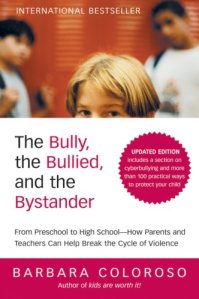
Briliant Book! Click to read reviews at Amazon
The longitudinal study was conducted by researchers at the University of Groningen in the Netherlands. It appears in the March/April 2010 issue of the journal Child Development.
In their work, the researchers questioned almost 500 elementary-school children ages 9 to 12. Based on their findings, they conclude that bullies generally choose to gain status by dominating their victims. But at the same time, they try to reduce the chances that they’ll end up on the outs with other classmates by choosing as victims children who are weak and not well-liked by others. In short, even bullies care a lot about others’ affection and don’t want to lose it.
Gender also plays a role. For example, the study finds that at this age, bullies only care about not losing affection from classmates of their own gender. So when boys bully boys, it doesn’t matter whether girls approve or disapprove. The same holds for girls. Moreover, boys will bully only those girls that aren’t well liked by other boys, regardless of what girls think about it, and girls will do the same in their bullying of boys.
“To understand the complex nature of acceptance and rejection, it’s necessary to distinguish the gender of the bully, the gender of the target, and the gender of the classmates who accept and reject bullies and victims,” according to René Veenstra, professor of sociology at the University of Groningen, who led the study.
Read The Original Research Paper HERE (Free PDF-internal link)
Video : Lecture By Temple Grandin – Focus on Autism and Asperger’s Syndrome
I came across this fascinating lecture by Temple Grandin. Enjoy!
Vodpod videos no longer available.
About Peter
Peter Brown BHMS (Hons) MPsychClin MAPS
I’m a Clinical Psychologist and have a private practice and consultancy in Brisbane Australia. I have 24 years experience in child, adult and family clinical psychology. I have a wonderful wife and three kids.
I am co-founder of Christian Wholeness Counselling Services.
I like researching issues of the brain & mind, reading and seeking out new books and resources for myself and my clients. I thought that others might be interested in some of what I have found also, hence this blog…

Subscribe to My Blog Posts & Updates
-

Blog Surfer
Alphainventions


Recent Comments


 Peter H Brown Clinical Psychologist