Binge Eating: A 12 Week Self-Guided Program Gets Great Results
Kaiser Permanente Center for Health Research, Press Release
Short-Term Program  for Binge Eaters Using “Overcoming Binge Eating” by Dr. Christopher Fairburn Has Long-Term Benefits
PORTLAND, Ore. — A new study finds that a self-guided, 12-week program helps binge eaters stop binging for up to a year and the program can also save money for those who participate. Recurrent binge eating is the most common eating disorder in the country, affecting more than three percent of the population, or nine million people, yet few treatment options are available.
But a first-of-a-kind study conducted by researchers at the Kaiser Permanente Center for Health Research, Wesleyan University and Rutgers University found that more than 63 percent of participants had stopped binging at the end of the program — compared to just over 28 percent of those who did not participate. The program lasted only 12 weeks, but most of the participants were still binge free a year later. A second study, also published in the April issue of the Journal of Consulting and Clinical Psychology, found that program participants saved money because they spent less on things like dietary supplements and weight loss programs.
“It is unusual to find a program like this that works well, and also saves the patient money. It’s a win-win for everyone,” said study author Frances Lynch, PhD, MSPH, a health economist at the Kaiser Permanente Center for Health Research. “This type of program is something that all health care systems should consider implementing.”
“People who binge eat more than other people do during a short period of time and they lose control of their eating during these episodes. Binge eating is often accompanied by depression, shame, weight gain, loss of self-esteem and it costs the health care system millions of extra dollars,” said the study’s principal investigator Ruth H. Striegel-Moore, PhD, a professor of psychology at Wesleyan University. “Our studies show that recurrent binge eating can be successfully treated with a brief, easily administered program, and that’s great news for patients and their providers.”
Binge eating has received a lot of media attention recently because the American Psychiatric Association is recommending that it be considered a separate, distinct eating disorder like bulimia and anorexia. This new diagnosis can be expected to focus more attention on binge eating and how best to treat it, according to the researchers. It also could influence the number of people diagnosed and how insurers will cover treatment.
This randomized controlled trial, conducted in 2004–2005, involved 123 members of the Kaiser Permanente health plan in Oregon and southwest Washington. More than 90 percent of them were women, and the average age was 37. To be included in the study, participants had to have at least one binge eating episode a week during the previous three months with no gaps of two or more weeks between episodes.
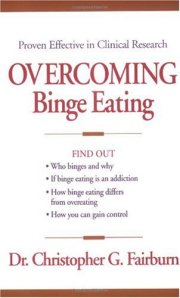
Click image to read reviews: Book helps achieve results in this research study
Half of the participants were enrolled in the intervention and asked to read the book “Overcoming Binge Eating” by Dr. Christopher Fairburn, a professor of psychiatry and expert on eating disorders. The book details scientific information about binge eating and then outlines a six-step self-help program using self-monitoring, self-control and problem-solving strategies. Participants in the study attended eight therapy sessions over the course of 12 weeks in which counselors explained the rationale for cognitive behavioral therapy and helped participants apply the strategies in the book. The first session lasted one hour, and subsequent sessions were 20–25 minutes. The average cost of the intervention was $167 per patient.
All participants were mailed fliers detailing the health plan’s offerings for healthy living and eating and encouraged to contact their primary care physician to learn about more services.
By the end of the 12-week program 63.5 percent of participants had stopped binging, compared to 28.3 percent of those who did not participate. Six months later, 74.5 percent of program participants abstained from binging, compared to 44.1 percent in usual care. At one year, 64.2 percent of participants were binge free, compared to 44.6 percent of those in usual care.
Everyone in the trial was asked to provide extensive information about their binge eating episodes, how often they missed work or were less productive at work, and the amount they spent on health care, weight-loss programs and weight loss supplements. Researchers also examined expenditures on medications, doctor visits, and other health-related services.
The researchers then compared these costs between the two groups and found that average total costs were $447 less in the intervention group. This included an average savings of $149 for the participants, who spent less on weight loss programs, over-the-counter medications and supplements. Total costs for the intervention group were $3,670 per person per year, and costs for the control group were $4,098.
“While program results are promising, we highly encourage anyone who has problems with binge eating to consult with their doctors to make sure this program is right for them,” said study co-author Lynn DeBar, PhD, clinical psychologist at the Kaiser Permanente Center for Health Research.
Study authors include: Lynn DeBar, John F. Dickerson, Frances Lynch and Nancy Perrin from the Kaiser Permanente Center for Health Research in Portland, Oregon; Ruth H. Striegel-Moore and Francine Rosselli from Wesleyan University; G. Terence Wilson from Rutgers, The State University of New Jersey; and Helena C. Kraemer from the Stanford University School of Medicine.

![Reblog this post [with Zemanta]](https://i0.wp.com/img.zemanta.com/reblog_e.png)
Martin Seligman: Author Of “Learned Optimism” Speaks About Positive Psychology And Authentic Happiness
Martin Seligman was originally best known for his classic psychology studies and theory of “Learned Helplessness” (1967) and it’s relationship to depression.
These days he is considered to be a founder of positive psychology, a field of study that examines healthy states, such as authentic happiness, strength of character and optimism, and is the author of “Learned Optimism”.
This is a terrific talk on Positive Psychology and what it means to be happy. It’s about 20 mins. long but definitely worth a watch!
Pack Up Your Troubles And (Apparently) Smile: Physical Enclosure Helps Psychological Closure
Read the original research paper HERE (Free PDF-internal link)
ScienceDaily (Mar. 25, 2010) — Finding it hard to get over a failed love interest? Just can’t get details of a bad financial move out of your head.
A new study from the Rotman School of Management suggests you might want to stick something related to your disappointment in a box or envelope if you want to feel better. In four separate experiments researchers found that the physical act of enclosing materials related to an unpleasant experience, such as a written recollection about it, improved people’s negative feelings towards the event and created psychological closure. Enclosing materials unrelated to the experience did not work as well.

Click image to read reviews
“If you tell people, ‘You’ve got to move on,’ that doesn’t work,” said Dilip Soman, who holds the Corus Chair in Communication Strategy at the Rotman School and is also a professor of marketing, who co-wrote the paper with colleagues Xiuping Li from the National University of Singapore and Liyuan Wei from City University of Hong Kong. “What works is when people enclose materials that are relevant to the negative memories they have. It works because people aren’t trying to explicitly control their emotions.”
While the market implications might not be immediately obvious, Prof. Soman believes the findings point to new angles on such things as fast pick-up courier services and pre-paid mortgage deals that relieve people’s sense of debt burden. If people realize that the memory of past events or tasks can be distracting, perhaps there is a market for products and services that can enclose or take away memories of that task.
The paper is to be published in Psychological Science.
Read the original research paper HERE (Free PDF-internal link)
Self Help For Anxiety & Depression: A List Of FREE Interactive Self Help Websites
Today I wanted to get around to doing what I have been meaning to do for a while and post a list of free access interactive and/or educational websites which I have come across. These sites are fantastic resources and each one offers a different way to get involved with your recovery. Please note I am not affiliated with any of these sites and they are not affiliate sites. I hope you find one or more useful as I know many of my clients have.
Click Image to Read Reviews
Click Image to Read Reviews
Self Help / Educational Websites
Updated 27th March 2010
- Anxiety Online
- Beyond Blue
- Depnet
- Bipolar Disorder Education Program
- Blackdoginstitute
- BlueBoard
- BluePages
- CRUfAD – Self Help
- Depression Education Program
- e-couch
- Feardrop – online exposure therapy for phobias
- Living Well Working Well
- MoodSwings
- Multicultural Information on Depression online (MIDonline)
- Virtual Clinic
- Added 27th March 2010
- Depressioncenter.net
- Beatingtheblues (UK)
There you have it! Check them out and let me know what you think. Know of any others? (No affiliate sites please).
Happiness: Why It’s Harder to Find in Depression’s “Shrinking World”
http://www.PsychologicalScience.org via http://www.psychcentral.comA new research study investigated whether happy and unhappy people differ in the types of conversations they tend to engage in.
For a four-day period, psychological scientists from the University of Arizona and Washington University in St. Louis had volunteers equipped with an unobtrusive recording device called the Electronically Activated Recorder (EAR).
 This device periodically records snippets of sounds as participants go about their lives. For this experiment, the EAR sampled 30 seconds of sounds every 12.5 minutes yielding a total of more than 20,000 recordings.
Researchers then listened to the recordings and identified the conversations as trivial small talk or substantive discussions. In addition, the volunteers completed personality and well-being assessments.
An analysis of the recordings revealed some very interesting findings.
Greater well-being was related to spending less time alone and more time talking to others: The happiest participants spent 25 percent less time alone and 70 percent more time talking than the unhappiest participants.
In addition to the difference in the amount of social interactions happy and unhappy people had, there was also a difference in the types of conversations they took part in: The happiest participants had twice as many substantive conversations and one third as much small talk as the unhappiest participants.
These findings suggest that the happy life is social and conversationally deep rather than solitary and superficial.
The researchers surmise that — though the current findings cannot identify the causal direction — deep conversations may have the potential to make people happier.
They note, “Just as self-disclosure can instill a sense of intimacy in a relationship, deep conversations may instill a sense of meaning in the interaction partners.”
The findings are reported in the latest issue of Psychological Science, http://www.psychologicalscience.org
Exercise and Mood: Healthy Activity Can Help Beat Depression and Anxiety
 es appear to have significant effects in terms of elevating mood,” says Dr. Andrew Leuchter, professor of psychiatry at the UCLA Semel Institute for Neuroscience and Human Behavior. Physical activity, he adds, is often used to augment treatments such as medication and cognitive behavioral therapy. “If people are on medication or in treatment and haven’t had a complete recovery from depression, exercise is useful in getting them all the way there.” Exercise affects the brain in several ways. “People with depression tend to become somewhat inert, and they don’t engage in their usual activities, and exercise gets people back to their usual level of activity,” Leuchter says. That can prompt an upward cycle, inspiring people to return to work and connect again with friends and family, ultimately providing motivation to stay on course. Such connections are crucial for depressed people.
“The psychological benefits make a big difference from my perspective,” says James Blumenthal, professor of medical psychology at Duke University in Durham, N.C. “People have a greater sense of being in control. They feel better about themselves and have more self-confidence.”
A physical change can instigate a mental change, says Vaccaro, director of development at Moonview Sanctuary, a psychological treatment center in Santa Monica. “When you’re getting somebody to move and getting them to change a pattern in their life, just that little bit of pattern change can relate to a mood change, and they start to see themselves as a person who is active, not just a couch potato. They change their perception.” There may be direct physical effects on the brain as well. The treatment center encourages exercise — yoga in particular — as a way to manage many types of mood disorders. Besides having a strong mind-body connection, “yoga is something that can be modified to someone’s activity level and is something they can do throughout their life,” Vaccaro says.
Mood elevation
Several studies illustrate the benefits of exercise.In one, published in the journal Psychosomatic Medicine in 2007, 202 men and women with major depression were randomly assigned to participate in a supervised exercise program in a group setting, do home-based exercise, take an antidepressant medication or take a placebo pill. After 16 weeks, 41% were in remission, meaning they no longer had major depressive disorder. Those who were in the exercise and medication groups tended to have higher remission rates than the placebo group.
Another study examined how much cardiovascular exercise was needed to see changes in mood among those with mild to moderate major depressive disorder. The 80 men and women who took part in the research were randomly placed in four exercise groups that varied in the number of calories burned and the frequency of the activity. A placebo group did flexibility exercises three days a week. Those in the group that exercised at moderate intensity three to five days a week for about 40 minutes (consistent with public health recommendations) showed the biggest decrease in depressive symptoms compared with those who exercised less, or just did stretching.
The 2005 study appeared in the American Journal of Preventive Medicine. Other pieces of the puzzle are still missing, however. Scientists aren’t sure what changes happen in the brain — and why — when people exercise. Many scientists and physicians believe that exercise increases levels of serotonin, a neurotransmitter thought to be linked to mood regulation. However, most of the studies supporting this have been done on animals. “It’s hard to quantify it in humans for a number of reasons,” Leuchter says. “We don’t entirely understand exactly why patients get depressed in the first place. We have theories, but it’s hard to know in individual cases. And we don’t have a good way of looking at [changes] in the brain.” Scientists do know that exercise causes an increase in blood flow to the brain and raises the amount of energy the brain uses. And even though the link between blood flow and mood isn’t known, Leuchter says, “the brain in general seems to be in a healthier state.”
Activity is key
Exercise may be key in fighting depression, but no generic prescription fits everyone. Overall health and exercise history factor into what kind of regimen might be prescribed. “If someone was a runner, I’d get them back to running,” Leuchter says. “If not, I’m not going to have the goal of turning someone into a major athlete. I’d simply want to get them active, and even walking around the block might be good.” Those who aren’t currently in treatment for depression should consult with a physician before exercising to make sure they have no underlying health problems. Patients who are on medication or in therapy for depression shouldn’t consider exercise a substitute for either treatment. “The key,” Blumenthal says, “is really maintenance. You have to do it on an ongoing basis. You should find something you enjoy, but doing something is better than nothing.”
Teen Bullying: Tori’s Story & Trouble on ‘Planet Girl’
As I was writing yesterdays post on internet safety, I was again reminded of the rise and rise of adolescent bullying, which is of course aided by the increase in “cyber” bullying. Of particular concern, certainly in Australia and many other Western countries, is the increase in intensity and severity of bullying amongst teenage girls.
This is an issue which all of us who work and live with teenage girls (and indeed even young adult women) are aware of, and as well as dealing with cyber bullying in my posts, I want to also provide some insight and direction for parents of young people who may be exposed to these issues within their social environment.
In April this year, Australian television current affairs program 4 Corners ran a story on this issue, and a young woman named Tori Matthews-Osman was prompted to write a story and to give her opinions in response to the show. who had written a story about bullying was invited to be a part of the show.
I have reproduced Tori’s story (with original spelling) about a girl named Morgan, as well as her reflections of her own experiences with bullying, as a way of providing first hand insight into the world in which some of our daughters and their friends survive on a daily basis. More on this topic soon.
Tori’s Story
At this very moment there’s a girl, sitting alone in a cubical in the girls toilets. She’s sitting there with her lunch on her lap, with tears pouring down her cheeks.
Her long black hair has fallen gracelessly around her face. Her sea green eyes stearing at the door. Her make-up is slowly starting to run and she just sits there. She sits there stearing into space, zoned out of the things happening in her surroundings. Slowly, she pulls out her compass that’s sitting on her lap, in her pencil case. She starts to trace a small design on the top of her upper-leg, hidden to everyone else by her school dress, where no-one will ever see. At first she traces the design lightly but slowly she presses hard and harder, suddenly placing enough force that she’s actually cut the design in her leg. Her eyes drift down to her leg because she saw a red spot in the corner of her eye; it’s blood. It’s her blood and yet she can’t feel the pain. You can’t feel pain when it’s all that you’ve ever felt.
She’s sitting there cutting herself, hiding and crying because of a different kind of pain. It’s the pain of humiliation. The humiliation of being attacked by bullies.
The students, she goes to school with, either ignores her or they bully her, mentally or physically. Her name’s Morgan.
As you know, Morgan is sitting there, crying and cutting, because of the bullying. Her attackers are the so called ”it” people, also known as the ”poplars”’. Morgan is always thinking to herself ”What the hell did I ever do to you? Why won’t you all just leave me alone?” She sometimes wants to seek revenge on her attackers and see how they like the humiliation. But she never does because somewhere deep inside her, she knows that she’s a better person than them and that what comes around, go’s around.
You may have noticed that I’m using the words ”attack” and ”attackers”, this is simply because the bulling is a form of attack against her and the thousands of others that go through the same thing.
Anyway, she hides in the toilets at recess and lunch, hoping to avoid being attacked for just 1 day, but sometimes those same girls come into the toilets. They talk about things like boys, clothes, they talk about friends behind their backs and, they tease anyone that looks different or because they don’t like the same stuff as them. Morgan knows that those girls talk about her, because she’s herd them on a number of times. They say things like, ”Oh, my, god, did you see what she wears?” or ”she is such a freak” or also ”what a loser. I can’t wait till she’s out of our lives for good. People will dance on her grave, they’ll be so happy.” Some people also call her emo, goth, Chopper (because she has cuts on her wrists and legs) and a lot of other, equally rude things. Some of really bitchy girls will make up rumors about her. A few examples are: she’s addicted to drugs, she’s an alcoholic, she’s sick of life and is going to end hers and also she has a bad reputation with all the boys. As you can probably guess, all these rumors are far from the truth.
The girls at Morgan’s school are the worst. Some of the boys are just as bad because they egg the girls on and cheer when they hurt Morgan. The girls do some really horrible things like throwing food and bottles at her, and then as it all happens, the boys will film it all and post it on YouTube for the world to see and laugh at. This is the humiliation she goes through, and what I was talking about at the start.
The reason why Morgan goes through all of this, is because she has black hair, listen’s to rock/heavy metal music, likes the color black along with others, sometimes she comes to school with a few cuts or burses’ on her and she also likes to be by herself. She doesn’t understand why this is happening to her. She does have a reason as to why she is the way she is. The reason is this: her mother and farther are no longer together, her dad lives 4 hours away from her, her dad has a new life with new kids and a wife, her mum’s constantly meeting new guys and has a new one each week, she has no friends, all of the teasing is getting so bad and she’s always depressed. All of these things add up and she just wants it all to stop, that’s the reason she hurts herself; it’s a way for her to release some of the plain and hurt. Some pretty scary thoughts go through Morgan’s head at times, things that others don’t understand, like, what if I ended all this now?, will anyone even care?, would anyone notice if I just left this hell hole? Or I don’t want this to keep going on, I’m scared that one of these days they’ll hurt me so bad that i get put in hospital and they’ll get away with it. Morgan hates these thoughts but she can’t help but think them, there is no way to stop them, but she hates them anyway.
The first bell has just gone, signaling the end of lunch. Reluctantly, with a sigh, Morgan get’s up and wipes her face to try and hide the evidence that she was crying and wipes away all the blood from her leg. On her way out, she catches a glimpse of her reflection: red and puffy eyes, black streaks of mascara running down her cheeks and a very pale face. Morgan walks over to the taps and tries to clean herself up a bit. Slowly her face gains some color and the black streaks are gone but her eyes are still a little red and puffy. Slowly at first, she makes her way to her last class of the day, its English Morgan’s favorite subject and the only one that she does well in.
English is over now and Morgan rushes to her locker, grabs her bag and her guitar and heads off at a fast walk, home. As soon as she gets inside the front door, she calls out to make sure that her so-called family is still out, all clear, so she locks herself in her bedroom and, slowly, quite sobs arise from deep within her chest. Soon Morgan is sobbing so hard that she can no longer control herself and her whole body starts to shake. After maybe 30 minutes of body-shaking tears, she hears voices: her mum and older brother are home from shopping. Slowly she hides all evidence of crying and heads to greet her family and help them. She forces a smile onto her lips, but it comes out very crooked, yet somehow no one seems to notice it.
After dinner, cleaning up and doing a little bit of homework, Morgan escapes to her bedroom, the one place that she can be alone and do what she wants without someone barging in on her. She starts to trace a design on her wrist and starts to think those scary thoughts again. This time they really scare her, so much so, that she starts sobbing again but they’re so quiet that only she can hear them. All of a sudden she has the urge to hurt herself, but, with some false positive thought’s, she doesn’t. To distract herself, Morgan gets up and turns on her favorite CD, music that tends to help her get through the toughest problems. Still quietly sobbing, she lies down under the covers of her nice, warm bed and cries herself to sleep.
This is the same thing that happens every day of every week of every month. Sometimes she does have those thoughts about ending her life and sometimes she thinks that she’s going to have a brake-down. Morgan is sick and tired of her mother being self-absorbed, of her farther not giving a damn about her or who he hurts, but mostly, she’s sick of being treated like she’s nothing, like she’s a piece of garbage being kicked around, because somewhere deep down inside, she knows that she’s not a piece of garbage and that she doesn’t deserve to be treated the way she is. One day she knows that she will do something about it all and she also knows that one day she will change her life for the good of things, because she has the will to do it and she believes in herself. She feels like she has to, since no one else does.
This is the way Morgan’s life is, every, single day and she’s very strong, a very strong 14 year old. Not a lot of people could go through this and hide it the way Morgan has and is. Especially no one she knows. No one should go through anything like this but people do.
What’s written above is part of a story that I have written about bullying and I hope that it opens up someones eyes.
This sort of thing happens in the real world. You may not want to believe it, but it’s the cold hard truth, and, the sad thing is that it will never stop. People say that they wish for world peace or for the famine over in Africa to end, but what I wish for is this: I wish that people, girls in particular, would stop being so bitchy towards one another. I wish that no-one goes through this, but I know that it’s kind of an un-realistic wish, because it will never happen. But even if it did, it wouldn’t last long at all, people would go back to the way they are now. It would be too hard a habit to brake, well for the bullies anyway.
I myself have gone through bullying and I’m still being bullied. I have friends that have been through it and are still going through it to this very day, and let me tell you this: it’s horrible to think at times that there must be something wrong with you to be picked on all the time, whether it’s because of the way you look or your weight or because you like really different things. It’s probably one of the worst feelings ever. Some of you may be thinking that what I’m going through is really bad, and at the times when it happens, it does feel really bad, but I know that it’s not that bad compared to what others go through.
I have been a victom of bullying since I first started school, in 2000. I have been teased because of my weight, because I wear reading glasses and a few other reasons. I have been called so many names, such as emo and goth plus a lot of other names that are too rude to say. I’m sick of being bullied when there’s no need for it. I’m bullied by one of my so-called friends, he calls me some really rude names and then when he asks why am I mad at him, I just look at him and say something like ”you can’t be serious! You know exaclly what you’ve done to get me mad!” He acts as if nothing has happened and expects me to ”give him another chance.”
Back in 2006 I would never have written to you or stood up for myself, but since starting high school, I have gained more confidence. In saying that I wil give you an example: Last year I entered your Short Story Compition and instead of winning, I was asked to be interviewed on my veiws on this isue. If I was asked that same question in ‘06 there is no way that I would have said yes.
This is something that I’m very passionate about. Someone asked me last month what my goal is and my answer was this: ”My goal is to go around to different places, whether it’s schools or other places, and tell people about what I go through and tell parents what the can do to spot the signs if your child is being bullied or how they can help their child get through it. Kind of like a spokes person against bullies.” I told my counciler about my goal and she told me that she needs someone that has been through it, to talk to a group of about 20 parents. I said yes and now I am waiting to find out when it will be.
There is no way that I would be able to get through all of this without the support from my mum. We are so close, we’re kind of like best friends. She’s always there for me when times get tough and I know that I can trust her with anything. It’s also thanks to my counciler, Chiara, that I can get through these things, because I know that I can talk to her any time at school, about anything and I know that I can trust her too.
After reading your artical and hearing about the boy, Elija I think his name was (sorry if it’s not), got me upset because he can’t help the way that he is. So what? He has something wronge with him, get over it! He seems like a pretty nice kid, and it’s not his fault that he makes faces sometimes. Everyone has flaws, no-one is perfect. The poor boy has no friends because people are turning others against him, and thats not fair!
Thanks for reading my what I have to say and my story,
Tori Matthews-Osman
Related articles by Zemanta
- Online help for victims of bullying (guardian.co.uk)
- After months of bullying-another student ends up in hospital (littlebytesnews.blogspot.com)
“I Just Want to be Happy!” The Struggle for Happiness PART 1: The Complete First Chapter of “The Happiness Trap”
If you’ve read some previous posts, you’ll be aware that I’m a huge fan of Australian MD Dr Russell Harris’ book “The Happiness Trap”. “The Happiness Trap” is a book which outlines the key principles of Acceptance and Commitment Therapy (ACT). I have said previously that I would come back to this topic so here goes!
 ACT is a relatively new (mid to late 1990’s) approach to cognitive therapy, based around the principles of “mindfulness” and acceptance of the difference between the realities of what is going on around you as opposed to your evaluation or judgment of what is going on around you. These evaluations and judgments are often dependent on how your thoughts and assumptions are attached to or “fused” to your emotions and perceptions of yourself and others. It is a well researched model which is widely becoming more and more accepted as an effective intervention for anxiety,depression and other mental health and wellness issues.
Sound complicated and confusing? Well actually it’s not. And to prove it I am providing a link here to The full first Chapter of Dr Harris’ book in PDF format. You will need acrobat reader (free) or another free PDF reader to access this chapter which you can find by clicking on the link below.
I will be coming back to the principle of ACT and mindulness hopefully once or twice a week, and my aim is to walk you through the rationale of this approach and show you some tools,worksheets and strategies to help you to explore and implement some of basics of ACT, so subscribe to my RSS or come back regularly to keep up!
Here’s the link!
Chapter 1 of “The Happiness Trap” – Dr Russell Harris (No catches or tricks..it’s free!)
You will probably find a copy of The Happiness Trap and other ACT Books in your local library. You can also purchase a copy Here, and if you are in Australasia, Here. You can read more about it at Dr Harris’ website and there are customer reviews in My Highly Recommended Books.
Enjoy
Part Two coming soon!
//
Do We Need A Simpler Definition For Major Depressive Disorder?
I’ve just come across this press release. Thought provoking..will have to chew it over.
Researchers from Rhode Island Hospital’s department of psychiatry propose that the definition for major depressive disorder (MDD) should be shortened to include only the mood and cognitive symptoms that have been part of the definition in the Diagnostic and Statistical Manual of Mental Disorders (DSM) for the past 35 years. Their recommendation would exclude those symptoms that are currently part of the definition that may be associated with medical illness rather than depression. The proposal is based on a study that appears in the July 23 online first edition of the journal Psychological Medicine.
The current definition of major depressive disorder in the fourth edition of the DSM (DSM-IV) includes nine  symptoms — a definition that has remained essentially unchanged since the 1970s. With preparations for the fifth edition of the DSM underway, the researchers propose that there are two practical problems with the symptom criteria: the length of the definition and the difficulty in applying some of the criteria to patients with co-morbid medical illnesses. The researchers’ proposal recommends a shortened list of symptom criteria that includes only low mood, loss of interest or pleasure, guilt/worthlessness, impaired concentration/indecision and suicidal thoughts. It would exclude the somatic criteria of fatigue, appetite disturbance and sleep disturbance (increased sleep or insomnia) as these may be associated with medical illnesses other than depression. Their proposal is called the “simpler definition of MDD.”
Lead author Mark Zimmerman, MD, director of outpatient psychiatry at Rhode Island Hospital, says, “While the principles guiding criteria revision have not been clearly explained, we believe that existing diagnostic criteria should be revised when a conceptual problem is identified, or a more valid or simpler method of defining a disorder is developed. The reason for even considering a change to the symptom criteria for major depressive disorder after all these years is two-fold.”
Zimmerman, who is also an associate professor of psychiatry and human behavior at The Warren Alpert Medical School of Brown University, continues, “First, studies have indicated that there are significant gaps in the knowledge or application of the MDD criteria among practitioners. Second, somatic criteria that are currently part of the DSM-IV definition such as fatigue or sleep or appetite disturbances are also symptoms of other medical illnesses and may not be indicative of a major depressive episode.”
Under Zimmerman’s direction, researchers from Rhode Island Hospital and The Warren Alpert Medical School of Brown University previously developed the simpler definition of MDD for a project known as the Rhode Island Methods to Improve Diagnostic Assessment and Services (RI MIDAS) project, an integration of research quality diagnostic methods into a community-based outpatient practice affiliated with an academic medical center.
Zimmerman says, “In our previous report from the RI MIDAS project, we developed a briefer list of the symptom criteria of MDD that was composed entirely of the DSM-IV mood and cognitive symptoms. That simplified definition did not include the somatic symptoms.” He continues, “Our initial research found high levels of agreement in diagnosing MDD between the simplified and DSM-IV definitions of MDD. Our goal in this study was to replicate these findings in a large sample of psychiatric outpatients, and to extend the findings to other patient populations, including those presenting for treatment of pathological gambling and candidates for bariatric surgery.”
Zimmerman says, “After eliminating the four somatic criteria from the DSM-IV definition of MDD, leaving the five mood and cognitive features, a high level of concordance was found between this simpler definition of MDD with the original classification in all three patient samples studied.” He adds, “This new definition offers two advantages over the DSM-IV definition – it is briefer and therefore more likely to be recalled and correctly applied in clinical practice, and it is free of somatic symptoms, thereby making it easier to apply with medically ill patients.”
Using the Structured Clinical Interview for DSM-IV (SCID), the researchers conducted a study of more than 2,500 patients. The patient population consisted of 1,100 psychiatric outpatients, 210 pathological gamblers who presented for treatment and 1,200 candidates for bariatric surgery. Across all patients, the level of agreement between the simplified definition and the DSM-IV definition was more than 95 percent.
The researchers note that there are implications to changing the criteria for MDD. Because their findings indicate that the simpler definition is highly concordant with the current version, there would be no meaningful impact on prevalence rates. Reducing the number of criteria, however, would reduce the time needed to fully assess criteria in patients and diagnostic interviews could be shortened.
Zimmerman and the researchers conclude, “In deciding how to proceed in the next version of the DSM, the conceptual and practical advantages of a briefer set of criteria that is easy to apply to all patients, particularly medically ill patients, needs to be weighted against the disadvantages of deviation from tradition.”
Along with Zimmerman, other researchers involved in the study include Janine Galione, PhD; Iwona Chelminski, PhD; Joseph McGlinchey, PhD; Diane Young, PhD; Kristy Dalrymple, PhD; Camile Ruggero, PhD; and Caren Francione Witt, PhD; all of Rhode Island Hospital and Brown University.
Source: Nancy Jean Lifespan
//
What do you think? Leave a comment and we’ll see if we can get some discussion happening!
Hypnosis Really can Help:Debunking Common Myths around being Hypnotized
I am pleased that I’ve actually come across some sound and sensible information regarding hypnosis on the internet! Hypnosis when put in to action well, can be a very effective tool for some interpersonal and habitual problems. However there are a number of reasons why a lot of people won’t touch it with the preverbial bargepole! From the site www.hypnosisdownloads.com here are some accurate debunks of 5 myths about hypnosis.
Hypnosis Myth 1) All hypnosis is the same As with anything, hypnosis can be good, bad or indifferent. The most common is old-style authoritarian hypnosis of the type “You are getting sleepy, you are feeling confident”. Unsurprisingly, this sort of hypnosis doesn’t work well with many people. Good hypnosis uses subtle psychological principles and advanced communication patterns. It’s like the difference between a football coach who thinks you’ll perform best if he yells at you, compared with the more elegant style of a great leader who knows that to get the best from his people, he needs to understand motivation, to cajole, encourage and reward. Hypnosis Downloads.com offers hundreds of sessions using the best type of hypnosis.
Hypnosis Myth 2) Subliminals work Subliminals are words that you can’t hear. Common sense says they shouldn’t work, and there’s no research proving that they do.
Hypnosis Myth 3) Some people can’t be hypnotized .The only reason you can’t be hypnotized is if you are incapable of paying attention due to extremely low IQ or brain damage. That’s not to say that every hypnotist can hypnotize you however. The more flexible the hypnotist, the more effective she will be with the largest number of people.
Hypnosis Myth 4) Hypnosis is something weird that other people do to you If you couldn’t go into hypnosis, you wouldn’t be able to sleep, to learn, or get nervous through ‘negative self hypnosis’. (You know when you imagine things going wrong and it makes you feel anxious? Well that’s self hypnosis!)
Hypnosis is simply a deliberate utilization of the REM (Rapid Eye Movement) or dream state. We’re not giving people medication here – if it wasn’t a natural ability, hypnosis wouldn’t work!
Hypnosis Myth 5) You lose control in hypnosis Crazy news stories, stage hypnotists and gossip have created the illusion that you lose control in hypnosis. In fact, when hypnotized, you are relaxed and focused – and able to choose to get up and walk away at any time. You choose to give your attention to the hypnotist, and you can withdraw it at any time.
If you have been scared of hypnosis in the past, this article has hopefully helped give you a more balanced perspective. But remember, ensure what you’re getting is the real thing. If you are curious, ask you therapist or psychologist before you seek further information or help. Online, try www.hypnosisdownloads.com for further resources or information.
Adapted from an article by Mark Tyrrell of Hypnosis Downloads.com.
About Peter
Peter Brown BHMS (Hons) MPsychClin MAPS
I’m a Clinical Psychologist and have a private practice and consultancy in Brisbane Australia. I have 24 years experience in child, adult and family clinical psychology. I have a wonderful wife and three kids.
I am co-founder of Christian Wholeness Counselling Services.
I like researching issues of the brain & mind, reading and seeking out new books and resources for myself and my clients. I thought that others might be interested in some of what I have found also, hence this blog…

Subscribe to My Blog Posts & Updates
-

Blog Surfer
Alphainventions


Recent Comments


 Peter H Brown Clinical Psychologist