Emotional Intelligence: Learning To Roll With The Punches
 It’s a hot-buzz topic that covers everything from improving workplace performance and successfully climbing the corporate ladder to building the happiest of marriages to ending school bullying. But what exactly is Emotional Intelligence (EI)? If we lack it, can we learn it? And how do we know if our EI is high or low? Is it only high if we’re really, really nice?
Three scholarly researchers – including University of Cincinnati Psychology Professor Gerry Matthews – delved into the science of EI and published “What We Know About Emotional Intelligence: How it Affects Learning, Work, Relationships, and Our Mental Health.”
Published by MIT Press (2009), the book was recently awarded the American Publishers Award for Professional and Scholarly Excellence – the PROSE Awards – in the biological and life sciences category of biomedicine and neuroscience. The book, co-authored by Matthews, Moshe Zeidner (University of Haifa) and Richard D. Roberts (Center for New Constructs, Educational Testing Service, Princeton, N.J.), was also on display at the UC Libraries’ Authors, Editors and Composers Reception and Program from 3:30-5 p.m., Thursday, April 22, in the Russell C. Myers Alumni Center.
MIT Press promotions describe EI as the “ability to perceive, regulate and communicate emotions – to understand emotions in ourselves and others.” Workplaces want to test for it to find the most EI-talented employees, and consultants are touting training and EI tests to improve productivity. “In the popular writings, EI tends to be defined very broadly and one can’t proceed with scientific research with such a vague and broad definition,” Matthews says.
Matthews’ research interests have explored how stress, mood and coping ability can affect performance on tests, in the workplace and on the highway. He adds that amid the grim economy, even the people who have jobs are feeling high levels of stress in the workplace and are feeling more challenged by workplace demands and concerns about job security. In general terms, those who can roll with the punches – with a shrug and a smile – may have higher Emotional Intelligence.
Click image to read reviews
Then again, “The intimate association of personality and emotion sets a trap for researchers interested in Emotional Intelligence,” writes Matthews. “It might seem that happy, calm states of mind should be seen as the person imbued with high Emotional Intelligence. However, such emotional tendencies may be no more than a consequence of biases in brain functioning or information-processing routines operating without insight or ‘intelligence.’ Some individuals – in part because of their DNA – are simply fortunate in being prone to pleasant moods, so it follows that emotional states do not alone provide an index of Emotional Intelligence,” Matthews states in the book.
In fact, Matthews says he’s skeptical that people who are better at managing stress hold higher Emotional Intelligence, but as the researchers found as they tried to narrow down the science of Emotional Intelligence, more research is needed. For instance, is someone with higher EI in the workplace more productive, or are they just better at self-promotion and forming positive relationships with co-workers? Matthews says he believes EI appears to be very modestly related to workplace performance, and could turn out to be nothing more than a business fad.
He adds the researchers are also skeptical about all of those EI tests, particularly those self-assessments. After all, people could be rating themselves the way they see themselves or the way they would like to be seen, and not like they actually are.
Currently, authors Matthews and Roberts are researching the testing of EI through video scenarios. The situation judgment test involves watching the videos unfold a challenging situation, and then the video comes to a stop and offers different options for resolving the problem. Matthews is building on his earlier research which explored whether negative moods affected good decision making abilities. “Through the video project, the idea is to see if emotionally intelligent people are better able to make rational decisions under stress,” he says.
The researchers are also examining the link between EI and school social and emotional learning programs.
Source:
Dawn Fuller
University of Cincinnati
Related articles by Zemanta
- Learning beyond the classroom (boston.com)
- “The Importance of Emotional Intelligence in Small Business Owners” :The Cross-cultural Connector (translatorpower.wordpress.com)
- Brain Training Or Just Brain Straining?: The Benefits Of Brain Exercise Software Are Unclear (peterhbrown.wordpress.com)
- Winners Are Grinners: Even If There’s Nothing to Win! (peterhbrown.wordpress.com)
![Reblog this post [with Zemanta]](https://i0.wp.com/img.zemanta.com/reblog_e.png)
Violent Video Games & Kids: Definitive Study Shows Both Short & Long Term Harmful Effects
 Iowa State University Distinguished Professor of Psychology Craig Anderson has made much of his life’s work studying how violent video game play affects youth behavior. And he says a new study he led, analyzing 130 research reports on more than 130,000 subjects worldwide, proves conclusively that exposure to violent video games makes more aggressive, less caring kids — regardless of their age, sex or culture.
Read the original research paper (PDF)
“We can now say with utmost confidence that regardless of research method — that is experimental, correlational, or longitudinal — and regardless of the cultures tested in this study [East and West], you get the same effects,” said Anderson, who is also director of Iowa State’s Center for the Study of Violence. “And the effects are that exposure to violent video games increases the likelihood of aggressive behavior in both short-term and long-term contexts. Such exposure also increases aggressive thinking and aggressive affect, and decreases prosocial behavior.”
The study was conducted by a team of eight researchers, including ISU psychology graduate students Edward Swing and Muniba Saleem; and Brad Bushman, a former Iowa State psychology professor who now is on the faculty at the University of Michigan. Also on the team were the top video game researchers from Japan — Akiko Shibuya from Keio University and Nobuko Ihori from Ochanomizu University — and Hannah Rothstein, a noted scholar on meta-analytic review from the City University of New York.
Meta-analytic procedure used in research
The team used meta-analytic procedures — the statistical methods used to analyze and combine results from previous, related literature — to test the effects of violent video game play on the behaviors, thoughts and feelings of the individuals, ranging from elementary school-aged children to college undergraduates.
The research also included new longitudinal data which provided further confirmation that playing violent video games is a causal risk factor for long-term harmful outcomes.
“These are not huge effects — not on the order of joining a gang vs. not joining a gang,” said Anderson. “But these effects are also not trivial in size. It is one risk factor for future aggression and other sort of negative outcomes. And it’s a risk factor that’s easy for an individual parent to deal with — at least, easier than changing most other known risk factors for aggression and violence, such as poverty or one’s genetic structure.”
The analysis found that violent video game effects are significant in both Eastern and Western cultures, in males and females, and in all age groups. Although there are good theoretical reasons to expect the long-term harmful effects to be higher in younger, pre-teen youths, there was only weak evidence of such age effects.
Time to refocus the public policy debate
The researchers conclude that the study has important implications for public policy debates, including development and testing of potential intervention strategies designed to reduce the harmful effects of playing violent video games.
“From a public policy standpoint, it’s time to get off the question of, ‘Are there real and serious effects?’ That’s been answered and answered repeatedly,” Anderson said. “It’s now time to move on to a more constructive question like, ‘How do we make it easier for parents — within the limits of culture, society and law — to provide a healthier childhood for their kids?'”

Click Image To Read Reviews
But Anderson knows it will take time for the creation and implementation of effective new policies. And until then, there is plenty parents can do to protect their kids at home.
“Just like your child’s diet and the foods you have available for them to eat in the house, you should be able to control the content of the video games they have available to play in your home,” he said. “And you should be able to explain to them why certain kinds of games are not allowed in the house — conveying your own values. You should convey the message that one should always be looking for more constructive solutions to disagreements and conflict.”
Anderson says the new study may be his last meta-analysis on violent video games because of its definitive findings. Largely because of his extensive work on violent video game effects, Anderson was chosen as one of the three 2010 American Psychological Association Distinguished Scientist Lecturers
Read the original research paper (PDF)
Source: Iowa State University

Related articles by Zemanta
- Study: Violent Video Game Play Makes More Aggressive Kids (usnews.com)
- Metastudy: Violent video games raise aggression (news.cnet.com)
- “I Saw It Happen”: Children Who Witness Bullying Can Be Traumatized Too (peterhbrown.wordpress.com)
“I Saw It Happen”: Children Who Witness Bullying Can Be Traumatized Too
 Students who witness bullying of their peers may suffer more psychologically than the victim or the bullies.
Read The Original Research Paper (PDF)
2002 students ages 12 to 16 were surveyed at public schools in England. The survey asked them whether they’d committed, witnessed, or been the victim of several types of bullying behavior (e.g., kicking, name-calling, threatening, etc.) and whether they had experienced psychological stress symptoms such as anxiety, depression, or hostility.
Why bystanders suffer more than victims of bullying
As reported in the article, previous research shows that children who witness bullying feel guilty, presumably for not doing anything to help the victim.
In addition, they may have felt more stressed by vacillating between doing what they thought they should do (i.e., help the victim) on the one hand, and being afraid of being victimized themselves, on the other. Being in this type of “approach/avoidance” conflict has been shown in numerous studies to create high levels of stress.
The combination of guilt and fear among witnesses that they will experience the same thing may be another reason why they are more affected by bullying than the actual victims.

Click image to read reviews
Uncertainty, especially combined with feelings of fear or guilt, contributes to stress. Stress leads to depression, anxiety, and other mental disorders.
Sitting down and discussing feelings of fear and guilt with your child may help to minimize the destructive force and ultimate impact of those emotions on mental health. Practical “survival” tips about how to avoid, distract, or other means of handling bullies would help, too, giving kids options if they are cornered by or are a witness to bullies in action.
Read The Original Research Paper (PDF)
Source: Psychological Association (2009, December 15). Witnesses to bullying may face more mental health risks than bullies and victims. ScienceDaily.
Related articles by Zemanta
- Online help for victims of bullying (guardian.co.uk)
- Witnesses to Bullying May Suffer Most of All (nlm.nih.gov)
Facebook: Is it Really your Face or Someone Else’s?
Do people display their actual or idealised personalities on social networking sites? This interesting article from PsyBlog reports that recent research addressed this issue with surprising results. I wonder if similar research on role playing and avatar based environments like World of Warcraft and Second Life would yield different findings…
There are now over 700 million people around the world with profiles on social networking sites like Facebook and MySpace. In the US 75% of those between 18 and 24 who have access to the internet use social networking sites. And over the past four years, across all adult age-groups, their use has quadrupled.
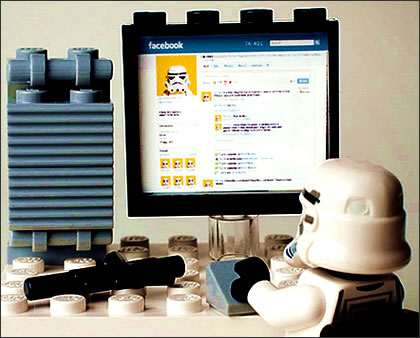 But do these profiles tell us anything about people’s real-life personalities? Online it is very easy to display an idealised version of the self to others so surely the temptation to exaggerate or even give a completely misleading impression is just too great?
Actual versus idealised personality
To find out psychologists recruited 236 US and German students who use social networking sites and had them complete personality measures (Back et al., 2010).
These measured first their actual personalities on what psychologists call the ‘Big 5‘ personality traits (extraversion, agreeableness, conscientiousness, neuroticism and openness to experience).
Secondly it measured their idealised personalities: who they would like to be. Then independent observers were shown their real social networking profiles and asked to rate participants’ personalities.
The surprising truth
After comparing the actual personalities with the idealised and observed, the researchers found that, on average, people were much more likely to display their real personality on the social networking sites rather than their idealised selves.
Overall people were remarkably honest in representing themselves. People were honest—we don’t read those words often enough.
In line with other findings, this study found that, when looking at a stranger’s profile for the first time, some aspects of personality are more difficult to discern. Neuroticism in others is particularly difficult to gauge, whereas people find extraversion and openness to experience relatively easily to assess, even in strangers.

Todd Kashdan's Book "Curious?: Discover the Missing Ingredient to a Fulfilling Life"
Lying online?
This study is another blow for that old stereotype that the web is some kind of scary hinterland, an untrustworthy place where anything goes and nothing is what it appears, peopled by adolescent boys pretending to be anything but adolescent boys.
Contrary to the received wisdom, as well as academic theorising that the internet encourages people to project an idealised self, this research suggests that people are remarkably honest in displaying their true personalities online.
Whatever the cause, this fact may help to explain the phenomenal popularity of social networking sites: the truth draws people in.
Source: http://www.PsyBlog.com
Related articles by Zemanta
- The Psychology of Facebook Profiles (wellness.blogs.time.com)
- Self-Reporting (ezrasf.com)
Just Do It: Asking For Help & Why People Are Twice as Likely to Assist as You Think!
In everyday life asking others for help can be embarrassing, perhaps even a painful experience. Requesting help potentially show s our own weakness and also opens us up to rejection. It’s a relief when people say yes.
Perhaps this explains the conclusion of new research published in the Journal of Personality and Social Psychology that finds we grossly underestimate just how willing others are to help us out.
In a series of studies Francis Flynn and Vanessa Lake of Columbia University tested people’s estimation of how likely others were to help them out. They got people to ask others to fill in questionnaires, to borrow cell phones and to escort them to the gym.
Across these studies they found that people underestimated how likely others were to help them by as much as 100%.
This is such a high figure that it demands an explanation – what’s going on here?
Part of the answer is our egocentric bias – we find it difficult to understand what others are thinking and feeling because we are stuck inside our own heads.
But it’s more than just that, argue Flynn and Lake, it’s also the fact that we underestimate just how much social pressure there is on other people to say yes. In effect, when you ask someone to help you, it’s much more awkward and embarrassing for them to say ‘no’ than you might think.
In two further studies Flynn and Lake supported this intuition by asking participants to put themselves in either the role of someone asking for help, or someone being asked for help.
They found that when people were help-seekers they reliably played down the social costs of saying no. But when they were the potential helper they realised how difficult it was to say no.
There’s two very practical messages coming out of this research:
- If you want help, just ask. People are much more likely to help than you think, especially if the request is relatively small. Most people take pleasure in helping others out from time-to-time.
- Make it easy for others to say no. The other side of the coin is that most of us don’t realise just how hard it is to say no to a request for help. Other people feel much more pressure to say yes to our requests than we realise. If the help you need is likely to be burdensome then think about ways of making it easier to say no.
//
Related articles by Zemanta
- Want to buy happiness? Book a plane ticket (msnbc.msn.com)
- Brain Training Centers Bring Miracles to South Florida (eon.businesswire.com)
40 Superb Psychology Blogs from Psyblog UK
I’ve had so may retweets of this find from Psyblog at www.spring.org.uk that I’ve decided to repost it here. This is a great list. Enjoy!

Forty of the best psychology blogs, chosen to give you a broad sweep of the most interesting content being produced online right now.
The list is split into three sections: first are more general psychological blogs, followed by those with an academic slant, followed by condition specific and patient perspective blogs. Other than that the blogs are presented in no particular order:
- MindHacks: links to psychological goodness from all around the web.
- Cognitive Daily: in-depth coverage of cognitive psychology research.
- The Last Psychiatrist: thoughtful, iconoclastic perspective from a practising psychiatrist.
- Channel N: brain and behaviour videos.
- BPS Research Digest: accessibly covers new psychological research.
- Encephalon: neuroscience/psychology ‘blog carnival’.
- Neurophilosophy: about molecules, minds and everything inbetween.
- Neuromarketing: brain science in marketing and sales.
- PsychCentral Blog: team blog, focusing more on clinical topics: depression, anxiety etc..
- The Situationist: links to articles on social psychology.
- We’re Only Human: journalist Wray Herbert writes about the quirks of human nature.
- Psychology Today Blogs: ‘essential reads’ from Psychology Today’s stable of bloggers.
- The Frontal Cortex: by author and journalist Jonah Lehrer.
- All In The Mind Blog: companion to good Australian radio show covering mind matters.
- Frontier Psychiatrist: anonymous London-based psychiatrist critical of the profession.
- Neuronarrative: psychology with a public health slant.
- Jena Pincott: science of love, sex and attraction.
- Research Blogging: posts collected from variety of blogs but all peer-reviewed research.
- In the News: forensic psychologist Karen Franklin on the intersection between psychology and law.
- The Mouse Trap: musings on cognitive and developmental psychology.
- The Trouble with Spikol: mental health policy issues discussed by writer Liz Spikol.
- Bad Science: Covers more than psychology but Dr Ben Goldacre is such good value we’ll let him off.
- PsyBlog: In case you didn’t notice, the blog you’re reading right now!
- Dr Petra Boynton: sex educator and academic exposes media misrepresentations of science.
- Babel’s Dawn: exploring the origins of language.
- The Neurocritic: anonymous, critical, mischievous.
- Advances in the History of Psychology: it’s all in the title.
- Deric Bounds’ MindBlog: biological view of the brain from an Emeritus Professor.
- Brain Stimulant: neurotechnology methods of brain stimulation.
- Social Psychology Eye: written by contributors to the journal Social and Personality Psychology Compass.
- Child Psychology Research Blog: by clinical child psychologist, an expert on mood disorders.
- Panic!: writer who’s been dealing with panic disorder for 20 years.
- The Tangled Neuron: layperson reports on memory loss, Alzheimer’s & dementia.
- Furious Seasons: journalist with bipolar disorder who rattles the cage of Big Pharma.
- Beyond Blue: author provides guidance on how to get through depression.
- Walking the Black Dog: one person’s battle with ‘the black dog’.
- Postpartum Progress: advocate for women, Katherine Stone, on postpartum mental health problems.
- The Secret Life of a Manic Depressive: Seaneen is a twenty-three year old Irish girl writing about her life.
- Autism Blog: autism research described by Lisa Jo Rudy, who has first-hand experience of the condition.
- The Reality of Anxiety: Aimee, who suffers from social anxiety, promoting understanding of the condition
General:
More academic:
Condition specific/patient perspective blogs:


Hypnosis Really can Help:Debunking Common Myths around being Hypnotized
I am pleased that I’ve actually come across some sound and sensible information regarding hypnosis on the internet! Hypnosis when put in to action well, can be a very effective tool for some interpersonal and habitual problems. However there are a number of reasons why a lot of people won’t touch it with the preverbial bargepole! From the site www.hypnosisdownloads.com here are some accurate debunks of 5 myths about hypnosis.
Hypnosis Myth 1) All hypnosis is the same As with anything, hypnosis can be good, bad or indifferent. The most common is old-style authoritarian hypnosis of the type “You are getting sleepy, you are feeling confident”. Unsurprisingly, this sort of hypnosis doesn’t work well with many people. Good hypnosis uses subtle psychological principles and advanced communication patterns. It’s like the difference between a football coach who thinks you’ll perform best if he yells at you, compared with the more elegant style of a great leader who knows that to get the best from his people, he needs to understand motivation, to cajole, encourage and reward. Hypnosis Downloads.com offers hundreds of sessions using the best type of hypnosis.
Hypnosis Myth 2) Subliminals work Subliminals are words that you can’t hear. Common sense says they shouldn’t work, and there’s no research proving that they do.
Hypnosis Myth 3) Some people can’t be hypnotized .The only reason you can’t be hypnotized is if you are incapable of paying attention due to extremely low IQ or brain damage. That’s not to say that every hypnotist can hypnotize you however. The more flexible the hypnotist, the more effective she will be with the largest number of people.
Hypnosis Myth 4) Hypnosis is something weird that other people do to you If you couldn’t go into hypnosis, you wouldn’t be able to sleep, to learn, or get nervous through ‘negative self hypnosis’. (You know when you imagine things going wrong and it makes you feel anxious? Well that’s self hypnosis!)
Hypnosis is simply a deliberate utilization of the REM (Rapid Eye Movement) or dream state. We’re not giving people medication here – if it wasn’t a natural ability, hypnosis wouldn’t work!
Hypnosis Myth 5) You lose control in hypnosis Crazy news stories, stage hypnotists and gossip have created the illusion that you lose control in hypnosis. In fact, when hypnotized, you are relaxed and focused – and able to choose to get up and walk away at any time. You choose to give your attention to the hypnotist, and you can withdraw it at any time.
If you have been scared of hypnosis in the past, this article has hopefully helped give you a more balanced perspective. But remember, ensure what you’re getting is the real thing. If you are curious, ask you therapist or psychologist before you seek further information or help. Online, try www.hypnosisdownloads.com for further resources or information.
Adapted from an article by Mark Tyrrell of Hypnosis Downloads.com.
About Peter
Peter Brown BHMS (Hons) MPsychClin MAPS
I’m a Clinical Psychologist and have a private practice and consultancy in Brisbane Australia. I have 24 years experience in child, adult and family clinical psychology. I have a wonderful wife and three kids.
I am co-founder of Christian Wholeness Counselling Services.
I like researching issues of the brain & mind, reading and seeking out new books and resources for myself and my clients. I thought that others might be interested in some of what I have found also, hence this blog…

Subscribe to My Blog Posts & Updates
-

Blog Surfer
Alphainventions


Recent Comments


 Peter H Brown Clinical Psychologist