Mid Life – What’s The Crisis?: Why Self Esteem Peaks In The Middle-Aged
Credit: LiveScience
Read the original research article HERE (PDF)
Bad vision and other physical ailmen ts aren’t the only things that seem to get worse as people grow old. Self-esteem also declines around the age of retirement, a new study finds.
The study involved 3,617 American men and women ranging in age from 25 to 104. Self-esteem was lowest among young adults, but increased throughout adulthood, peaking at age 60, before it started to decline.
Several factors might explain this trend, the researchers say.
“Midlife is a time of highly stable work, family and romantic relationships. People increasingly occupy positions of power and status, which might promote feelings of self-esteem,” said study author Richard Robins of the University of California, Davis. “In contrast, older adults may be experiencing a change in roles such as an empty nest, retirement and obsolete work skills in addition to declining health.”
Measuring self-esteem
The participants were surveyed four times between 1986 and 2002. They were asked to rate their level of agreement with statements such as: “I take a positive attitude toward myself,” which suggests high self-esteem; “At times I think I am no good at all,” and “All in all, I am inclined to feel that I am a failure,” which both suggest low self-esteem.
Subjects also indicated their demographics, relationship satisfaction, and whether they had experienced stressful life events, including suddenly losing a job, being the victim of a violent crime, or experiencing the death of a parent or child.
On average, women had lower self-esteem than men throughout most of adulthood, but self-esteem levels converged as men and women reached their 80s and 90s. Blacks and whites had similar self-esteem levels throughout young adulthood and middle age. In old age, average self-esteem among blacks dropped much more sharply than self-esteem among whites. This result held even after accounting for differences in income and health.
Future research should further explore these ethnic differences, which might lead to better interventions aimed at improving self-esteem, the study authors say.

Click on image to read reviews
More self-esteem factors
Education, income, health and employment status all had some effect on the self-esteem trajectories, especially as people aged.
“People who have higher incomes and better health in later life tend to maintain their self-esteem as they age,” Orth said.
“We cannot know for certain that more wealth and better health directly lead to higher self-esteem, but it does appear to be linked in some way. For example, it is possible that wealth and health are related to feeling more independent and better able to contribute to one’s family and society, which in turn bolsters self-esteem.”
People of all ages in satisfying and supportive relationships tend to have higher self-esteem, according to the findings.
However, despite maintaining higher self-esteem throughout their lives, people in happy relationships experienced the same drop in self-esteem during old age as people in unhappy relationships.
“Thus, being in a happy relationship does not protect a person against the decline in self-esteem that typically occurs in old age,” said study author Kali H. Trzesniewski of the University of Western Ontario.
With medical advances, the drop in self-esteem might occur later for baby boomers, Orth said. Boomers might be healthier for longer and, therefore, able to work and earn money longer.
Read the original research article HERE (PDF)

Related articles by Zemanta
- Self-Esteem And Self-Respect (andrewsullivan.theatlantic.com)
- Aging Health Strongly Affected by How You Feel About Aging (seniormemorysource.com)
- Parenting: Signs of Low Self-Esteem in Children (abcnews.go.com)
![Reblog this post [with Zemanta]](https://i0.wp.com/img.zemanta.com/reblog_e.png)
Exercise DOES Help Improve Mood! And Just 25 Minutes Worth Will Decrease Stress & Increase Energy
Having an Honors degree in Human Movement Studies and working in gyms in a former life while studying for my Clinical Masters degree, I have seen this to be true. Of course it seems self evident, but these researchers have used great science with an excellent and now research-proven written program and workbook. These, along with their recent meta-analytic research review, show just how effective exercise can be in improving mood.
 Credit: PhysOrg.com) — Exercise is a magic drug for many people with depression and anxiety disorders, according to researchers who analyzed numerous studies, and it should be more widely prescribed by mental health care providers.
“Exercise has been shown to have tremendous benefits for mental health,” says Jasper Smits, director of the Anxiety Research and Treatment Program at Southern Methodist University in Dallas. “The more therapists who are trained in exercise therapy, the better off patients will be.”
The traditional treatments of cognitive behavioral therapy and pharmacotherapy don’t reach everyone who needs them, says Smits, an associate professor of psychology.
“Exercise can fill the gap for people who can’t receive traditional therapies because of cost or lack of access, or who don’t want to because of the perceived social stigma associated with these treatments,” he says. “Exercise also can supplement traditional treatments, helping patients become more focused and engaged.”
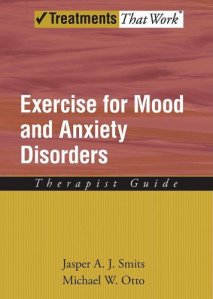
The Program used in the study is available from bookstores-Click Image to view description
Smits and Michael Otto, psychology professor at Boston University, presented their findings to researchers and mental health care providers March 6 at the Anxiety Disorder Association of America’s annual conference in Baltimore.
Their workshop was based on their therapist guide “Exercise for Mood and Anxiety Disorders,” with accompanying patient workbook (Oxford University Press, September 2009).
The guide draws on dozens of population-based studies, clinical studies and meta-analytic reviews that demonstrate the efficacy of exercise programs, including the authors’ meta-analysis of exercise interventions for mental health and study on reducing anxiety sensitivity with exercise.
“Individuals who exercise report fewer symptoms of anxiety and depression, and lower levels of stress and anger,” Smits says. “Exercise appears to affect, like an antidepressant, particular neurotransmitter systems in the brain, and it helps patients with depression re-establish positive behaviors. For patients with anxiety disorders, exercise reduces their fears of fear and related bodily sensations such as a racing heart and rapid breathing.”
After patients have passed a health assessment, Smits says, they should work up to the public health dose, which is 150 minutes a week of moderate-intensity activity or 75 minutes a week of vigorous-intensity activity.
At a time when 40 percent of Americans are sedentary, he says, mental health care providers can serve as their patients’ exercise guides and motivators.
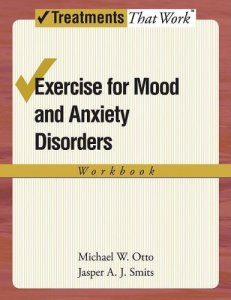
The patient workbook which accompanies the program - Click image to view description
“Rather than emphasize the long-term health benefits of an exercise program — which can be difficult to sustain — we urge providers to focus with their patients on the immediate benefits,” he says. “After just 25 minutes, your mood improves, you are less stressed, you have more energy — and you’ll be motivated to exercise again tomorrow. A bad mood is no longer a barrier to exercise; it is the very reason to exercise.”
Smits says health care providers who prescribe exercise also must give their patients the tools they need to succeed, such as the daily schedules, problem-solving strategies and goal-setting featured in his guide for therapists.
“Therapists can help their patients take specific, achievable steps,” he says. “This isn’t about working out five times a week for the next year. It’s about exercising for 20 or 30 minutes and feeling better today.”
Related articles by Zemanta
- Personal Health: Research Is Starting to Shed Light on Body Dysmorphic Disorder (nytimes.com)
- Music Soothes Anxiety as Well as Massage Does (nlm.nih.gov)
Binge Eating: A 12 Week Self-Guided Program Gets Great Results
Kaiser Permanente Center for Health Research, Press Release
Short-Term Program  for Binge Eaters Using “Overcoming Binge Eating” by Dr. Christopher Fairburn Has Long-Term Benefits
PORTLAND, Ore. — A new study finds that a self-guided, 12-week program helps binge eaters stop binging for up to a year and the program can also save money for those who participate. Recurrent binge eating is the most common eating disorder in the country, affecting more than three percent of the population, or nine million people, yet few treatment options are available.
But a first-of-a-kind study conducted by researchers at the Kaiser Permanente Center for Health Research, Wesleyan University and Rutgers University found that more than 63 percent of participants had stopped binging at the end of the program — compared to just over 28 percent of those who did not participate. The program lasted only 12 weeks, but most of the participants were still binge free a year later. A second study, also published in the April issue of the Journal of Consulting and Clinical Psychology, found that program participants saved money because they spent less on things like dietary supplements and weight loss programs.
“It is unusual to find a program like this that works well, and also saves the patient money. It’s a win-win for everyone,” said study author Frances Lynch, PhD, MSPH, a health economist at the Kaiser Permanente Center for Health Research. “This type of program is something that all health care systems should consider implementing.”
“People who binge eat more than other people do during a short period of time and they lose control of their eating during these episodes. Binge eating is often accompanied by depression, shame, weight gain, loss of self-esteem and it costs the health care system millions of extra dollars,” said the study’s principal investigator Ruth H. Striegel-Moore, PhD, a professor of psychology at Wesleyan University. “Our studies show that recurrent binge eating can be successfully treated with a brief, easily administered program, and that’s great news for patients and their providers.”
Binge eating has received a lot of media attention recently because the American Psychiatric Association is recommending that it be considered a separate, distinct eating disorder like bulimia and anorexia. This new diagnosis can be expected to focus more attention on binge eating and how best to treat it, according to the researchers. It also could influence the number of people diagnosed and how insurers will cover treatment.
This randomized controlled trial, conducted in 2004–2005, involved 123 members of the Kaiser Permanente health plan in Oregon and southwest Washington. More than 90 percent of them were women, and the average age was 37. To be included in the study, participants had to have at least one binge eating episode a week during the previous three months with no gaps of two or more weeks between episodes.
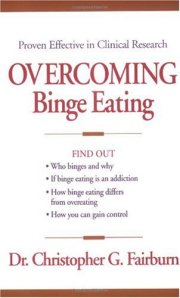
Click image to read reviews: Book helps achieve results in this research study
Half of the participants were enrolled in the intervention and asked to read the book “Overcoming Binge Eating” by Dr. Christopher Fairburn, a professor of psychiatry and expert on eating disorders. The book details scientific information about binge eating and then outlines a six-step self-help program using self-monitoring, self-control and problem-solving strategies. Participants in the study attended eight therapy sessions over the course of 12 weeks in which counselors explained the rationale for cognitive behavioral therapy and helped participants apply the strategies in the book. The first session lasted one hour, and subsequent sessions were 20–25 minutes. The average cost of the intervention was $167 per patient.
All participants were mailed fliers detailing the health plan’s offerings for healthy living and eating and encouraged to contact their primary care physician to learn about more services.
By the end of the 12-week program 63.5 percent of participants had stopped binging, compared to 28.3 percent of those who did not participate. Six months later, 74.5 percent of program participants abstained from binging, compared to 44.1 percent in usual care. At one year, 64.2 percent of participants were binge free, compared to 44.6 percent of those in usual care.
Everyone in the trial was asked to provide extensive information about their binge eating episodes, how often they missed work or were less productive at work, and the amount they spent on health care, weight-loss programs and weight loss supplements. Researchers also examined expenditures on medications, doctor visits, and other health-related services.
The researchers then compared these costs between the two groups and found that average total costs were $447 less in the intervention group. This included an average savings of $149 for the participants, who spent less on weight loss programs, over-the-counter medications and supplements. Total costs for the intervention group were $3,670 per person per year, and costs for the control group were $4,098.
“While program results are promising, we highly encourage anyone who has problems with binge eating to consult with their doctors to make sure this program is right for them,” said study co-author Lynn DeBar, PhD, clinical psychologist at the Kaiser Permanente Center for Health Research.
Study authors include: Lynn DeBar, John F. Dickerson, Frances Lynch and Nancy Perrin from the Kaiser Permanente Center for Health Research in Portland, Oregon; Ruth H. Striegel-Moore and Francine Rosselli from Wesleyan University; G. Terence Wilson from Rutgers, The State University of New Jersey; and Helena C. Kraemer from the Stanford University School of Medicine.
An Attractive Lady Makes The Boys Go Gaga:Testosterone And Risk Taking Behavior
Read The Original Research Paper HERE (Free PDF-internal link)
From UNIS : University of Queensland research suggests that the presence of a beautiful woman can lead men to throw caution to the wind. Professor Bill von Hippel and doctoral student Richard Ronay, from UQ’s School of Psychology, have been examining the links between physical risk-taking in young men and the presence of attractive women.
To examine this issue, they conducted a field experiment with young male skateboarders and found the skateboarders took more risks at the skate park when they were observed by an attractive female experimenter than when they were observed by a male experimenter.
This increased risk-taking led to more successes but also more crash landings in front of the female observer.
Click image to view reviews
Professor von Hippel and Mr Ronay also measured testosterone from participants’ saliva, and found that the skateboarders’ increased risk taking was caused by elevated testosterone levels brought about by the presence of the attractive female.
According to the researchers these findings suggest an evolutionary basis for male risk-taking.
“Historically, men have competed with each other for access to fertile women and the winners of those competitions are the ones who pass on their genes to future generations. Risk-taking would have been inherent in such a competitive mating strategy,” said Professor von Hippel.
“Our results suggest that displays of physical risk-taking might best be understood as hormonally fuelled advertisements of health and vigour aimed at potential mates, and signals of strength, fitness, and daring intended to intimidate potential rivals.”
The researchers point out that although evolution may have favoured males who engage in risky behaviour to attract females, such behaviours can also be detrimental in terms of survival.
“Other instances of physical risk-taking that contribute to men’s early mortality, such as dangerous driving and physical aggression, might also be influenced by increases in testosterone brought about by the presence of attractive women.”
Read The Original Research Paper HERE (Free PDF-internal link)
Academic Dishonesty = Fail: Procrastination & Copying Homework Increases Failure Rate Irrespective of Aptitude
Read The Original Research Paper HERE (PDF)
From ScienceDaily (Mar. 21, 2010) — The history of students who copy homework from classmates may be as old as school itself. But in today’s age of lecture-hall laptops and online coursework, how prevalent and damaging to the education of students has such academic dishonesty become?
According to research published online March 18 in Physical Review Special Topics: Physics Education Research, it turns out that unnoticed student cheating is a significant cause of course failure nationally.
A researcher from the University of Kansas has teamed up with colleagues from the Massachusetts Institute of Technology to get a better handle on copying in college in the 21st century.
Young-Jin Lee, assistant professor of educational technology at KU, and the Research in Learning, Assessing and Tutoring Effectively group at MIT spent four years seeing how many copied answers MIT students submitted to MasteringPhysics, an online homework tutoring system.
“MIT freshmen are required to take physics,” said Lee. “Homework was given through a Web-based tutor that our group had developed. We analyzed when they logged in, when they logged out, what kind of problems they solved and what kinds of hints they used.”

Click Image to View
Lee said that it was easy to spot students who had obtained answers from classmates before completing the homework.
“We ran into very interesting students who could solve the problems — very hard problems — in less than one minute, without making any mistakes,” said Lee.
Students also were asked to complete an anonymous survey about the frequency of their homework copying. (According to the survey, students nationally admit to engaging in more academic dishonesty than MIT students.)
Among the researchers’ most notable findings:
* Students who procrastinated also copied more often. Those who started their homework three days ahead of deadline copied less than 10 percent of their problems, while those who drug their feet until the last minute were repetitive copiers.
The students who copied frequently had about three times the chance of failing the course.
* Results of the survey show that students are twice as likely to copy on written homework than on online homework.
* This study showed that doing all the homework assigned is “a surer route to exam success” than a preexisting aptitude for physics.
“People believe that students copy because of their poor academic skills,” Lee said. “But we found that repetitive copiers — students who copy over 30 percent of their homework problems — had enough knowledge, at least at the beginning of the semester. But they didn’t put enough effort in. They didn’t start their homework long enough ahead of time, as compared to noncopiers.”
Because repetitive copiers don’t adequately learn physics topics on which they copy the homework, Lee said, the research strongly implies that copying caused declining performance on analytic test problems later in the semester.
“Even though everyone knows not doing homework is bad for learning, no one knows how bad it is,” said Lee. “Now we have a quantitative measurement. It could make an A student get B or even C.”
At the beginning of a semester, the researchers found that copying was not as widespread as it was late in the semester.
“Obviously, the amount of copying was not so prevalent because the academic load was not as much at the beginning of the semester,” said Lee. “In order to copy solutions, the students need to build their networks. They need to get to know each other so that they can ask for the answers.”
But the KU researcher and his MIT colleagues also demonstrated that changes to college course formats — such as breaking up large lecture classes into smaller “studio” classes, increasing interactions between teaching staff and students, changing the grading system — could reduce student copying fourfold.
Read The Original Research Paper HERE (PDF)
Adapted from materials provided by University of Kansas
Improve Self Control and Impulsivity Through Abstract Thinking
Read Original Research Paper HERE (Free PDF internal link)
[A] New study shows that self-control can be automatically, unconsciously bolstered by abstract thinking.
Wouldn’t it be great if we could just spontaneously and automatically exercise self-control, without all that painful back-and-forth battle with ourselves?
Just automatically resist that cake and choose the apple; or suddenly find ourselves out jogging without resorting to self-blackmail […]
Unfortunately so often temptation wins. And experiments show that when we are run down from exercising self-discipline all day, we become even more likely to give in to temptation.
Apple or candy bar?
[Previous studies suggest ]that self-control can be increased by thinking abstractly about our goals. This suggests we should see our actions as just one part of a larger plan, rather than focusing on the details of what we’re doing. The power of abstract thinking may offer a way for us to increase our self-control without really trying.
But how does thinking abstractly about our goals increase our self-control? In a recent article published in Psychological Science, Fujita and Han (2009) wondered if our unconscious mind is somehow pitching in to help out. They used an implicit association test as a way of measuring people’s unconscious thoughts about eating either an apple or a tempting candy bar.
Before taking this test people were put into either an abstract or concrete mode of thinking. Participants were split into two groups with each asked to think about maintaining good personal relationships, but in different ways. One group thought about why we need to maintain good relationships (abstract, high-level) while the other focused on how we maintain good relationships (concrete, low-level).
As you can see, for the purposes of this experiment, the reason participants were thinking abstractly didn’t matter so much. That’s because when we think abstractly about one thing, we tend to carry on thinking in an abstract mode about anything else that’s put in front of us, including the choice between an apple and a candy bar.
Automatic, unconscious self-control
The results showed that, when participants were thinking concretely, they tended to unconsciously see candy bars in a positive light and apples in a negative light. But this was reversed when participants were thinking abstractly. Just as predicted, abstract thinking automatically made people unconsciously think of candy bars as the devil’s own food.
To back this up they asked participants in the two conditions whether they would like an apple or a candy bar, right now. They found that when participants were thinking in a concrete low-level way, they chose the apple over the candy bar only 50% of the time. But when they were thinking abstractly this percentage shot up to 76%. Not bad for such a simple manipulation.
So it seems you can bolster resistance to temptation by thinking abstractly about the goal you want to obtain because it causes your mind to automatically associate temptations with negativity. Hey presto, more self-control and thank you unconscious mind.
Why not try applying this to whatever you are finding difficult to achieve?
Read Original Research Paper HERE (Free PDF internal link)
Adapted from an article posted at PsyBlog 03/10
Social Anxiety: Another Side To The Struggle
Read Original Research Paper HERE (Free PDF internal link)
From ScienceDaily (Mar. 19, 2010) — When you think of people suffering from social anxiety, you probably characterize them as shy, inhibitive and submissive. However, new research from psychologists Todd Kashdan and Patrick McKnight at George Mason University suggests that there is a subset of socially anxious people who act out in aggressive, risky ways — and that their behavior patterns are often misunderstood.
In the new study published in Current Directions in Psychological Science, Kashdan and McKnight found evidence that a subset of adults diagnosed with Social Anxiety Disorder were prone to behaviors such as violence, substance abuse, unprotected sex and other risk-prone actions. These actions caused positive experiences in the short-term, yet detracted from their quality of life in the longer-term.
“We often miss the underlying problems of people around us. Parents and teachers might think their kid is a bully, acts out and is a behavior problem because they have a conduct disorder or antisocial tendencies,” says Kashdan. “However, sometimes when we dive into the motive for their actions, we will find that they show extreme social anxiety and extreme fears of being judged. If social anxiety was the reason for their behavior, this would suggest an entirely different intervention.”
Kashdan and McKnight suggest that looking at the underlying cause of extreme behavior can help us understand the way people interact within society.
“In the adult world, the same can be said for managers, co-workers, romantic partners and friends. It is easy to misunderstand why people are behaving the way we do and far too often we assume that the aggressive, impulsive behaviors are the problem. What we are finding is that for a large minority of people, social anxiety underlies the problem,” says Kashdan.
The researchers suggest that further studies of this subset group can help psychologists better understand and treat the behaviors. “Recent laboratory experiments suggest that people can be trained to enhance their self-control capacities and thus better inhibit impulsive urges and regulate emotions and attention,” says McKnight. “Essentially, training people to be more self-disciplined — whether in physical workout routines or finances or eating habits — improves willpower when their self-control is tested.”
Credit: George Mason University
Read Original Research Paper HERE (Free PDF internal link)
Youth Today: The “Me” Generation Or More Of The Same?
Read the original research paper HERE (Free PDF)
Today’s youth are generally not the self-centered, antisocial slackers that previous research has made them out to be, according to a provocative new study co-authored by a Michigan State University psychologist.
In a scientific analysis of nearly a half-million high-school seniors spread over three decades, MSU’s Brent Donnellan and Kali Trzesniewski of the University of Western Ontario argue teens today are no more egotistical – and just as happy and satisfied – as previous generations.
 “We concluded that, more often than not, kids these days are about the same as they were back in the mid-1970s,” said Donnellan, associate professor of psychology.
The study appears in the research journal Perspectives on Psychological Science. Donnellan acknowledges that many people will be surprised by the findings, which refute previous studies classifying today’s youth as selfish loafers with extremely high levels of self-esteem.
But while much previous research has relied on “convenience studies” of relatively small samples of young adults, Donnellan said, the current study analyzes the psychological profile data of 477,380 high school seniors from 1976 to 2006. The data comes from the University of Michigan’s federally funded Monitoring the Future survey, which each year tracks the behaviors, attitudes and values of American students.
In other findings:
* Today’s youth are more cynical and less trusting of institutions than previous generations. But Donnellan said this is generally true of the broader population.
* The current generation is less fearful of social problems such as race relations, hunger, poverty and energy shortages.
* Today’s youth have higher educational expectations.
Ultimately, Donnellan said, it’s common for older generations to paint youth in a negative light – as lazy and self-absorbed, for example – which can perpetuate stereotypes. It can be easy, he added, to forget what it’s like to grow up.
“Kids today are like they were 30 years ago – they’re trying to find their place in the world, they’re trying to carve out an identity, and it can be difficult,” Donnellan said. “But lots of research shows that the stereotypes of all groups are much more overdrawn than the reality.”
Read the original research paper HERE (Free PDF)
Source: Brent Donnellan
Michigan State University
Only As Young Or Old As You Feel?: When Does Youth End & Old Age Start?
Source: University of Kent, UK: 15 March 2010Professor Dominic Abrams and Dr Melanie Vauclair from the School of Psychology at the University of Kent will present findings from the European Social Survey’s research project ‘Attitudes to Age in the UK and Europe’ during an event at City University, London, on Monday 15 March.
Titled What do the British think about… ageism, political institutions and welfare?, this Economic and Social Research Council (ESRC) event will consist of an information seminar and an online demonstration of how to access and use the European Social Survey (ESS) data archive, currently comprising 21 European countries and more than 40,000 respondents.
With a steadily growing proportion of older people in the UK and Europe, the 2008 ESS included a module that examined how people perceive and feel about their own and other age groups.
Professor Abra ms explained: ‘The survey showed that age prejudice – being treated as ‘too young’ or ‘too old’ – is perceived to be a serious or very serious issue by 63 per cent of respondents, so it is obviously important to know what these age labels mean to people’. To find out, the survey asked when does ‘youth’ end and ‘old age’ begin? For the UK, the average response to this question was that youth ends at the age of 35 and old age begins at 58.
However, the survey also revealed that people’s judgements depend strongly on the ‘age of the beholder’. On average, the youngest respondents (15 to 24-year old) judged that youth ends at 28 and old age starts at 54, whereas the oldest age group (80 and older) judged that youth ends at 42 and old age starts at 67.
In the UK, there is a gap of almost 40 years between young people’s judgement of the end of youth and older people’s judgement of the beginning of old age. However, more startlingly, there is a gap of only 12 years between older people’s judgement of the end of youth and younger people’s judgement of the start of old age.
In general, men regarded the end of youth and start of old age to begin two years earlier than women did.
There were also large differences between European countries. Youth was perceived to end earliest among respondents in Portugal (at the age of 29) and latest by those in Cyprus (at the age of 45). Portugal scored lowest for the belief when old age starts (at the age of 51), whereas Belgium ranked highest (at the age 64).
The findings illustrate that when people discover another person’s age, their judgement of whether that person is young or old is highly subjective and this may have important implications in influencing people’s assumptions about the person’s responsibilities, rights and capabilities.
Professor Abrams said: ‘This evidence shows that what counts as young and old is very largely down to the age of the beholder.’
Amongst other findings, the survey also showed that 28 per cent of UK respondents reported that they had been treated with prejudice because of their age in the past year and that the youngest age group were more likely to report experiences of prejudice than any other. Across the European countries in the survey, age prejudice was most widely reported in Finland (47 per cent) and least so in Cyprus and Portugal (19 per cent). The UK ranked 16 out of 21 countries in regard to this question.
Pay It Forward: Research Proves That Acts Of Kindness From A Few Cascade On To Dozens
Read The Original Research Paper HERE (Free PDF)
ScienceDaily (Mar. 10, 2010) — For all those dismayed by scenes of looting in disaster-struck zones, whether Haiti or Chile or elsewhere, take heart: Good acts — acts of kindness, generosity and cooperation — spread just as easily as bad. And it takes only a handful of individuals to really make a difference.

This diagram illustrates how a single act of kindness can spread between individuals and across time. Cooperative behavior spreads three degrees of separation
In a study published in the March 8 early online edition of the Proceedings of the National Academy of Sciences, researchers from the University of California, San Diego and Harvard provide the first laboratory evidence that cooperative behavior is contagious and that it spreads from person to person to person. When people benefit from kindness they “pay it forward” by helping others who were not originally involved, and this creates a cascade of cooperation that influences dozens more in a social network.
The research was conducted by James Fowler, associate professor at UC San Diego in the Department of Political Science and Calit2’s Center for Wireless and Population Health Systems, and Nicholas Christakis of Harvard, who is professor of sociology in the Faculty of Arts and Sciences and professor of medicine and medical sociology at Harvard Medical School. Fowler and Christakis are coauthors of the recently published book Connected: The Surprising Power of Our Social Networks and How They Shape Our Lives.
In the current study, Fowler and Christakis show that when one person gives money to help others in a “public-goods game,” where people have the opportunity to cooperate with each other, the recipients are more likely to give their own money away to other people in future games. This creates a domino effect in which one person’s generosity spreads first to three people and then to the nine people that those three people interact with in the future, and then to still other individuals in subsequent waves of the experiment.
The effect persists, Fowler said: “You don’t go back to being your ‘old selfish self.”’ As a result, the money a person gives in the first round of the experiment is ultimately tripled by others who are subsequently (directly or indirectly) influenced to give more. “The network functions like a matching grant,” Christakis said.
“Though the multiplier in the real world may be higher or lower than what we’ve found in the lab,” Fowler said, “personally it’s very exciting to learn that kindness spreads to people I don’t know or have never met. We have direct experience of giving and seeing people’s immediate reactions, but we don’t typically see how our generosity cascades through the social network to affect the lives of dozens or maybe hundreds of other people.”
The study participants were strangers to each other and never played twice with the same person, a study design that eliminates direct reciprocity and reputation management as possible causes.
 In previous work demonstrating the contagious spread of behaviors, emotions and ideas — including obesity, happiness, smoking cessation and loneliness — Fowler and Christakis examined social networks re-created from the records of the Framingham Heart Study. But like all observational studies, those findings could also have partially reflected the fact that people were choosing to interact with people like themselves or that people were exposed to the same environment. The experimental method used here eliminates such factors.
The study is the first work to document experimentally Fowler and Christakis’s earlier findings that social contagion travels in networks up to three degrees of separation, and the first to corroborate evidence from others’ observational studies on the spread of cooperation.
The contagious effect in the study was symmetric; uncooperative behavior also spread, but there was nothing to suggest that it spread any more or any less robustly than cooperative behavior, Fowler said.
From a scientific perspective, Fowler added, these findings suggest the fascinating possibility that the process of contagion may have contributed to the evolution of cooperation: Groups with altruists in them will be more altruistic as a whole and more likely to survive than selfish groups.
“Our work over the past few years, examining the function of human social networks and their genetic origins, has led us to conclude that there is a deep and fundamental connection between social networks and goodness,” said Christakis. “The flow of good and desirable properties like ideas, love and kindness is required for human social networks to endure, and, in turn, networks are required for such properties to spread. Humans form social networks because the benefits of a connected life outweigh the costs.”
The research was funded by the National Institute on Aging, the John Templeton Foundation, and a Pioneer Grant from the Robert Wood Johnson Foundation.
Read The Original Research Paper HERE (Free PDF)
Related articles by Zemanta
- How Social Networks Impact Drinking Habits (wellness.blogs.time.com)
- A new way of thinking about social networks and the world (boston.com)
- Loneliness May Be Contagious (wired.com)
About Peter
Peter Brown BHMS (Hons) MPsychClin MAPS
I’m a Clinical Psychologist and have a private practice and consultancy in Brisbane Australia. I have 24 years experience in child, adult and family clinical psychology. I have a wonderful wife and three kids.
I am co-founder of Christian Wholeness Counselling Services.
I like researching issues of the brain & mind, reading and seeking out new books and resources for myself and my clients. I thought that others might be interested in some of what I have found also, hence this blog…

Subscribe to My Blog Posts & Updates
-

Blog Surfer
Alphainventions


Recent Comments


 Peter H Brown Clinical Psychologist