Exercise DOES Help Improve Mood! And Just 25 Minutes Worth Will Decrease Stress & Increase Energy
Having an Honors degree in Human Movement Studies and working in gyms in a former life while studying for my Clinical Masters degree, I have seen this to be true. Of course it seems self evident, but these researchers have used great science with an excellent and now research-proven written program and workbook. These, along with their recent meta-analytic research review, show just how effective exercise can be in improving mood.
 Credit: PhysOrg.com) — Exercise is a magic drug for many people with depression and anxiety disorders, according to researchers who analyzed numerous studies, and it should be more widely prescribed by mental health care providers.
“Exercise has been shown to have tremendous benefits for mental health,” says Jasper Smits, director of the Anxiety Research and Treatment Program at Southern Methodist University in Dallas. “The more therapists who are trained in exercise therapy, the better off patients will be.”
The traditional treatments of cognitive behavioral therapy and pharmacotherapy don’t reach everyone who needs them, says Smits, an associate professor of psychology.
“Exercise can fill the gap for people who can’t receive traditional therapies because of cost or lack of access, or who don’t want to because of the perceived social stigma associated with these treatments,” he says. “Exercise also can supplement traditional treatments, helping patients become more focused and engaged.”
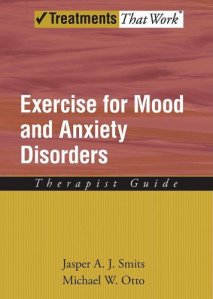
The Program used in the study is available from bookstores-Click Image to view description
Smits and Michael Otto, psychology professor at Boston University, presented their findings to researchers and mental health care providers March 6 at the Anxiety Disorder Association of America’s annual conference in Baltimore.
Their workshop was based on their therapist guide “Exercise for Mood and Anxiety Disorders,” with accompanying patient workbook (Oxford University Press, September 2009).
The guide draws on dozens of population-based studies, clinical studies and meta-analytic reviews that demonstrate the efficacy of exercise programs, including the authors’ meta-analysis of exercise interventions for mental health and study on reducing anxiety sensitivity with exercise.
“Individuals who exercise report fewer symptoms of anxiety and depression, and lower levels of stress and anger,” Smits says. “Exercise appears to affect, like an antidepressant, particular neurotransmitter systems in the brain, and it helps patients with depression re-establish positive behaviors. For patients with anxiety disorders, exercise reduces their fears of fear and related bodily sensations such as a racing heart and rapid breathing.”
After patients have passed a health assessment, Smits says, they should work up to the public health dose, which is 150 minutes a week of moderate-intensity activity or 75 minutes a week of vigorous-intensity activity.
At a time when 40 percent of Americans are sedentary, he says, mental health care providers can serve as their patients’ exercise guides and motivators.
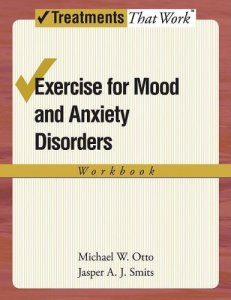
The patient workbook which accompanies the program - Click image to view description
“Rather than emphasize the long-term health benefits of an exercise program — which can be difficult to sustain — we urge providers to focus with their patients on the immediate benefits,” he says. “After just 25 minutes, your mood improves, you are less stressed, you have more energy — and you’ll be motivated to exercise again tomorrow. A bad mood is no longer a barrier to exercise; it is the very reason to exercise.”
Smits says health care providers who prescribe exercise also must give their patients the tools they need to succeed, such as the daily schedules, problem-solving strategies and goal-setting featured in his guide for therapists.
“Therapists can help their patients take specific, achievable steps,” he says. “This isn’t about working out five times a week for the next year. It’s about exercising for 20 or 30 minutes and feeling better today.”

Related articles by Zemanta
- Personal Health: Research Is Starting to Shed Light on Body Dysmorphic Disorder (nytimes.com)
- Music Soothes Anxiety as Well as Massage Does (nlm.nih.gov)
![Reblog this post [with Zemanta]](https://i0.wp.com/img.zemanta.com/reblog_e.png)
Martin Seligman: Author Of “Learned Optimism” Speaks About Positive Psychology And Authentic Happiness
Martin Seligman was originally best known for his classic psychology studies and theory of “Learned Helplessness” (1967) and it’s relationship to depression.
These days he is considered to be a founder of positive psychology, a field of study that examines healthy states, such as authentic happiness, strength of character and optimism, and is the author of “Learned Optimism”.
This is a terrific talk on Positive Psychology and what it means to be happy. It’s about 20 mins. long but definitely worth a watch!
Multitasking: New Study Challenges Previous Cognitive Theory But Shows That Only A Few “Supertaskers” Can Drive And Phone
Read The Original Research Paper HERE (PDF – internal link)
A new study from University of Utah psychologists found a small group of people with an extraordinary ability to multitask: Unlike 97.5 percent of those studied, they can safely drive while chatting on a cell phone.
These individuals – described by the researchers as “supertaskers” – constitute only 2.5 percent of the population. They are so named for their ability to successfully do two things at once: in this case, talk on a cell phone while operating a driving simulator without noticeable impairment.

Jason Watson, a University of Utah psychologist, negotiates cybertraffic in a driving simulator used to study driver distractions such as cell phones and testing. While many people think they can safely drive and talk on a cell phone at the same time, Watson's new study shows only one in 40 is a "supertasker" who can perform both tasks at once without impairment of abilities measured in the study. Credit: Valoree Dowell, University of Utah
The study, conducted by psychologists Jason Watson and David Strayer, is now in press for publication later this year in the journal Psychonomic Bulletin and Review.
This finding is important not because it shows people can drive well while on the phone – the study confirms that the vast majority cannot – but because it challenges current theories of multitasking. Further research may lead eventually to new understanding of regions of the brain that are responsible for supertaskers’ extraordinary performance.
“According to cognitive theory, these individuals ought not to exist,” says Watson. “Yet, clearly they do, so we use the supertasker term as a convenient way to describe their exceptional multitasking ability. Given the number of individuals who routinely talk on the phone while driving, one would have hoped that there would be a greater percentage of supertaskers. And while we’d probably all like to think we are the exception to the rule, the odds are overwhelmingly against it. In fact, the odds of being a supertasker are about as good as your chances of flipping a coin and getting five heads in a row.”
The researchers assessed the performance of 200 participants over a single task (simulated freeway driving), and again with a second demanding activity added (a cell phone conversation that involved memorizing words and solving math problems). Performance was then measured in four areas—braking reaction time, following distance, memory, and math execution.
As expected, results showed that for the group, performance suffered across the board while driving and talking on a hands-free cell phone.
For those who were not supertaskers and who talked on a cell phone while driving the simulators, it took 20 percent longer to hit the brakes when needed and following distances increased 30 percent as the drivers failed to keep pace with simulated traffic while driving. Memory performance declined 11 percent, and the ability to do math problems fell 3 percent.

Click image to read reviews
However, when supertaskers talked while driving, they displayed no change in their normal braking times, following distances or math ability, and their memory abilities actually improved 3 percent.
The results are in line with Strayer’s prior studies showing that driving performance routinely declines under “dual-task conditions” – namely talking on a cell phone while driving – and is comparable to the impairment seen in drunken drivers.
Yet contrary to current understanding in this area, the small number of supertaskers showed no impairment on the measurements of either driving or cell conversation when in combination. Further, researchers found that these individuals’ performance even on the single tasks was markedly better than the control group.
“There is clearly something special about the supertaskers,” says Strayer. “Why can they do something that most of us cannot? Psychologists may need to rethink what they know about multitasking in light of this new evidence. We may learn from these very rare individuals that the multitasking regions of the brain are different and that there may be a genetic basis for this difference. That is very exciting. Stay tuned.”
Watson and Strayer are now studying expert fighter pilots under the assumption that those who can pilot a jet aircraft are also likely to have extraordinary multitasking ability.
The current value society puts on multitasking is relatively new, note the authors. As technology expands throughout our environment and daily lives, it may be that everyone – perhaps even supertaskers – eventually will reach the limits of their ability to divide attention across several tasks.
“As technology spreads, it will be very useful to better understand the brain’s processing capabilities, and perhaps to isolate potential markers that predict extraordinary ability, especially for high-performance professions,” Watson concludes.
Information from University of Utah
Read The Original Research Paper HERE (PDF – internal link)
//
Pack Up Your Troubles And (Apparently) Smile: Physical Enclosure Helps Psychological Closure
Read the original research paper HERE (Free PDF-internal link)
ScienceDaily (Mar. 25, 2010) — Finding it hard to get over a failed love interest? Just can’t get details of a bad financial move out of your head.
A new study from the Rotman School of Management suggests you might want to stick something related to your disappointment in a box or envelope if you want to feel better. In four separate experiments researchers found that the physical act of enclosing materials related to an unpleasant experience, such as a written recollection about it, improved people’s negative feelings towards the event and created psychological closure. Enclosing materials unrelated to the experience did not work as well.

Click image to read reviews
“If you tell people, ‘You’ve got to move on,’ that doesn’t work,” said Dilip Soman, who holds the Corus Chair in Communication Strategy at the Rotman School and is also a professor of marketing, who co-wrote the paper with colleagues Xiuping Li from the National University of Singapore and Liyuan Wei from City University of Hong Kong. “What works is when people enclose materials that are relevant to the negative memories they have. It works because people aren’t trying to explicitly control their emotions.”
While the market implications might not be immediately obvious, Prof. Soman believes the findings point to new angles on such things as fast pick-up courier services and pre-paid mortgage deals that relieve people’s sense of debt burden. If people realize that the memory of past events or tasks can be distracting, perhaps there is a market for products and services that can enclose or take away memories of that task.
The paper is to be published in Psychological Science.
Read the original research paper HERE (Free PDF-internal link)
Self Help For Anxiety & Depression: A List Of FREE Interactive Self Help Websites
Today I wanted to get around to doing what I have been meaning to do for a while and post a list of free access interactive and/or educational websites which I have come across. These sites are fantastic resources and each one offers a different way to get involved with your recovery. Please note I am not affiliated with any of these sites and they are not affiliate sites. I hope you find one or more useful as I know many of my clients have.
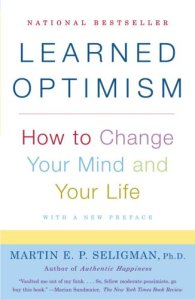
Click Image to Read Reviews
Click Image to Read Reviews
Self Help / Educational Websites
Updated 27th March 2010
- Anxiety Online
- Beyond Blue
- Depnet
- Bipolar Disorder Education Program
- Blackdoginstitute
- BlueBoard
- BluePages
- CRUfAD – Self Help
- Depression Education Program
- e-couch
- Feardrop – online exposure therapy for phobias
- Living Well Working Well
- MoodSwings
- Multicultural Information on Depression online (MIDonline)
- Virtual Clinic
- Added 27th March 2010
- Depressioncenter.net
- Beatingtheblues (UK)
There you have it! Check them out and let me know what you think. Know of any others? (No affiliate sites please).
Academic Dishonesty = Fail: Procrastination & Copying Homework Increases Failure Rate Irrespective of Aptitude
Read The Original Research Paper HERE (PDF)
From ScienceDaily (Mar. 21, 2010) — The history of students who copy homework from classmates may be as old as school itself. But in today’s age of lecture-hall laptops and online coursework, how prevalent and damaging to the education of students has such academic dishonesty become?
According to research published online March 18 in Physical Review Special Topics: Physics Education Research, it turns out that unnoticed student cheating is a significant cause of course failure nationally.
A researcher from the University of Kansas has teamed up with colleagues from the Massachusetts Institute of Technology to get a better handle on copying in college in the 21st century.
Young-Jin Lee, assistant professor of educational technology at KU, and the Research in Learning, Assessing and Tutoring Effectively group at MIT spent four years seeing how many copied answers MIT students submitted to MasteringPhysics, an online homework tutoring system.
“MIT freshmen are required to take physics,” said Lee. “Homework was given through a Web-based tutor that our group had developed. We analyzed when they logged in, when they logged out, what kind of problems they solved and what kinds of hints they used.”

Click Image to View
Lee said that it was easy to spot students who had obtained answers from classmates before completing the homework.
“We ran into very interesting students who could solve the problems — very hard problems — in less than one minute, without making any mistakes,” said Lee.
Students also were asked to complete an anonymous survey about the frequency of their homework copying. (According to the survey, students nationally admit to engaging in more academic dishonesty than MIT students.)
Among the researchers’ most notable findings:
* Students who procrastinated also copied more often. Those who started their homework three days ahead of deadline copied less than 10 percent of their problems, while those who drug their feet until the last minute were repetitive copiers.
The students who copied frequently had about three times the chance of failing the course.
* Results of the survey show that students are twice as likely to copy on written homework than on online homework.
* This study showed that doing all the homework assigned is “a surer route to exam success” than a preexisting aptitude for physics.
“People believe that students copy because of their poor academic skills,” Lee said. “But we found that repetitive copiers — students who copy over 30 percent of their homework problems — had enough knowledge, at least at the beginning of the semester. But they didn’t put enough effort in. They didn’t start their homework long enough ahead of time, as compared to noncopiers.”
Because repetitive copiers don’t adequately learn physics topics on which they copy the homework, Lee said, the research strongly implies that copying caused declining performance on analytic test problems later in the semester.
“Even though everyone knows not doing homework is bad for learning, no one knows how bad it is,” said Lee. “Now we have a quantitative measurement. It could make an A student get B or even C.”
At the beginning of a semester, the researchers found that copying was not as widespread as it was late in the semester.
“Obviously, the amount of copying was not so prevalent because the academic load was not as much at the beginning of the semester,” said Lee. “In order to copy solutions, the students need to build their networks. They need to get to know each other so that they can ask for the answers.”
But the KU researcher and his MIT colleagues also demonstrated that changes to college course formats — such as breaking up large lecture classes into smaller “studio” classes, increasing interactions between teaching staff and students, changing the grading system — could reduce student copying fourfold.
Read The Original Research Paper HERE (PDF)
Adapted from materials provided by University of Kansas
Social Anxiety: Another Side To The Struggle
Read Original Research Paper HERE (Free PDF internal link)
From ScienceDaily (Mar. 19, 2010) — When you think of people suffering from social anxiety, you probably characterize them as shy, inhibitive and submissive. However, new research from psychologists Todd Kashdan and Patrick McKnight at George Mason University suggests that there is a subset of socially anxious people who act out in aggressive, risky ways — and that their behavior patterns are often misunderstood.
In the new study published in Current Directions in Psychological Science, Kashdan and McKnight found evidence that a subset of adults diagnosed with Social Anxiety Disorder were prone to behaviors such as violence, substance abuse, unprotected sex and other risk-prone actions. These actions caused positive experiences in the short-term, yet detracted from their quality of life in the longer-term.
“We often miss the underlying problems of people around us. Parents and teachers might think their kid is a bully, acts out and is a behavior problem because they have a conduct disorder or antisocial tendencies,” says Kashdan. “However, sometimes when we dive into the motive for their actions, we will find that they show extreme social anxiety and extreme fears of being judged. If social anxiety was the reason for their behavior, this would suggest an entirely different intervention.”
Kashdan and McKnight suggest that looking at the underlying cause of extreme behavior can help us understand the way people interact within society.
“In the adult world, the same can be said for managers, co-workers, romantic partners and friends. It is easy to misunderstand why people are behaving the way we do and far too often we assume that the aggressive, impulsive behaviors are the problem. What we are finding is that for a large minority of people, social anxiety underlies the problem,” says Kashdan.
The researchers suggest that further studies of this subset group can help psychologists better understand and treat the behaviors. “Recent laboratory experiments suggest that people can be trained to enhance their self-control capacities and thus better inhibit impulsive urges and regulate emotions and attention,” says McKnight. “Essentially, training people to be more self-disciplined — whether in physical workout routines or finances or eating habits — improves willpower when their self-control is tested.”
Credit: George Mason University
Read Original Research Paper HERE (Free PDF internal link)
REPOST: Talking to Your Child About What’s in The News
I originally blogged this post on August 5th last year. With the recent natural disasters in places like Haiti and Chile, and also the very raw and terrible tragedies involving young children and youth closer to my home in southeast Queensland, Australia, I have decided to repost it. I have done so in case it is helpful for other parents who, like myself are dealing with kids who are concerned about what they see and hear and read about troubling local and world events…
My experience is that many children, particularly those who have generalised anxiety can become quite distressed by exposure to seemingly innocuous exposure to events that are a part of everyday life.
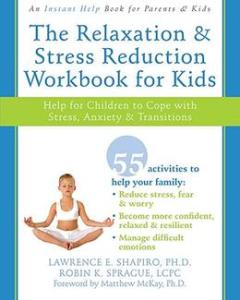 Although news gleaned from television, radio, or the Internet often is a positive educational experience for kids, problems can arise when the images presented are violent or the stories touch on disturbing topics. While we worry about our childrens’ exposure to violence and sexual content in movies, on the internet, and on tv, we need to remember that news programs shpw often live and real images and media from real events which are often distressing and increasingly graphic.
News about a natural disaster, such as the devastating earthquake in China or cyclone in Myanmar, could make kids worry that something similar is going to hit home, or fear a part of daily life — such as rain and thunderstorms — that they’d never worried about before.
Reports on natural disasters, child abductions, homicides, terrorist attacks, and school violence can teach kids to view the world as a confusing, threatening, or unfriendly place.
How can you deal with these disturbing stories and images? Talking to your kids about what they watch or hear will help them put frightening information into a reasonable context.
How Kids Perceive the News
Unlike movies or entertainment programs, news is real. But depending on a child’s age or maturity level, he or she may not yet understand the distinctions between fact and fantasy. By the time kids reach 7 or 8, however, what they see on TV can seem all too real. For some youngsters, the vividness of a sensational news story can be internalized and transformed into something that might happen to them. A child watching a news story about a bombing on a bus or a subway might worry, “Could I be next? Could that happen to me?”Natural disasters or
stories of other types of devastation can be personalized in the same manner. A child in Massachusetts who sees a house being swallowed by floods from a hurricane in Louisiana may spend a sleepless night worrying about whether his home will be OK in a rainstorm. A child in Chicago, seeing news about an attack on subways in London, might get scared about using public transportation around town. TV has the effect of shrinking the world and bringing it into our own living rooms.
By concentrating on violent stories, TV news also can promote a “mean-world” syndrome and give kids an inaccurate view of what the world and society are actually like.
Talking About the News
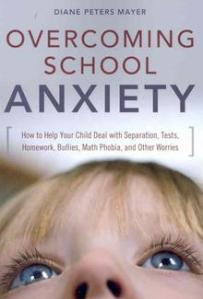
To calm children’s fears about the news, parents should be prepared to deliver what psychologists call “calm, unequivocal, but limited information.” This means delivering the truth, but only as much truth as a child needs to know. The key is to be as truthful yet as inexplicit as you can be. There’s no need to go into more details than your child is interested in. Although it’s true that some things — like a natural disaster — can’t be controlled, parents should still give kids space to share their fears. Encourage them to talk openly about what scares them.
Older kids are less likely to accept an explanation at face value. Their budding skepticism about the news and how it’s produced and sold might mask anxieties they have about the stories it covers. If older kids are bothered about a story, help them cope with these fears. An adult’s willingness to listen sends a powerful message.
Teens also can be encouraged to consider why a frightening or disturbing story was on the air: Was it to increase the program’s ratings because of its sensational value or because it was truly newsworthy? In this way, a scary story can be turned into a worthwhile discussion about the role and mission of the news.
Tips for Parents
Keeping an eye on kids’ TV news habits can go a long way toward monitoring the content of what they hear and see. Other tips:
- Recognize that news doesn’t have to be driven by disturbing pictures. Public TV programs, newspapers, or newsmagazines specifically designed for kids can be less sensational — and less upsetting — ways of getting information to children.
- Discuss current events with your child regularly. It’s important to help kids think through stories they hear about. Ask questions: What do you think about these events? How do you think these things happen? These questions can encourage conversation about non-news topics too.
- Put news stories in proper context. Showing that certain events are isolated or explaining how one event relates to another helps kids make better sense of what they hear. Broaden the discussion from a disturbing news item to a larger conversation: Use the story of a natural disaster as an opportunity to talk about philanthropy, cooperation, and the ability of people to cope with overwhelming hardship.
- Watch the news with your kids to filter inappropriate or frightening stories.
- Anticipate when guidance will be necessary and avoid shows that aren’t appropriate for your child’s age or level of development.
- If you’re uncomfortable with the content of the news or if it’s inappropriate for your child’s age, turn it off.
- Talk about what you can do to help. In the case of a news event like a natural disaster, kids may gain a sense of control and feel more secure if you find ways to help those who have been affected.
sourced from http://www.kidshealth.org
reviewed by: Mary L. Gavin, MD
School Related Issues: Guest apearance on 96.5 FM’s “Talking Life”
On Sunday 14th February I took part in a discussion on School related issues from preschool to Secondary school as a guest on Peter Jan etzki’s terrific “Talking Life” radio program on which I have been a regular guest over its nine year history. It was a great discussion with some interesting content and phone calls.

Peter Janetzki
A podcast of the entire show and recent shows can be found here or by clicking on the 96.5 logo.You can listen to the podcast from your browser or with iTunes, The show streams live every Sunday night from from 8-10pm Australian Eastern Standard Time (GMT+10) and you can listen by going to the 96.5 website @ 96five.com and clicking on the home page media player.
Talking to Your Child About What’s in The News
My experience is that many children, particularly those who have generalised anxiety can become quite distressed by exposure toseemingly innocuous exposure to events that are a part of everyday life.
Although news gleaned from television, radio, or the Internet often is a positive educational experience for kids, problems can arise when the images presented are violent or the stories touch on disturbing topics. While we worry about our childrens’ exposure to violence and sexual content in movies, on the internet, and on tv, we need to remember that news programs shpw often live and real images and media from real events which are often distressing and increasingly graphic.
News about a natural disaster, such as the devastating earthquake in China or cyclone in Myanmar, could make kids worry that something similar is going to hit home, or fear a part of daily life — such as rain and thunderstorms — that they’d never worried about before.
Reports on natural disasters, child abductions, homicides, terrorist attacks, and school violence can teach kids to view the world as a confusing, threatening, or unfriendly place.
How can you deal with these disturbing stories and images? Talking to your kids about what they watch or hear will help them put frightening information into a reasonable context.
How Kids Perceive the News
Unlike movies or entertainment programs, news is real. But depending on a child’s age or maturity level, he or she may not yet understand the distinctions between fact and fantasy. By the time kids reach 7 or 8, however, what they see on TV can seem all too real. For some youngsters, the vividness of a sensational news story can be internalized and transformed into something that might happen to them. A child watching a news story about a bombing on a bus or a subway might worry, “Could I be next? Could that happen to me?”Natural disasters or
stories of other types of devastation can be personalized in the same manner. A child in Massachusetts who sees a house being swallowed by floods from a hurricane in Louisiana may spend a sleepless night worrying about whether his home will be OK in a rainstorm. A child in Chicago, seeing news about an attack on subways in London, might get scared about using public transportation around town. TV has the effect of shrinking the world and bringing it into our own living rooms.
By concentrating on violent stories, TV news also can promote a “mean-world” syndrome and give kids an inaccurate view of what the world and society are actually like.
Talking About the News
To calm children’s fears about the news, parents should be prepared to deliver what psychologists call “calm, unequivocal, but limited information.” This means delivering the truth, but only as much truth as a child needs to know. The key is to be as truthful yet as inexplicit as you can be. There’s no need to go into more details than your child is interested in. Although it’s true that some things — like a natural disaster — can’t be controlled, parents should still give kids space to share their fears. Encourage them to talk openly about what scares them.
Older kids are less likely to accept an explanation at face value. Their budding skepticism about the news and how it’s produced and sold might mask anxieties they have about the stories it covers. If older kids are bothered about a story, help them cope with these fears. An adult’s willingness to listen sends a powerful message.
Teens also can be encouraged to consider why a frightening or disturbing story was on the air: Was it to increase the program’s ratings because of its sensational value or because it was truly newsworthy? In this way, a scary story can be turned into a worthwhile discussion about the role and mission of the news.
Tips for Parents
Keeping an eye on kids’ TV news habits can go a long way toward monitoring the content of what they hear and see. Other tips:
- Recognize that news doesn’t have to be driven by disturbing pictures. Public TV programs, newspapers, or newsmagazines specifically designed for kids can be less sensational — and less upsetting — ways of getting information to children.
- Discuss current events with your child regularly. It’s important to help kids think through stories they hear about. Ask questions: What do you think about these events? How do you think these things happen? These questions can encourage conversation about non-news topics too.
- Put news stories in proper context. Showing that certain events are isolated or explaining how one event relates to another helps kids make better sense of what they hear. Broaden the discussion from a disturbing news item to a larger conversation: Use the story of a natural disaster as an opportunity to talk about philanthropy, cooperation, and the ability of people to cope with overwhelming hardship.
- Watch the news with your kids to filter inappropriate or frightening stories.
- Anticipate when guidance will be necessary and avoid shows that aren’t appropriate for your child’s age or level of development.
- If you’re uncomfortable with the content of the news or if it’s inappropriate for your child’s age, turn it off.
- Talk about what you can do to help. In the case of a news event like a natural disaster, kids may gain a sense of control and feel more secure if you find ways to help those who have been affected.
sourced from kidshealth.org
reviewed by: Mary L. Gavin, MD
Related articles by Zemanta
- When headlines are rattling; How to talk to your children about bad news (bendbulletin.com)
About Peter
Peter Brown BHMS (Hons) MPsychClin MAPS
I’m a Clinical Psychologist and have a private practice and consultancy in Brisbane Australia. I have 24 years experience in child, adult and family clinical psychology. I have a wonderful wife and three kids.
I am co-founder of Christian Wholeness Counselling Services.
I like researching issues of the brain & mind, reading and seeking out new books and resources for myself and my clients. I thought that others might be interested in some of what I have found also, hence this blog…

Subscribe to My Blog Posts & Updates
-

Blog Surfer
Alphainventions


Recent Comments


 Peter H Brown Clinical Psychologist