Spank Now, Pay Later? Children Spanked At 3yrs More Likely To Be Aggressive At 5
 April 12, 2010 — Mums who spank their 3-year-olds may be increasing their children’s risk of aggressive behavior, such as bullying, by the time they turn 5, a study shows.
The study, published in the May issue of Pediatrics, adds to evidence suggesting that spanking and other types of corporal punishment set kids up for aggressive behaviors later in life.
“Children need guidance and discipline; however, parents should focus on positive, non-physical forms of discipline and avoid the use of spanking,” study researcher Catherine A. Taylor, PhD, an assistant professor of community health sciences at Tulane University School of Public Health and Tropical Medicine in New Orleans, tells WebMD in an email. “This message is consistent with that of the American Academy of Pediatrics, which ‘strongly opposes striking a child for any reason.'”
Taylor and colleagues asked about 2,500 mothers how often they had spanked their 3-year-old child in the past month. Nearly half of the moms said they had not spanked their child during the previous month, 27.9% said they spanked their 3-year-old once or twice within the last month, and 26.5% percent said they spanked their child more than twice in the past month.
The researchers also asked moms questions about their child’s aggressive behavior, such as whether they were bullies, cruel, mean, destructive, and/or prone to getting into fights with others at age 3 and again at age 5.
Although other studies have shown a link between spanking and aggressive behavior, the new study solidifies the connection because the researchers controlled for other maternal risk factors that might have explained the link, such as neglect, maternal use of drugs and alcohol, maternal stress and depression, and the physical or psychological maltreatment of the child.
“This study reinforces that any kind of violence or physical aggression in the home is another risk factor for kids being more aggressive in the future,” says Patricia Hametz, MD, director of the Injury and Violence Prevention Center and assistant clinical professor of pediatrics at Columbia University and director of the general pediatrics inpatient service at New York-Presbyterian Morgan Stanley Children’s Hospital in New York City.
Age-Appropriate Discipline
“The way you discipline depends on the age of the child, and pediatricians should give age-appropriate suggestions about how to discipline toddlers,” Hametz [says]. “Some people like time-outs, which remove a child from whatever it is that is overstimulating them.”
Another tactic is to reward good behavior. “Praising, pointing out, and literally rewarding good behavior is a better discipline strategy than punishing bad behavior after it happens,” she says.
Jennifer E. Lansford, PhD, a research scientist at the Duke University Center for Child and Family Policy in Durham, N.C., agrees. “These findings suggest that spanking has the unintended consequence of increasing children’s aggressive behavior, so the implication for parents would be that they should not use corporal punishment, but find other ways of managing their children’s misbehavior and promoting good behavior,” she says in an email.
This may include teaching about good and bad behavior and trying to prevent misbehavior rather than just reacting to it once it has occurred, she suggests. “Parents can use reward systems such as sticker charts, where a child earns a sticker or something else for good behavior, and special privileges such as extra time with mom or dad can be offered for completing the sticker chart.”s

Click image to read reviews
Click image to read reviews
Learning Aggressive Attitudes
The new findings make sense to child psychologist Vincent J. Barone, PhD, an associate professor of pediatrics at the University of Missouri-Kansas City School of Medicine and the director of Developmental and Behavioral Sciences South Clinic at Children’s Mercy Hospital and Clinics, also in Kansas City.
“The findings in this research are consistent with what we know about violent experiences for children. Whether a violent video game or corporal punishment, children learn aggressive attitudes and act them out when they are exposed to violence,” he says. “Children don’t learn peaceful ways of solving conflict when they are exposed to violence.”
Barone usually suggests that parents briefly describe the inappropriate behavior and then use a time-out.
Also, he suggests, “use your attention and passion to describe and praise positive behaviors such as cooperation, thoughtfulness, and respect for others.”
Sources
American Academy of Pediatrics

Related articles by Zemanta
- Spanking and Kids’ Aggression: 3 Alternatives to Spanking That Work for Parents and Kids (health.usnews.com)
- Study: Spanking Kids Leads to More Aggressive Behavior (time.com)
![Reblog this post [with Zemanta]](https://i0.wp.com/img.zemanta.com/reblog_e.png)
Teen Myths Busted: New Science Reveals That Common Assumptions Are Wrong
 A new book, The Teen Years Explained: A Guide to Healthy Adolescent Development, dispels many common myths about adolescence with the latest scientific findings on the physical, emotional, cognitive, sexual and spiritual development of teens. [Book is available for download through the Center of Adolescent Health website at Johns Hopkins Center for Adolescent Health (CURRENTLY FREE).] Authors Clea McNeely and Jayne Blanchard from the Center for Adolescent Health at the Johns Hopkins Bloomberg School of Public Health, provide useful tips and strategies for real-life situations and experiences from bullying, to nutrition and sexuality.
Created in partnership with an alliance of youth-serving professionals, The Teen Years Explained is science-based and accessible. The practical and colorful guide to healthy adolescent development is an essential resource for parents and all people who work with young people.
“Whether you have five minutes or five hours, you will find something useful in the guide,” said McNeely. “We want both adults and young people to understand the changes – what is happening and why – so everyone can enjoy this second decade of life.”
Popular Myths about Teenagers:
Myth: Teens are bigger risk-takers and thrill-seekers than adults. Fact: Teens perceive more risk than adults do in certain areas, such as the chance of getting into an accident if they drive with a drunk driver.
Myth: Young people only listen to their friends. Fact: Young people report that their parents or a caring adult are their greatest influence – especially when it comes to sexual behavior.
Myth: Adolescents live to push your buttons. Fact: Adolescents may view conflict as a way of expressing themselves, while adults take arguments personally.
Myth: When you’re a teenager, you can eat whatever you want and burn it off. Fact: Obesity rates have tripled for adolescents since 1980.
Myth: Teens don’t need sleep. Fact: Teens need as much sleep or more than they got as children – 9 to 10 hours is optimum.
Three years in the making, the guide came about initially at the request of two of the Center’s partners, the Maryland Mentoring Partnership and the Maryland Department of Health and Mental Hygiene, who felt there was a need in the community for an easily navigated and engaging look at adolescent development.
“Add The Teen Years Explained to the ‘must-read’ list,” said Karen Pittman, director of the Forum for Youth Investment. “In plain English, the book explains the science behind adolescent development and challenges and empowers adults to invest more attention and more time to young people.”

Click Image to read reviews
The Teen Years Explained: A Guide to Healthy Adolescent Development will be available for purchase on April 10 through Amazon.com. Electronic copies will also be available for download through the Center of Adolescent Health website atJohns Hopkins Center for Adolescent Health (CURRENTLY FREE).
The Center for Adolescent Health is a Prevention Research Center at the Bloomberg School of Public Health funded by the Centers for Disease Control and Prevention (CDC) that is committed to assisting urban youth in becoming healthy and productive adults. Together with community partners, the Center conducts research to identify the needs and strengths of young people, and evaluates and assists programs to promote their health and well-being. The Center’s mission is to work in partnership with youth, people who work with youth, public policymakers and program administrators to help urban adolescents develop healthy adult lifestyles.
Source:
Johns Hopkins University Bloomberg School of Public Health
Related articles by Zemanta
- Teenagers Are Programmed for Risk, Study Finds (nlm.nih.gov)
- The best way to guide your teenager through the high-risk years. (slate.com)
- The Kids Are Alright: Why Hooking Up Won’t Damage Our Youth [Fornication Nation] (jezebel.com)
Why Your Job Doesn’t Make You Happy
Information supplied by T he British Psychological Society
Read the original research paper here (PDF)
People who are unhappy in life are unlikely to find satisfaction at work. This is the finding of a study published online last thursday, 1st April 2010, in the Journal of Occupational and Organizational Psychology.
Assistant Professor Nathan Bowling of Wright State University, USA, and colleagues Kevin Eschleman and Qiang Wang undertook a meta-analysis on the results of 223 studies carried out between 1967 and 2008. All of the studies had investigated some combination of job satisfaction and life satisfaction (or subjective well-being).
Assistant Professor Nathan Bowling said: “We used studies that assessed these factors at two time points so that we could better understand the causal links between job satisfaction and life satisfaction. If people are satisfied at work, does this mean they will be more satisfied and happier in life overall? Or is the causal effect the opposite way around?”

Click image to read reviews
The causal link between subjective well-being and subsequent levels of job satisfaction was found to be stronger than the link between job satisfaction and subsequent levels of subjective well-being.
“These results suggest that if people are, or are predisposed to be, happy and satisfied in life generally, then they will be likely to be happy and satisfied in their work,” said Nathan Bowling.
“However, the flipside of this finding could be that those people who are dissatisfied generally and who seek happiness through their work, may not find job satisfaction. Nor might they increase their levels of overall happiness by pursuing it.”
Read the original research paper here (PDF)
Related articles by Zemanta
- Those Who Enjoy Life More Likely to Be Happy at Work (nlm.nih.gov)
Mid Life – What’s The Crisis?: Why Self Esteem Peaks In The Middle-Aged
Credit: LiveScience
Read the original research article HERE (PDF)
Bad vision and other physical ailmen ts aren’t the only things that seem to get worse as people grow old. Self-esteem also declines around the age of retirement, a new study finds.
The study involved 3,617 American men and women ranging in age from 25 to 104. Self-esteem was lowest among young adults, but increased throughout adulthood, peaking at age 60, before it started to decline.
Several factors might explain this trend, the researchers say.
“Midlife is a time of highly stable work, family and romantic relationships. People increasingly occupy positions of power and status, which might promote feelings of self-esteem,” said study author Richard Robins of the University of California, Davis. “In contrast, older adults may be experiencing a change in roles such as an empty nest, retirement and obsolete work skills in addition to declining health.”
Measuring self-esteem
The participants were surveyed four times between 1986 and 2002. They were asked to rate their level of agreement with statements such as: “I take a positive attitude toward myself,” which suggests high self-esteem; “At times I think I am no good at all,” and “All in all, I am inclined to feel that I am a failure,” which both suggest low self-esteem.
Subjects also indicated their demographics, relationship satisfaction, and whether they had experienced stressful life events, including suddenly losing a job, being the victim of a violent crime, or experiencing the death of a parent or child.
On average, women had lower self-esteem than men throughout most of adulthood, but self-esteem levels converged as men and women reached their 80s and 90s. Blacks and whites had similar self-esteem levels throughout young adulthood and middle age. In old age, average self-esteem among blacks dropped much more sharply than self-esteem among whites. This result held even after accounting for differences in income and health.
Future research should further explore these ethnic differences, which might lead to better interventions aimed at improving self-esteem, the study authors say.
Click on image to read reviews
More self-esteem factors
Education, income, health and employment status all had some effect on the self-esteem trajectories, especially as people aged.
“People who have higher incomes and better health in later life tend to maintain their self-esteem as they age,” Orth said.
“We cannot know for certain that more wealth and better health directly lead to higher self-esteem, but it does appear to be linked in some way. For example, it is possible that wealth and health are related to feeling more independent and better able to contribute to one’s family and society, which in turn bolsters self-esteem.”
People of all ages in satisfying and supportive relationships tend to have higher self-esteem, according to the findings.
However, despite maintaining higher self-esteem throughout their lives, people in happy relationships experienced the same drop in self-esteem during old age as people in unhappy relationships.
“Thus, being in a happy relationship does not protect a person against the decline in self-esteem that typically occurs in old age,” said study author Kali H. Trzesniewski of the University of Western Ontario.
With medical advances, the drop in self-esteem might occur later for baby boomers, Orth said. Boomers might be healthier for longer and, therefore, able to work and earn money longer.
Read the original research article HERE (PDF)
Related articles by Zemanta
- Self-Esteem And Self-Respect (andrewsullivan.theatlantic.com)
- Aging Health Strongly Affected by How You Feel About Aging (seniormemorysource.com)
- Parenting: Signs of Low Self-Esteem in Children (abcnews.go.com)
Exercise DOES Help Improve Mood! And Just 25 Minutes Worth Will Decrease Stress & Increase Energy
Having an Honors degree in Human Movement Studies and working in gyms in a former life while studying for my Clinical Masters degree, I have seen this to be true. Of course it seems self evident, but these researchers have used great science with an excellent and now research-proven written program and workbook. These, along with their recent meta-analytic research review, show just how effective exercise can be in improving mood.
 Credit: PhysOrg.com) — Exercise is a magic drug for many people with depression and anxiety disorders, according to researchers who analyzed numerous studies, and it should be more widely prescribed by mental health care providers.
“Exercise has been shown to have tremendous benefits for mental health,” says Jasper Smits, director of the Anxiety Research and Treatment Program at Southern Methodist University in Dallas. “The more therapists who are trained in exercise therapy, the better off patients will be.”
The traditional treatments of cognitive behavioral therapy and pharmacotherapy don’t reach everyone who needs them, says Smits, an associate professor of psychology.
“Exercise can fill the gap for people who can’t receive traditional therapies because of cost or lack of access, or who don’t want to because of the perceived social stigma associated with these treatments,” he says. “Exercise also can supplement traditional treatments, helping patients become more focused and engaged.”
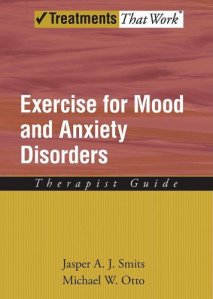
The Program used in the study is available from bookstores-Click Image to view description
Smits and Michael Otto, psychology professor at Boston University, presented their findings to researchers and mental health care providers March 6 at the Anxiety Disorder Association of America’s annual conference in Baltimore.
Their workshop was based on their therapist guide “Exercise for Mood and Anxiety Disorders,” with accompanying patient workbook (Oxford University Press, September 2009).
The guide draws on dozens of population-based studies, clinical studies and meta-analytic reviews that demonstrate the efficacy of exercise programs, including the authors’ meta-analysis of exercise interventions for mental health and study on reducing anxiety sensitivity with exercise.
“Individuals who exercise report fewer symptoms of anxiety and depression, and lower levels of stress and anger,” Smits says. “Exercise appears to affect, like an antidepressant, particular neurotransmitter systems in the brain, and it helps patients with depression re-establish positive behaviors. For patients with anxiety disorders, exercise reduces their fears of fear and related bodily sensations such as a racing heart and rapid breathing.”
After patients have passed a health assessment, Smits says, they should work up to the public health dose, which is 150 minutes a week of moderate-intensity activity or 75 minutes a week of vigorous-intensity activity.
At a time when 40 percent of Americans are sedentary, he says, mental health care providers can serve as their patients’ exercise guides and motivators.
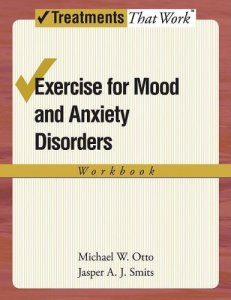
The patient workbook which accompanies the program - Click image to view description
“Rather than emphasize the long-term health benefits of an exercise program — which can be difficult to sustain — we urge providers to focus with their patients on the immediate benefits,” he says. “After just 25 minutes, your mood improves, you are less stressed, you have more energy — and you’ll be motivated to exercise again tomorrow. A bad mood is no longer a barrier to exercise; it is the very reason to exercise.”
Smits says health care providers who prescribe exercise also must give their patients the tools they need to succeed, such as the daily schedules, problem-solving strategies and goal-setting featured in his guide for therapists.
“Therapists can help their patients take specific, achievable steps,” he says. “This isn’t about working out five times a week for the next year. It’s about exercising for 20 or 30 minutes and feeling better today.”
Related articles by Zemanta
- Personal Health: Research Is Starting to Shed Light on Body Dysmorphic Disorder (nytimes.com)
- Music Soothes Anxiety as Well as Massage Does (nlm.nih.gov)
Martin Seligman: Author Of “Learned Optimism” Speaks About Positive Psychology And Authentic Happiness
Martin Seligman was originally best known for his classic psychology studies and theory of “Learned Helplessness” (1967) and it’s relationship to depression.
These days he is considered to be a founder of positive psychology, a field of study that examines healthy states, such as authentic happiness, strength of character and optimism, and is the author of “Learned Optimism”.
This is a terrific talk on Positive Psychology and what it means to be happy. It’s about 20 mins. long but definitely worth a watch!
You Can Trust Me More Than You Can Trust Them: Cynicism & The Trust Gap
Read the original research paper HERE (PDF)
Credit: Jeremy Dean from Psyblog
How do people come to believe that others are so much less trustworthy than themselves?
Much as we might prefer otherwise, there’s solid evidence that, on average, people are quite cynical. When thinking about strangers, studies have shown that people think others are more selfishly motivated than they really are and that others are less helpful than they really are.
 Similarly in financial games psychologists have run in the lab, people are remarkably cynical about the trustworthiness of others. In one experiment people honored the trust placed in them between 80 and 90 percent of the time, but only estimated that others would honor their trust about 50 percent of the time.
Our cynicism towards strangers may develop as early as 7 years old (Mills & Keil, 2005). Surprisingly people are even overly cynical about their loved ones, assuming they will behave more selfishly than they really do (Kruger & Gilovich, 1999).
What could create such a huge gap between how people behave themselves and how they think others behave?
Trust me
People often say that it’s experience that breeds this cynicism rather than a failing in human nature. This is true, but only in a special way.
Think about it like this: the first time you trust a stranger and are betrayed, it makes sense to avoid trusting other strangers in the future. The problem is that when we don’t ever trust strangers, we never find out how trustworthy people in general really are. As a result our estimation of them is governed by fear.
If this argument is correct, it is lack of experience that leads to people’s cynicism, specifically not enough positive experiences of trusting strangers. This idea is tested in a new study published in Psychological Science. Fetchenhauer and Dunning (2010) set up a kind of ideal world in the lab where people were given accurate information about the trustworthiness of strangers to see if that would reduce their cynicism.
They recruited 120 participants to take part in a game of economic trust. Each person was given €7.50 and asked if they’d like to hand it to another person. If the other person made the same decision the pot would increase to €30. They were then asked to estimate whether the other person would opt to give them their half of the total winnings.

Click image to read reviews
The participants watched 56 short videos of the people they were playing against. The researchers set up two experimental conditions, one to mimic what happens in the real world and one to test an ideal world scenario:
1. Real life condition: in this group participants were only told about the other person’s decision when they decided to trust them. The idea is that this condition simulates real life. You only find out if others are trustworthy when you decide to trust them. If you don’t trust someone you never find out whether or not they are trustworthy.
2. Ideal world condition: here participants were given feedback about the trustworthiness of other people whether or not they decided to trust them. This simulates an ideal-world condition where we all know from experience just how trustworthy people are (i.e. much more trustworthy than we think!)
Breaking down cynicism
Once again this study showed that people are remarkably cynical about strangers. Participants in this study thought that only 52 percent of the people they saw in the videos could be trusted to share their winnings. But the actual level of trustworthiness was a solid 80 percent. There’s the cynicism.
That cynicism was quickly broken down, though, by giving participants accurate feedback about others’ trustworthiness. People in the ideal world condition noticed that others could be trusted (they upped their estimate to 71 percent) and were also more trusting themselves, handing over the money 70.1 percent of the time.
People in the ideal world condition could even be seen shedding their cynicism as the study went on, becoming more trusting as they noticed that others were trustworthy. This suggests people aren’t inherently cynical, it’s just that we don’t get enough practice at trusting.
Self-fulfilling prophecy
Unfortunately we don’t live in the ideal world condition and have to put up with only receiving feedback when we decide to trust others. This leaves us in the position of trusting to psychology studies like this one to tell us that other people are more trustworthy than we imagine (or at least people who take part in psychology studies are!).
Trusting others is also a kind of self-fulfilling prophecy, just as we find in interpersonal attraction. If you try trusting others you’ll find they frequently repay that trust, leading you to be more trusting. On the other hand if you never trust anyone, except those nearest and dearest, then you’ll end up more cynical about strangers.
Visit Psyblog
Read the original research paper HERE (PDF)
Pack Up Your Troubles And (Apparently) Smile: Physical Enclosure Helps Psychological Closure
Read the original research paper HERE (Free PDF-internal link)
ScienceDaily (Mar. 25, 2010) — Finding it hard to get over a failed love interest? Just can’t get details of a bad financial move out of your head.
A new study from the Rotman School of Management suggests you might want to stick something related to your disappointment in a box or envelope if you want to feel better. In four separate experiments researchers found that the physical act of enclosing materials related to an unpleasant experience, such as a written recollection about it, improved people’s negative feelings towards the event and created psychological closure. Enclosing materials unrelated to the experience did not work as well.

Click image to read reviews
“If you tell people, ‘You’ve got to move on,’ that doesn’t work,” said Dilip Soman, who holds the Corus Chair in Communication Strategy at the Rotman School and is also a professor of marketing, who co-wrote the paper with colleagues Xiuping Li from the National University of Singapore and Liyuan Wei from City University of Hong Kong. “What works is when people enclose materials that are relevant to the negative memories they have. It works because people aren’t trying to explicitly control their emotions.”
While the market implications might not be immediately obvious, Prof. Soman believes the findings point to new angles on such things as fast pick-up courier services and pre-paid mortgage deals that relieve people’s sense of debt burden. If people realize that the memory of past events or tasks can be distracting, perhaps there is a market for products and services that can enclose or take away memories of that task.
The paper is to be published in Psychological Science.
Read the original research paper HERE (Free PDF-internal link)
Online ‘Cold Shoulder’ Shown To Effect Kids Self-Esteem
Read the original Research Paper HERE (Free PDF-internal link)
From ScienceDaily (Mar. 22, 2010) — Research by psychologists at the University of Kent has revealed that online ostracism is a threat to children’s self-esteem.
The study, the results of which are published March 22 in the British Journal of Developmental Psychology, looked at how children, adolescents and adults react to being ostracised by other players during an online computer game. This is the first time the effect of online ostracism on children has been investigated.
The study was carried out by a team at the University’s Centre for the Study of Group Processes and was led by Professor Dominic Abrams. Professor Abrams explained that research into cyber-bullying usually focuses on direct abuse and insults. ‘However, a more indirect and perhaps common form of bullying is ostracism — when people are purposefully ignored by others,’ he said. Professor Abrams also explained that ‘online ostracism affects adults by threatening their basic needs for self-esteem, sense of belonging, sense of meaning and sense of control. We wanted to discover whether children and adolescents have similar reactions.’
Click image to read reviews
Three groups of participants took part in the study: 41 eight and nine-year-old children, 79 thirteen and fourteen-year-olds and 46 twenty-year-old adults. All were asked to play a game of online ‘cyberball’ in which three online players — depicted on screen by their names — passed a ball to one another. In games where the participant was included, they threw and received the ball four times within the trial. However, in a game when they were ostracised they received the ball only twice at the start, and then the other two players continued to play only passing the ball between themselves.
After each game participants’ basic needs were assessed, as well as how much they had enjoyed the game.
Professor Abrams said: ‘For all age groups, online ostracism substantially threatened the four basic needs — esteem, belonging, meaning and control — and also lowered their mood, showing that social exclusion online is very powerful even among children.’
However, there were also differences between the three age groups in their responses to cyber-ostracism. Ostracism affected the self-esteem of the eight and nine-year-old children more than the other groups. This suggests that the adolescents and adults have developed better buffers against threats to self-esteem.
Among the thirteen to fourteen-year-olds ostracism had the largest effect on feelings of belonging, strongly suggesting that adolescents may place a higher value on inclusion in peer networks than do children or adults.
The good news is that the negative reactions were cancelled out when children were included in a later game. Professor Abrams added: ‘Whereas adults might be quite skilled at finding a relationship in which to be included after having been ostracised, it could be a bigger challenge for children. This suggests that parents and schools need to be vigilant in case children in their care are experiencing sustained ostracism.
Read the original Research Paper HERE (Free PDF-internal link)
//
Game On: The Decline of Backyard Play

Click Image to View Reviews
I found this post from Peter G. Stromberg @ Psychology Today. It really got me thinking about kids and the pressure that we may put on them as parents…What do you think?
A few weeks ago I flew to Denver with my younger daughter so that she could participate in a volleyball tournament; she has been travelling to tournaments for the last two years but this is the first time we had to fly. My daughter is 11 years old.
Shouldn’t my daughter be riding her bike around the neighborhood and jumping rope with her friends? Why is she, at age 11, playing on a team coached by a former Olympic-level athlete and competing against nationally-ranked teams based thousands of miles from our home? There is research to suggest that unstructured play and basic movement activities (running, jumping, balancing) are more beneficial for children of her age than specialized training in one particular sport. Why in the world should an 11 year old child be in year-round volleyball training? Well, let me explain.
I would guess that many readers who are older than 30 will share my own experience: at my daughter’s age and into my early teens, I spent every possible minute getting into pick-up games of basketball and football with my friends or just roaming around outside. This approach didn’t produce a skilled athlete, but it sure was fun (and cheap). Today, in most areas of the country, such activities are simply less available. One reason my daughter doesn’t head down to the park to play with her friends is that they aren’t there-they are at soccer practice, or piano lessons, or having pre-arranged play dates.
There has been a recent and enormous shift in the way children play in our society, away from unstructured outside play and towards organized competition under adult supervision. Why? One reason that will come quickly to mind is stranger danger. Many parents (including me, by the way) now believe it is unsafe for children-perhaps particularly girls-to be outside without adult supervision. Although neighborhoods vary, statistics that I have seen on this issue do not support the belief that in general accidents or attacks on children are more frequent now than, say, 30 years ago. It seems more likely that what has changed is extensive news coverage of issues such as attacks on children, which often fosters the belief that such events are frequent.
In short, actual danger from strangers is probably not the real reason for the decline in outside play. Well, how about this? Public funding for playgrounds, parks, and recreation centers has been declining since the 1980s. There aren’t as many places to go for public play anymore, and the ones that persist are likely not as well-maintained.
That’s relevant, but it still isn’t really at the heart of why my daughter plays highly competitive volleyball at such a young age. The fact is that if she doesn’t play now and decides to take up the sport at 14 or 15, the train will have left the station. Unless a child has extraordinary athletic gifts, she will be so far behind by that age that she will not be able to find a place on a team. It isn’t only that opportunities for unstructured public play have declined, it’s that opportunities for highly competitive play have expanded to such an extent that in some sports that is all that exists. There are simply no possibilities in my part of the country for recreational volleyball for children 10-18. And the situation is similar for many other sports as well: our focus on producing highly competitive teams with highly skilled participants leads to a lack of focus on producing opportunities for children who simply want to play a sport casually.
This, I think, gets us close to probably the most important reason that highly competitive sport for the few has begun to replace recreational sport for the many among children today. We as a society don’t care about recreational sport for the many. The logic of entertainment has come to control youth sports. Parents, kids, and the society as a whole are excited by the possibility of championships, cheering spectators, and (for the really elite) media coverage. And we aren’t really excited by our children playing disorganized touch football until they have to come in for dinner. What’s the point of that? Nobody is watching.
This isn’t anyone’s fault, it’s just the way our society works. I really wish my kids could play pick up games and intramurals the way their not-so-athletically-talented dad did. But the intramurals and pick up games are far fewer now. Strangely enough, childhood obesity rates have skyrocketed as they have faded. Or maybe that’s not strange at all.
This post reflects on issues I have been thinking about for years, but it is also heavily influenced by a recent book called Game On by ESPN writer Tom Farrey. To learn more about play in general, visit my website
from Peter G. Stromberg @ Psychology Today
About Peter
Peter Brown BHMS (Hons) MPsychClin MAPS
I’m a Clinical Psychologist and have a private practice and consultancy in Brisbane Australia. I have 24 years experience in child, adult and family clinical psychology. I have a wonderful wife and three kids.
I am co-founder of Christian Wholeness Counselling Services.
I like researching issues of the brain & mind, reading and seeking out new books and resources for myself and my clients. I thought that others might be interested in some of what I have found also, hence this blog…

Subscribe to My Blog Posts & Updates
-

Blog Surfer
Alphainventions


Recent Comments


 Peter H Brown Clinical Psychologist