Ripped Off!: The Psychological Cost Of Wearing A Fake Rolex (Or Other Knockoffs)
Credit: Wray Herbert: The Huffington Post April 7 2010:
Read the original research paper HERE (PDF)
 Within just a few blocks of my office, street vendors will sell me a Versace t-shirt or a silk tie from Prada, cheap. Or I could get a deal on a Rolex, or a chic pair of Ray Ban shades. These aren’t authentic brand name products, of course. They’re inexpensive replicas. But they make me look and feel good, and I doubt any of my friends can tell the difference.
That’s why we buy knockoffs, isn’t it? To polish our self-image–and broadcast that polished version of our personality to the world–at half the price? But does it work? After all, we first have to convince ourselves of our idealized image if we are going to sway anyone else. Can we really become Ray Ban-wearing, Versace-bedecked sophisticates in our own mind–just by dressing up?
New research suggests that knockoffs may not work as magically as we’d like–and indeed may backfire. Three psychological scientists–Francesca Gino of Chapel Hill, Michael Norton of Harvard Business School, and Dan Ariely of Duke–have been exploring the power and pitfalls of fake adornment in the lab. They wanted to see if counterfeit stuff might have hidden psychological costs, warping our actions and attitudes in undesirable ways.
Here’s an example of their work. The scientists recruited a large sample of young women and had them wear pricey Chloe sunglasses. The glasses were the real thing, but half the women thought they were wearing knockoffs. They wanted to see if wearing counterfeit shades–a form of dishonesty–might actually make the women act dishonestly in other ways.
So they had them perform a couple tasks–tasks that presented opportunities for lying and cheating. In one, for example, the women worked on a complicated set of mathematical puzzles–a task they couldn’t possibly complete in the time allowed. When time elapsed, the women were told to score themselves on the honor system–and to take money for each correct score. Unbeknownst to them, the scientists were monitoring both their work and their scoring.
And guess what. The women wearing the fake Chloe shades cheated more–considerably more. Fully 70 percent inflated their performance when they thought nobody was checking on them–and in effect stole cash from the coffer. To double-check this distressing result, the scientists put the women through a completely different task, one that forced a choice between the right answer and the more profitable answer. And again the Chloe-wearing women pocketed the petty cash. Notably, the women cheated not only when they expressed a preference for the cheap knockoffs, but also when the real and fake designer glasses were randomly handed out. So it appears that the very act of wearing the counterfeit eyewear triggered the lying and cheating.

Click image to read reviews
This is bizarre and disturbing, but it gets worse. The psychologists wondered if inauthentic image-making might not only corrupt personal ethics, but also lead to a generally cynical attitude toward other people. In other words, if wearing counterfeit stuff makes people feel inauthentic and behave unethically, might they see others as phony and unethical, too? To test this, they again handed out genuine and counterfeit Chloe shades, but this time they had the volunteers complete a survey about “someone they knew.” Would this person use an express line with too many groceries? Pad an expense report? Take home office supplies? There were also more elaborate scenarios involving business ethics. The idea was that all the answers taken together would characterize each volunteer as having a generally positive view of others–or a generally cynical view.
Cynical, without question. Compared to volunteers who were wearing authentic Chloe glasses, those wearing the knockoffs saw other people as more dishonest, less truthful, and more likely to act unethically in business dealings.
So what’s going on here? Well, the scientists ran a final experiment to answer this question, and here are the ironic results they report on-line this week in the journal Psychological Science: Wearing counterfeit glasses not only fails to bolster our ego and self-image the way we hope, it actually undermines our internal sense of authenticity. “Faking it” makes us feel like phonies and cheaters on the inside, and this alienated, counterfeit “self” leads to cheating and cynicism in the real world.
Counterfeiting is a serious economic and social problem, epidemic in scale. Most people buy these fake brands because they are a lot cheaper, but this research suggests there may be a hidden moral cost yet to be tallied.
Read the original research paper HERE (PDF)

Related articles by Zemanta
- The Most Counterfeited Products (images.businessweek.com)
- A Question of Authenticity and Designer Sunglasses (outspokenmedia.com)
![Reblog this post [with Zemanta]](https://i0.wp.com/img.zemanta.com/reblog_e.png)
Mid Life – What’s The Crisis?: Why Self Esteem Peaks In The Middle-Aged
Credit: LiveScience
Read the original research article HERE (PDF)
Bad vision and other physical ailmen ts aren’t the only things that seem to get worse as people grow old. Self-esteem also declines around the age of retirement, a new study finds.
The study involved 3,617 American men and women ranging in age from 25 to 104. Self-esteem was lowest among young adults, but increased throughout adulthood, peaking at age 60, before it started to decline.
Several factors might explain this trend, the researchers say.
“Midlife is a time of highly stable work, family and romantic relationships. People increasingly occupy positions of power and status, which might promote feelings of self-esteem,” said study author Richard Robins of the University of California, Davis. “In contrast, older adults may be experiencing a change in roles such as an empty nest, retirement and obsolete work skills in addition to declining health.”
Measuring self-esteem
The participants were surveyed four times between 1986 and 2002. They were asked to rate their level of agreement with statements such as: “I take a positive attitude toward myself,” which suggests high self-esteem; “At times I think I am no good at all,” and “All in all, I am inclined to feel that I am a failure,” which both suggest low self-esteem.
Subjects also indicated their demographics, relationship satisfaction, and whether they had experienced stressful life events, including suddenly losing a job, being the victim of a violent crime, or experiencing the death of a parent or child.
On average, women had lower self-esteem than men throughout most of adulthood, but self-esteem levels converged as men and women reached their 80s and 90s. Blacks and whites had similar self-esteem levels throughout young adulthood and middle age. In old age, average self-esteem among blacks dropped much more sharply than self-esteem among whites. This result held even after accounting for differences in income and health.
Future research should further explore these ethnic differences, which might lead to better interventions aimed at improving self-esteem, the study authors say.
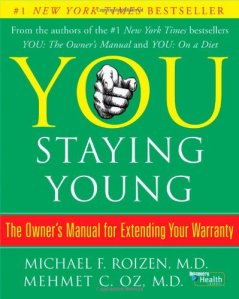
Click on image to read reviews
More self-esteem factors
Education, income, health and employment status all had some effect on the self-esteem trajectories, especially as people aged.
“People who have higher incomes and better health in later life tend to maintain their self-esteem as they age,” Orth said.
“We cannot know for certain that more wealth and better health directly lead to higher self-esteem, but it does appear to be linked in some way. For example, it is possible that wealth and health are related to feeling more independent and better able to contribute to one’s family and society, which in turn bolsters self-esteem.”
People of all ages in satisfying and supportive relationships tend to have higher self-esteem, according to the findings.
However, despite maintaining higher self-esteem throughout their lives, people in happy relationships experienced the same drop in self-esteem during old age as people in unhappy relationships.
“Thus, being in a happy relationship does not protect a person against the decline in self-esteem that typically occurs in old age,” said study author Kali H. Trzesniewski of the University of Western Ontario.
With medical advances, the drop in self-esteem might occur later for baby boomers, Orth said. Boomers might be healthier for longer and, therefore, able to work and earn money longer.
Read the original research article HERE (PDF)
Related articles by Zemanta
- Self-Esteem And Self-Respect (andrewsullivan.theatlantic.com)
- Aging Health Strongly Affected by How You Feel About Aging (seniormemorysource.com)
- Parenting: Signs of Low Self-Esteem in Children (abcnews.go.com)
Exercise DOES Help Improve Mood! And Just 25 Minutes Worth Will Decrease Stress & Increase Energy
Having an Honors degree in Human Movement Studies and working in gyms in a former life while studying for my Clinical Masters degree, I have seen this to be true. Of course it seems self evident, but these researchers have used great science with an excellent and now research-proven written program and workbook. These, along with their recent meta-analytic research review, show just how effective exercise can be in improving mood.
 Credit: PhysOrg.com) — Exercise is a magic drug for many people with depression and anxiety disorders, according to researchers who analyzed numerous studies, and it should be more widely prescribed by mental health care providers.
“Exercise has been shown to have tremendous benefits for mental health,” says Jasper Smits, director of the Anxiety Research and Treatment Program at Southern Methodist University in Dallas. “The more therapists who are trained in exercise therapy, the better off patients will be.”
The traditional treatments of cognitive behavioral therapy and pharmacotherapy don’t reach everyone who needs them, says Smits, an associate professor of psychology.
“Exercise can fill the gap for people who can’t receive traditional therapies because of cost or lack of access, or who don’t want to because of the perceived social stigma associated with these treatments,” he says. “Exercise also can supplement traditional treatments, helping patients become more focused and engaged.”
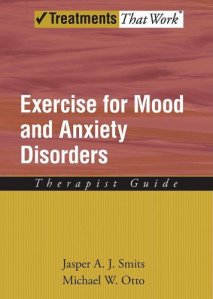
The Program used in the study is available from bookstores-Click Image to view description
Smits and Michael Otto, psychology professor at Boston University, presented their findings to researchers and mental health care providers March 6 at the Anxiety Disorder Association of America’s annual conference in Baltimore.
Their workshop was based on their therapist guide “Exercise for Mood and Anxiety Disorders,” with accompanying patient workbook (Oxford University Press, September 2009).
The guide draws on dozens of population-based studies, clinical studies and meta-analytic reviews that demonstrate the efficacy of exercise programs, including the authors’ meta-analysis of exercise interventions for mental health and study on reducing anxiety sensitivity with exercise.
“Individuals who exercise report fewer symptoms of anxiety and depression, and lower levels of stress and anger,” Smits says. “Exercise appears to affect, like an antidepressant, particular neurotransmitter systems in the brain, and it helps patients with depression re-establish positive behaviors. For patients with anxiety disorders, exercise reduces their fears of fear and related bodily sensations such as a racing heart and rapid breathing.”
After patients have passed a health assessment, Smits says, they should work up to the public health dose, which is 150 minutes a week of moderate-intensity activity or 75 minutes a week of vigorous-intensity activity.
At a time when 40 percent of Americans are sedentary, he says, mental health care providers can serve as their patients’ exercise guides and motivators.
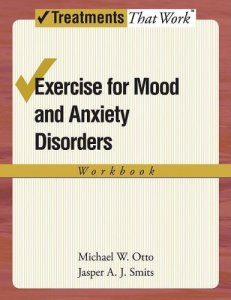
The patient workbook which accompanies the program - Click image to view description
“Rather than emphasize the long-term health benefits of an exercise program — which can be difficult to sustain — we urge providers to focus with their patients on the immediate benefits,” he says. “After just 25 minutes, your mood improves, you are less stressed, you have more energy — and you’ll be motivated to exercise again tomorrow. A bad mood is no longer a barrier to exercise; it is the very reason to exercise.”
Smits says health care providers who prescribe exercise also must give their patients the tools they need to succeed, such as the daily schedules, problem-solving strategies and goal-setting featured in his guide for therapists.
“Therapists can help their patients take specific, achievable steps,” he says. “This isn’t about working out five times a week for the next year. It’s about exercising for 20 or 30 minutes and feeling better today.”
Related articles by Zemanta
- Personal Health: Research Is Starting to Shed Light on Body Dysmorphic Disorder (nytimes.com)
- Music Soothes Anxiety as Well as Massage Does (nlm.nih.gov)
Asperger’s Syndrome on “Arthur”
Here’s a different look at Asperger’s as explained by Brain on the kids show Arthur!
Related articles by Zemanta
- ARTHUR Explores Asperger’s Syndrome in a New Episode on Monday (susanheim.blogspot.com)
- The New Autism Spectrum Disorder (NASD) in the DSM-5: Autism Minus Intellectual Disability (autisminnb.blogspot.com)
- “Parenthood”: Sex, Drugs, & Asperger’s (blisstree.com)
The Real “Rain Man”: A Fascinating Look At Kim Peek

Kim Peek 1951-2009 Image via Wikipedia
Kim Peek was the inspiration for the movie Rain Man starring Dustin Hoffman and Tom Cruise. Peek, who passed away last year at the age of 58, lived with his father Fran. Peek suffered from a brain development disorder known as agenesis of the corpus collosum. Malformation and absence of the corpus callosum are rare developmental disorders that result in a wide spectrum of symptoms, ranging from severe cerebral palsy, epilepsy and autism to relatively mild learning problems.
While Kim was able to perform extraordinary mental feats, particularly related to memory of historical facts, he struggled with many of the day to day tasks of life. This is a fascinating short video of Kim’s visit to London and his explanation of his condition. Enjoy!Vodpod videos no longer available.

click image to read reviews
click image to read reviews
Related articles by Zemanta
- Man Who Inspired ‘Rain Man’ Dies At 58 (npr.org)
- “I have so many things in me that you can’t even guess them all.” – Kim Peek. (althouse.blogspot.com)
Binge Eating: A 12 Week Self-Guided Program Gets Great Results
Kaiser Permanente Center for Health Research, Press Release
Short-Term Program  for Binge Eaters Using “Overcoming Binge Eating” by Dr. Christopher Fairburn Has Long-Term Benefits
PORTLAND, Ore. — A new study finds that a self-guided, 12-week program helps binge eaters stop binging for up to a year and the program can also save money for those who participate. Recurrent binge eating is the most common eating disorder in the country, affecting more than three percent of the population, or nine million people, yet few treatment options are available.
But a first-of-a-kind study conducted by researchers at the Kaiser Permanente Center for Health Research, Wesleyan University and Rutgers University found that more than 63 percent of participants had stopped binging at the end of the program — compared to just over 28 percent of those who did not participate. The program lasted only 12 weeks, but most of the participants were still binge free a year later. A second study, also published in the April issue of the Journal of Consulting and Clinical Psychology, found that program participants saved money because they spent less on things like dietary supplements and weight loss programs.
“It is unusual to find a program like this that works well, and also saves the patient money. It’s a win-win for everyone,” said study author Frances Lynch, PhD, MSPH, a health economist at the Kaiser Permanente Center for Health Research. “This type of program is something that all health care systems should consider implementing.”
“People who binge eat more than other people do during a short period of time and they lose control of their eating during these episodes. Binge eating is often accompanied by depression, shame, weight gain, loss of self-esteem and it costs the health care system millions of extra dollars,” said the study’s principal investigator Ruth H. Striegel-Moore, PhD, a professor of psychology at Wesleyan University. “Our studies show that recurrent binge eating can be successfully treated with a brief, easily administered program, and that’s great news for patients and their providers.”
Binge eating has received a lot of media attention recently because the American Psychiatric Association is recommending that it be considered a separate, distinct eating disorder like bulimia and anorexia. This new diagnosis can be expected to focus more attention on binge eating and how best to treat it, according to the researchers. It also could influence the number of people diagnosed and how insurers will cover treatment.
This randomized controlled trial, conducted in 2004–2005, involved 123 members of the Kaiser Permanente health plan in Oregon and southwest Washington. More than 90 percent of them were women, and the average age was 37. To be included in the study, participants had to have at least one binge eating episode a week during the previous three months with no gaps of two or more weeks between episodes.
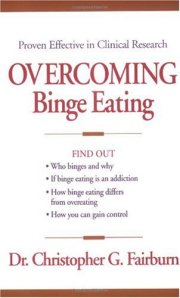
Click image to read reviews: Book helps achieve results in this research study
Half of the participants were enrolled in the intervention and asked to read the book “Overcoming Binge Eating” by Dr. Christopher Fairburn, a professor of psychiatry and expert on eating disorders. The book details scientific information about binge eating and then outlines a six-step self-help program using self-monitoring, self-control and problem-solving strategies. Participants in the study attended eight therapy sessions over the course of 12 weeks in which counselors explained the rationale for cognitive behavioral therapy and helped participants apply the strategies in the book. The first session lasted one hour, and subsequent sessions were 20–25 minutes. The average cost of the intervention was $167 per patient.
All participants were mailed fliers detailing the health plan’s offerings for healthy living and eating and encouraged to contact their primary care physician to learn about more services.
By the end of the 12-week program 63.5 percent of participants had stopped binging, compared to 28.3 percent of those who did not participate. Six months later, 74.5 percent of program participants abstained from binging, compared to 44.1 percent in usual care. At one year, 64.2 percent of participants were binge free, compared to 44.6 percent of those in usual care.
Everyone in the trial was asked to provide extensive information about their binge eating episodes, how often they missed work or were less productive at work, and the amount they spent on health care, weight-loss programs and weight loss supplements. Researchers also examined expenditures on medications, doctor visits, and other health-related services.
The researchers then compared these costs between the two groups and found that average total costs were $447 less in the intervention group. This included an average savings of $149 for the participants, who spent less on weight loss programs, over-the-counter medications and supplements. Total costs for the intervention group were $3,670 per person per year, and costs for the control group were $4,098.
“While program results are promising, we highly encourage anyone who has problems with binge eating to consult with their doctors to make sure this program is right for them,” said study co-author Lynn DeBar, PhD, clinical psychologist at the Kaiser Permanente Center for Health Research.
Study authors include: Lynn DeBar, John F. Dickerson, Frances Lynch and Nancy Perrin from the Kaiser Permanente Center for Health Research in Portland, Oregon; Ruth H. Striegel-Moore and Francine Rosselli from Wesleyan University; G. Terence Wilson from Rutgers, The State University of New Jersey; and Helena C. Kraemer from the Stanford University School of Medicine.
Intimacy & Desire: David Schnarch On Sex After Marriage

Dr David Schnarch
I have just found this video which includes a rare interview with Dr David Schnarch, author of “Passionate Marriage”, “Resurrecting Sex” & his latest book released in October 2009 “Intimacy & Desire”. Anyone who knows me well knows I am an advocate of Schnarch’s personal development approach to improving intimate relationships. For more information on my personal experiences with Schnarch and his unique contributions to this field read THIS POST.
Here are Schnarch’s online self evaluation surveys and statistics for the health of your sexual relationship and personal intimacy style. If you’re having issues (like 70% of couples in committed relationships) and have tried and failed to spark things up again, please watch this interview, read one of Schnarch’s books and check out his website for online resources. It will be worth your time and money.
Related articles by Zemanta
- Jim Selman: 7 Reasons Why Sex Is Better After 60 (huffingtonpost.com)
- Would You Ever Fight Your Romantic Battles on Facebook? (marieclaire.com)
Martin Seligman: Author Of “Learned Optimism” Speaks About Positive Psychology And Authentic Happiness
Martin Seligman was originally best known for his classic psychology studies and theory of “Learned Helplessness” (1967) and it’s relationship to depression.
These days he is considered to be a founder of positive psychology, a field of study that examines healthy states, such as authentic happiness, strength of character and optimism, and is the author of “Learned Optimism”.
This is a terrific talk on Positive Psychology and what it means to be happy. It’s about 20 mins. long but definitely worth a watch!
Self Help For Anxiety & Depression: A List Of FREE Interactive Self Help Websites
Today I wanted to get around to doing what I have been meaning to do for a while and post a list of free access interactive and/or educational websites which I have come across. These sites are fantastic resources and each one offers a different way to get involved with your recovery. Please note I am not affiliated with any of these sites and they are not affiliate sites. I hope you find one or more useful as I know many of my clients have.
Click Image to Read Reviews
Click Image to Read Reviews
Self Help / Educational Websites
Updated 27th March 2010
- Anxiety Online
- Beyond Blue
- Depnet
- Bipolar Disorder Education Program
- Blackdoginstitute
- BlueBoard
- BluePages
- CRUfAD – Self Help
- Depression Education Program
- e-couch
- Feardrop – online exposure therapy for phobias
- Living Well Working Well
- MoodSwings
- Multicultural Information on Depression online (MIDonline)
- Virtual Clinic
- Added 27th March 2010
- Depressioncenter.net
- Beatingtheblues (UK)
There you have it! Check them out and let me know what you think. Know of any others? (No affiliate sites please).
Youth Today: The “Me” Generation Or More Of The Same?
Read the original research paper HERE (Free PDF)
Today’s youth are generally not the self-centered, antisocial slackers that previous research has made them out to be, according to a provocative new study co-authored by a Michigan State University psychologist.
In a scientific analysis of nearly a half-million high-school seniors spread over three decades, MSU’s Brent Donnellan and Kali Trzesniewski of the University of Western Ontario argue teens today are no more egotistical – and just as happy and satisfied – as previous generations.
 “We concluded that, more often than not, kids these days are about the same as they were back in the mid-1970s,” said Donnellan, associate professor of psychology.
The study appears in the research journal Perspectives on Psychological Science. Donnellan acknowledges that many people will be surprised by the findings, which refute previous studies classifying today’s youth as selfish loafers with extremely high levels of self-esteem.
But while much previous research has relied on “convenience studies” of relatively small samples of young adults, Donnellan said, the current study analyzes the psychological profile data of 477,380 high school seniors from 1976 to 2006. The data comes from the University of Michigan’s federally funded Monitoring the Future survey, which each year tracks the behaviors, attitudes and values of American students.
In other findings:
* Today’s youth are more cynical and less trusting of institutions than previous generations. But Donnellan said this is generally true of the broader population.
* The current generation is less fearful of social problems such as race relations, hunger, poverty and energy shortages.
* Today’s youth have higher educational expectations.
Ultimately, Donnellan said, it’s common for older generations to paint youth in a negative light – as lazy and self-absorbed, for example – which can perpetuate stereotypes. It can be easy, he added, to forget what it’s like to grow up.
“Kids today are like they were 30 years ago – they’re trying to find their place in the world, they’re trying to carve out an identity, and it can be difficult,” Donnellan said. “But lots of research shows that the stereotypes of all groups are much more overdrawn than the reality.”
Read the original research paper HERE (Free PDF)
Source: Brent Donnellan
Michigan State University
About Peter
Peter Brown BHMS (Hons) MPsychClin MAPS
I’m a Clinical Psychologist and have a private practice and consultancy in Brisbane Australia. I have 24 years experience in child, adult and family clinical psychology. I have a wonderful wife and three kids.
I am co-founder of Christian Wholeness Counselling Services.
I like researching issues of the brain & mind, reading and seeking out new books and resources for myself and my clients. I thought that others might be interested in some of what I have found also, hence this blog…

Subscribe to My Blog Posts & Updates
-

Blog Surfer
Alphainventions


Recent Comments


 Peter H Brown Clinical Psychologist